

The Decentralized Finance (DeFi) sector finds itself at a critical crossroads in 2026. As artificial intelligence firms push the boundaries of cybersecurity, releasing advanced models capable of identifying and exploiting vulnerabilities with unprecedented speed, the broader crypto market is grappling with a paradox. On one hand, record-breaking numbers of hack incidents have shaken user confidence; on the other, prominent venture capitalists are arguing that the systemic risk profile of the industry is actually maturing and stabilizing.
This report explores the evolving landscape of DeFi security, examining whether the current wave of exploits represents a fundamental failure of blockchain architecture or a necessary, albeit painful, stage of maturation.
Main Facts: The Security Paradox
The central tension in the current DeFi market lies between the frequency of attacks and the absolute monetary impact of those attacks. While critics point to a "skyrocketing" number of individual security incidents in the first half of 2026, industry insiders argue that the severity of these events is shifting.
Haseeb Qureshi, managing partner at the prominent venture capital firm Dragonfly, has emerged as a key voice in this debate. Qureshi contends that the prevailing narrative—that DeFi is inherently unsafe—is vastly overblown. His assessment is rooted in a longitudinal analysis of hack data, suggesting that while small-scale exploits persist, the "median hack size" is trending downward.
According to Qureshi, the ecosystem is witnessing a move toward smaller, less impactful breaches targeting niche or underdeveloped protocols. This, he argues, suggests that the "blue-chip" DeFi platforms—those that have invested heavily in rigorous auditing, multi-signature security, and robust governance frameworks—are becoming increasingly resilient.
Chronology of the 2026 Security Landscape
To understand the current climate, one must look at the progression of security failures over the last 24 months:
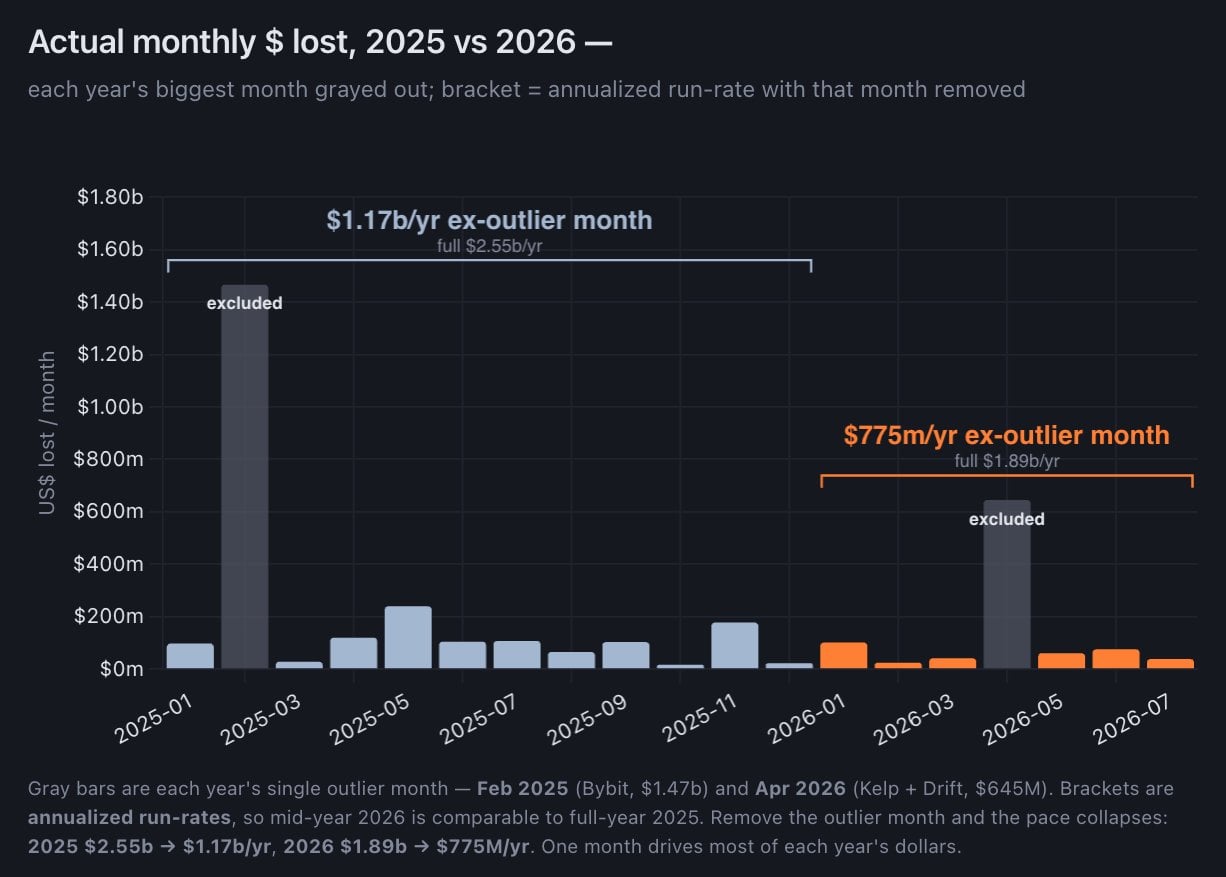
- 2025 – The Peak of Monetary Loss: The previous year saw a staggering $2.55 billion lost to exploits, averaging roughly $1.17 billion per year. This period was characterized by high-profile, multi-hundred-million-dollar failures that left the community questioning the viability of smart-contract-based finance.
- H1 2026 – The Surge in Frequency: The first half of 2026 witnessed a record high in the number of distinct hack incidents. Despite this, the total financial damage for the year sits at $1.89 billion (an annualized rate of approximately $775 million). This delta between the volume of attacks and the total value lost serves as the primary evidence for those who argue that the sector is becoming more efficient at containing damage.
- Mid-2026 – The "Vault" Crisis: The most recent period has seen significant volatility in Total Value Locked (TVL). Following major incidents, such as the KelpDAO hack, which triggered a partial bank run on the Aave lending protocol, confidence in "vaults"—automated yield-generation strategies layered on top of base protocols—cratered. TVL in these vaults plunged from a high of $113 billion to a low of $61 billion, marking a significant exodus of liquidity toward safer havens, such as U.S. Treasury bills.
Supporting Data: Analyzing the Trends
The raw numbers provide a complex picture. When one excludes outliers—specifically the $1.4 billion Bybit exploit and the $292 million KelpDAO breach—the data suggests a cooling period for massive, systemic collapses.
The Declining Median
The median hack size per year has undergone a dramatic contraction. In 2021, the median incident involved a loss exceeding $8 million. By 2026, that figure has plummeted to below $1 million. This downward trend supports the hypothesis that while the "surface area" for attacks remains large due to the proliferation of new, experimental protocols, the "target value" of these attacks is becoming smaller.
The Evolution of Operational Security
A significant portion of the nearly $1 billion stolen in 2026 was attributed to "operational failures"—incidents involving compromised admin keys or flawed signing infrastructure. Historically, these have been the most devastating types of attacks. However, Qureshi notes that even these categories are beginning to trend downward in dollar terms. The industry, he suggests, is finally learning the hard lessons of key management and multisig security that plagued the 2020-2022 era.
Official Responses and Expert Perspectives
The debate regarding DeFi safety has split the community into two camps: the "Institutional Realists" and the "Risk Skeptics."
The Institutional Realist View:
Proponents of this view, such as Qureshi, emphasize that risk is relative. "The average dollar in DeFi is as safe as it was a year ago," Qureshi remarked. The core of this argument is that capital allocation is becoming more rational. Users are increasingly moving funds away from unproven, high-yield experimental protocols toward large, established platforms that have the budget to afford continuous security audits and insurance.
The Risk Skeptic View:
Critics argue that the reliance on these "large protocols" creates a false sense of security. As demonstrated by the Aave bank run, even established giants are susceptible to contagion. When a protocol like KelpDAO is compromised, the downstream impact on linked lending platforms can be catastrophic, demonstrating that systemic risk in DeFi is interconnected and often underestimated.
Implications: The Path Toward Tokenization
Perhaps the most significant takeaway from the current climate is the perspective offered by S&P Global Ratings. Despite the high-profile hacks, the ratings giant has officially classified DeFi vaults as functionally equivalent to traditional managed funds.
This classification is not merely academic; it is a signal of institutional intent. S&P Global projects that DeFi vaults will eventually evolve into the "core infrastructure" for the tokenization of Real-World Assets (RWAs).
The Convergence of TradFi and DeFi
The implications for the next decade are clear:
- Institutionalization of Vaults: As traditional managed funds shift toward on-chain operations, the "DeFi vault" architecture will likely become the standard interface for institutional capital.
- Regulatory Scrutiny as a Security Buffer: The move toward tokenized assets will necessitate a higher standard of security, likely enforced by both regulatory bodies and institutional audit firms.
- Risk-Adjusted Yields: The current yield disparity between DeFi (approx. 2.7%–3.8%) and U.S. Treasury bills is a temporary hurdle. As DeFi matures and security protocols are standardized, the "risk premium" associated with smart-contract yield is expected to tighten, potentially making DeFi a more competitive alternative to traditional fixed-income products.
Conclusion: Will Security Fears Derail Adoption?
The narrative that "DeFi is unsafe" is an oversimplification that ignores the rapid maturation of the industry’s defensive infrastructure. While the high frequency of hacks in 2026 is undoubtedly a cause for concern, the data suggests that the sector is successfully shifting from a "wild west" environment to one defined by professionalized risk management.
The road to mass adoption will not be linear. It will continue to be paved with security incidents and, inevitably, more capital loss. However, the transition of DeFi from an experimental sandbox to the backend of the global financial system appears inevitable. As long as the sector continues to prioritize the hardening of base-layer protocols and the refinement of operational security, the "security fear" narrative may eventually be replaced by a more nuanced understanding of blockchain-based risk management. The challenge for 2027 and beyond will be whether these protocols can survive the "AI-driven" offensive capabilities that are currently looming on the horizon.
