

By Financial Markets Desk
Published: August 2026
Main Facts
The global financial landscape is undergoing a silent yet seismic transformation. Stablecoins—digital tokens pegged to fiat currencies like the U.S. dollar—are rapidly shedding their historical identity as niche instruments used exclusively for speculative cryptocurrency trading. Instead, they are stepping into the realm of everyday money.
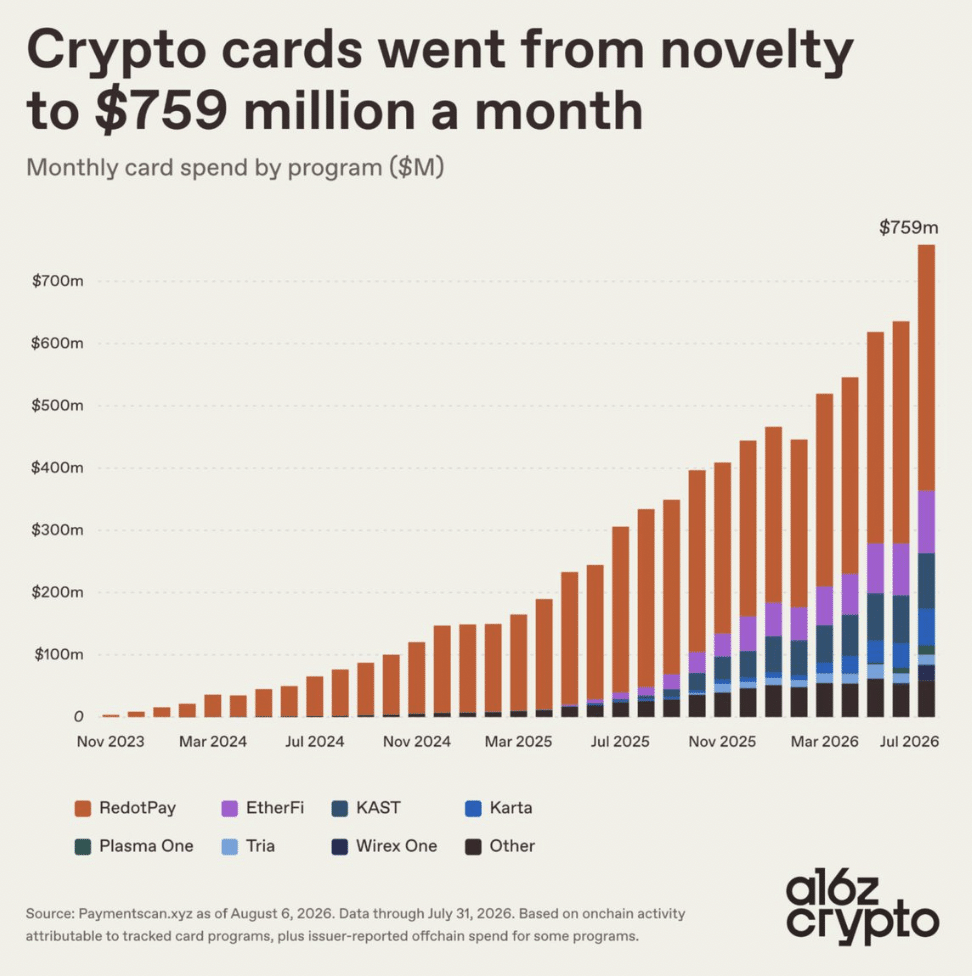
According to a recent comprehensive market analysis published by venture capital powerhouse a16z, global crypto payment card transactions have officially breached a staggering milestone, topping $750 million in monthly purchases.
This surge in real-world utility marks a departure from legacy crypto-to-fiat off-ramping methods. Historically, users wishing to spend their digital assets had to endure a tedious, multi-step process: selling stablecoins on a centralized crypto exchange, withdrawing the cash, and depositing it into a traditional bank account before making a purchase. Today, modern crypto debit and credit cards automate this process entirely. When a cardholder swipes at a merchant, the underlying payment network instantly converts the stablecoin into the local fiat currency. Consequently, businesses can accept familiar, standard fiat payments without ever needing to touch, hold, or understand cryptocurrency directly.
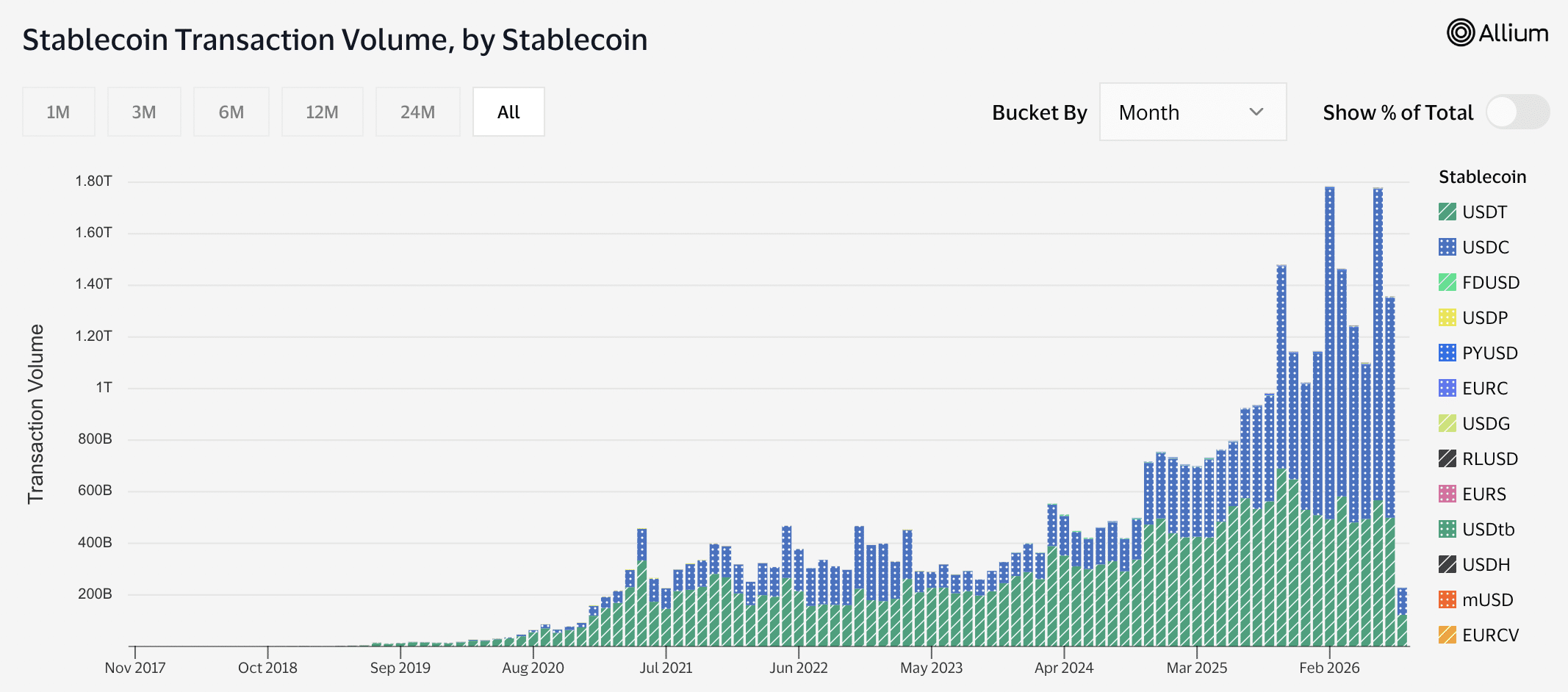
At the same time, the broader macro-crypto ecosystem is experiencing tectonic shifts. Data from Visa’s on-chain analytics highlights that Circle’s USDC has officially dethroned Tether’s USDT to become the dominant stablecoin by volume in 2026, contributing to an eye-watering $4.8 billion in total stablecoin transaction volume over the trailing thirty days.
Chronology: The Evolution of Stablecoin Utility
To understand how the market arrived at this $750 million monthly inflection point, it is crucial to trace the historical evolution of stablecoins from speculative tools to transactional workhorses:

- 2014–2018 (The Inception Era): Stablecoins like USDT are introduced primarily to solve a friction point for crypto traders—allowing them to park funds in a dollar-equivalent asset during market downturns without paying high gas fees or dealing with traditional banking hours. Utility is strictly confined to internal exchange trading pairs.
- 2019–2021 (The DeFi Boom): Decentralized Finance (DeFi) explodes. Stablecoins become the lifeblood of yield farming, lending protocols, and liquidity pools. While institutional awareness grows, everyday retail spending remains negligible due to high on-chain transaction fees and a lack of point-of-sale infrastructure.
- 2022–2024 (The Infrastructure Laying): Regulatory scrutiny intensifies, pushing issuers like Circle and Tether toward greater transparency. Simultaneously, fintech startups and traditional payment processors begin experimenting with crypto-to-fiat card bridges, allowing early adopters to spend digital balances using custom-issued Visa and Mastercard products.
- 2025–2026 (The Mainstream Inflection): Self-custody tech improves drastically, and account-abstraction wallets simplify user experiences. Crypto payment cards achieve widespread market penetration. Concurrently, USDC captures market share dominance over USDT, and global monthly card spend surges past the $750 million threshold, cementing stablecoins as viable, borderless retail currencies.
Supporting Data & Market Dynamics
The maturation of the stablecoin economy is not merely a retail phenomenon; it is deeply intertwined with macroeconomic crypto market indicators, liquidity flows, and shifting market dominance.
1. The Death of the Traditional Bank Account
A standout insight from the a16z analysis emphasizes financial inclusion: "Crypto cardholders don’t require a traditional bank account. Depending on the program, users either deposit stablecoins with a card issuer, or hold them directly onchain through self-custody."
For millions of unbanked or underbanked individuals across developing economies, these cards act as a gateway to digital U.S. dollar accounts globally. Unlike volatile assets such as Bitcoin or Ethereum—whose wild price fluctuations make them impractical for buying groceries or paying utility bills—stablecoins maintain a steady peg, making them uniquely suited for daily budgeting and commerce.
2. USDC Ascendancy and Transaction Volumes
In a watershed moment for the sector, Circle’s USDC has surpassed Tether’s USDT in structural adoption metrics throughout 2026, driven by tighter regulatory compliance frameworks in Western markets and deeper integration into institutional enterprise payment rails. Total monthly stablecoin transaction volumes have scaled to an unprecedented $4.8 trillion, rivaling traditional legacy settlement networks.
3. Stablecoin Supply Ratio (SSR) RSI and Bitcoin Correlations
Beyond retail spending, analysts closely monitor stablecoin liquidity relative to the broader crypto market using metrics like the Stablecoin Supply Ratio (SSR) Relative Strength Index (RSI).
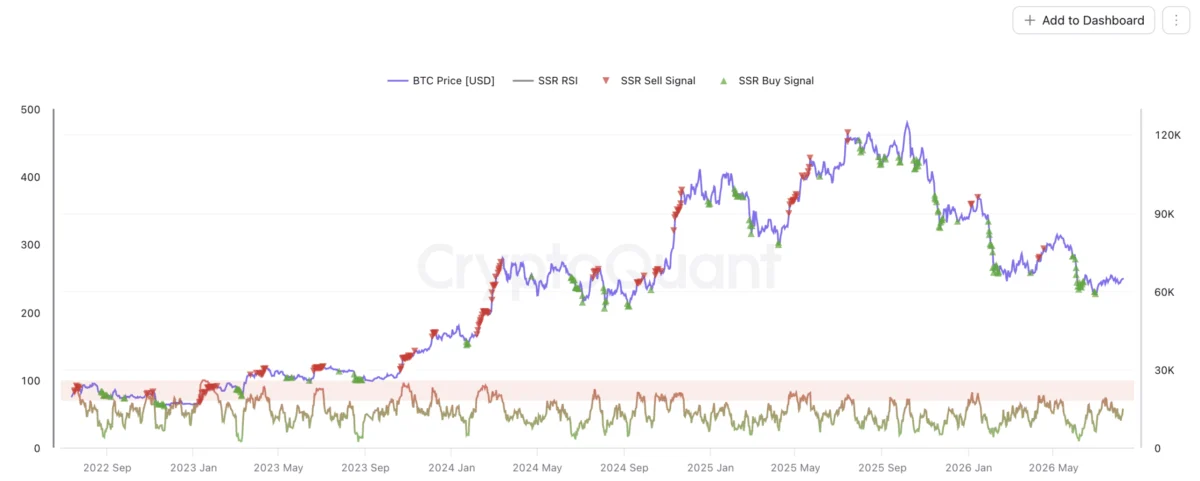
According to CryptoQuant data, the SSR RSI experienced a notable recovery in the second half of 2026 after hitting yearly lows. Earlier in the year—specifically during the late-spring market rally—elevated SSR RSI levels triggered red sell signals, preceding sharp Bitcoin corrections. However, as Bitcoin pulled back and consolidated within the $60,000 to $70,000 price range, the SSR RSI cooled down and generated a series of green buy signals.
This technical behavior signifies that stablecoin liquidity grew structurally stronger relative to Bitcoin’s market valuation in H2 2026, indicating that dry powder is sitting idle on sidelines in the form of stablecoins, ready to be deployed or utilized across various financial rails.
Official Responses and Expert Commentary
Industry leaders and venture capital analysts have been vocal about what this milestone means for the future of money movement.
In its official breakdown of the data, a16z crypto noted:
"Crypto cards expand people’s access to U.S. dollar accounts globally, and they offer a convenient way for stablecoin holders to transact. Simply put, the rising monthly expenditure indicates that stablecoins are becoming more and more valuable as a practical tool for in-person payments as well as digital assets."
Fintech analysts point out that the friction-free nature of modern payment gateways is the primary catalyst here. By shifting the burden of currency conversion to backend liquidity providers, merchants are shielded from regulatory headaches and crypto volatility, effectively turning every standard credit card terminal into a multi-currency acceptance node.
Furthermore, representatives from major payment processors observing the on-chain analytics emphasize that consumer demand is being driven organically by people seeking protection against local currency inflation, particularly in emerging markets suffering from severe devaluations of their national fiat currencies.
Implications for the Future of Global Finance
The transition of stablecoins from crypto-native trading tokens to real-world fiat alternatives carries profound implications across multiple economic sectors:
1. Disruption of Legacy Remittances and Cross-Border Payments
Traditional international money transfer services, such as Western Union or traditional wire transfers, rely on correspondent banking networks that are notoriously slow, expensive, and opaque. Stablecoin-powered cards and direct on-chain transfers bypass these legacy bottlenecks entirely. Money can move from a smartphone in New York to a merchant in Buenos Aires in seconds, for fractions of a cent.
2. Central Banks and Monetary Policy Pressure
The rapid globalization of U.S. dollar-pegged stablecoins poses a complex challenge for foreign central banks. As citizens in developing nations increasingly adopt USD stablecoins for everyday commerce to escape local inflation, local monetary authorities risk losing control over domestic money supplies—a phenomenon economists term "digital dollarization."
3. The Future of Commercial Banking
Traditional retail banks may face an existential threat to their deposit bases. If users can hold their funds in self-custodial on-chain wallets, earn yield through decentralized finance, and spend effortlessly via crypto debit cards without ever opening a checking account with a high-street bank, traditional financial institutions will be forced to modernize their tech stacks and offer competitive, crypto-integrated services.
Conclusion
The milestone of $750 million in monthly crypto card purchases is more than just a headline-grabbing statistic—it is a clear signal that the financial world has entered a new era. Stablecoins are no longer confined to the digital walls of cryptocurrency exchanges. By bridging the gap between blockchain efficiency and everyday merchant infrastructure, they have proven that the future of money is fast, borderless, and increasingly digital. As USDC dominance expands, liquidity ratios stabilize, and regulatory clarity catches up with technological innovation, stablecoins are solidifying their place as the backbone of modern global commerce.
