


By Global Markets Desk
Published: August 2026
Main Facts: The Anatomy of a Crypto Slowdown
The digital asset ecosystem is currently navigating a period of exceptionally weak liquidity and subdued trading activity. Across nearly every major performance indicator, the market is moving at a fraction of its expected speed, leaving analysts, institutional participants, and retail traders alike grappling with a central question: Are investors simply taking a defensive pause amid macroeconomic uncertainty, or are they abandoning the asset class altogether?
Recent on-chain analytics and exchange data provide a sobering look at the current landscape. Most notably, the market capitalization and circulating supply of Tether (USDT)—historically the primary barometer for available sidelined liquidity within the crypto market—have experienced a sharp, multi-billion-dollar contraction. Concurrently, derivatives and futures trading volumes across top-tier centralized exchanges have plummeted by as much as 50% year-over-year.
While the surface appearance of the market is one of unusual calm, this thin liquidity environment creates a precarious foundation. With fewer capital reserves buffering the order books, major digital assets like Bitcoin have become highly sensitive to marginal buying and selling pressures, setting the stage for potential volatility spikes.
Chronology: How the Liquidity Drain Unfolded
To understand how the cryptocurrency market arrived at its current state of lethargy, it is necessary to trace the trajectory of capital flows over the past several years.
- July 2025 (The Peak of Derivatives Activity): The market was riding high on robust futures volumes. Major centralized exchanges were registering historic figures, with Binance alone pulling in a staggering $2.55 trillion in monthly futures volume, while OKX comfortably surpassed the $1 trillion threshold at its cyclical peak. Optimism remained high, and liquidity appeared deep enough to absorb substantial institutional leverage.
- Late 2025 to Early 2026 (The Shift in Macro Sentiment): As global central banks maintained restrictive monetary policies and traditional asset yields shifted, investors began re-evaluating risk assets. Yields on stablecoins began to lose their competitive edge against traditional fixed-income instruments, reducing the incentive for capital to park indefinitely in digital dollar equivalents.
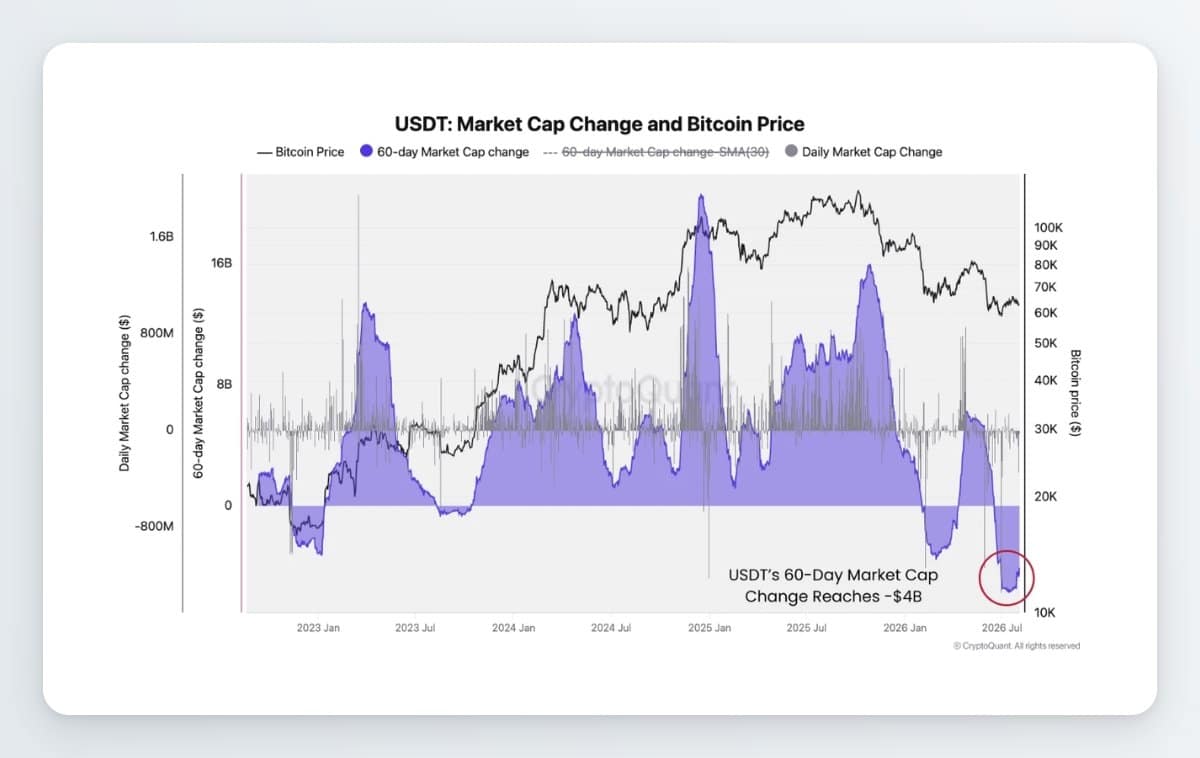
- Mid-2026 (Acceleration of USDT Outflows): The contraction in stablecoin supply accelerated dramatically. CryptoQuant data revealed that USDT’s 60-day market capitalization change plunged by roughly $4 billion. This downward trajectory marked one of the steepest multi-week contractions witnessed in recent years, pushing metric trends deep into negative territory.
- July 2026 (The Current Slump): Monthly futures volumes reflected the chilling effect of the liquidity drain. Binance’s monthly futures volume tumbled from $2.55 trillion in July 2025 to just $1.40 trillion by July 2026. Simultaneously, OKX experienced an equally steep decline, with its monthly futures metrics contracting to roughly $447 billion. The market transitioned from a state of dynamic leverage to an environment defined by extreme caution and volume starvation.
Supporting Data: Numbers Behind the Squeeze
A closer examination of the metrics illuminates the magnitude of the liquidity contraction currently gripping the digital asset economy.

1. The Tether (USDT) Supply Contraction
Tether remains the dominant liquidity gateway for cryptocurrencies. When the USDT supply expands, it typically signals that fresh capital is entering the ecosystem, waiting to be deployed into Bitcoin, Ethereum, and altcoins. Conversely, a shrinking USDT supply indicates that capital is exiting.
Recent CryptoQuant charts show that USDT’s 60-day market cap change has shed approximately $4 billion. This decline is not merely a flatlining of growth; it represents a hard withdrawal of funds. Market analysts have pointed out that this drop coincides with a broader shift in stablecoin yields, making holding digital dollars less lucrative for yield-seeking participants.
2. Derivatives Volume Collapse
The futures market serves as the engine room for crypto price discovery and speculative momentum. A drop in futures volume directly translates to diminished market participation.
- Binance: Experienced a 45% drop in monthly futures turnover, plunging from $2.55 trillion in July 2025 to $1.40 trillion in July 2026.
- OKX: Witnessed an even more dramatic contraction, with figures falling from a peak above $1 trillion to roughly $447 billion.
These figures illustrate that leveraged traders have largely stepped to the sidelines. Without aggressive directional betting, natural market momentum has stalled, resulting in tight consolidation ranges that frustrate short-term traders.
Official Responses and Analyst Commentary
Industry experts and on-chain researchers have offered varying interpretations of these sobering metrics. While some view the current market climate as a necessary period of sector-wide consolidation, others are raising red flags about structural capital flight.
Prominent market analyst Stacy Muur has offered a cautious perspective on the multi-billion-dollar USDT decline, suggesting that the shrinking supply may indicate investors are actively exiting the crypto ecosystem altogether rather than rotating funds into alternative crypto assets. According to this hypothesis, capital is being converted out of stablecoins and back into traditional fiat currencies, pointing to a broader macroeconomic reallocation away from digital assets.
Conversely, other desk analysts argue that declining volume does not automatically spell structural doom. Historically, prolonged periods of low liquidity and suppressed volatility have preceded major structural regime shifts. In previous market cycles, prolonged "calm before the storm" phases have allowed smart money to quietly accumulate positions while retail participants lost interest out of sheer boredom.
Implications: What This Means for the Market’s Future
The convergence of a contracting stablecoin supply and halved futures volumes carries profound implications for traders, long-term investors, and market infrastructure providers alike.
Increased Vulnerability to Shocks
With aggregate liquidity running thin, the market depth across centralized and decentralized exchanges is noticeably shallower. This means order books are less resilient. In a high-liquidity environment, a multi-million-dollar buy or sell order is absorbed smoothly. In the current thin-liquidity paradigm, even relatively modest buying or selling flows can trigger disproportionately large price swings. Consequently, Bitcoin and major altcoins remain exceptionally vulnerable to sudden flash moves or localized liquidations.
The Divergence of Market Narratives
The current environment presents a binary outlook for the remainder of the cycle:
- The Capital Flight Scenario: If analyst warnings prove correct and capital is permanently leaving the asset class due to unattractive yields and regulatory headwinds, the market could face an extended winter characterized by flat or downward price action and stagnant network activity.
- The Caution-Before-Expansion Scenario: If the present state is merely a period of macro-induced caution, the exhaustion of sellers could pave the way for a sudden liquidity rebound. As macroeconomic conditions evolve—such as potential shifts in global monetary policy or regulatory clarity—capital could rapidly flood back into stablecoins, reigniting derivatives activity and sparking a new volatility cycle.
Strategic Adjustments for Market Participants
For institutional funds and professional trading desks, operating in a low-liquidity environment requires tighter risk management. Execution strategies must account for slippage risks, and leverage must be managed conservatively to avoid being caught in sudden liquidity crunches. For retail investors, the takeaway is one of patience and heightened awareness; while the market may currently look tranquil on the surface, the underlying plumbing is under strain, and the next major directional move could arrive with little warning.
