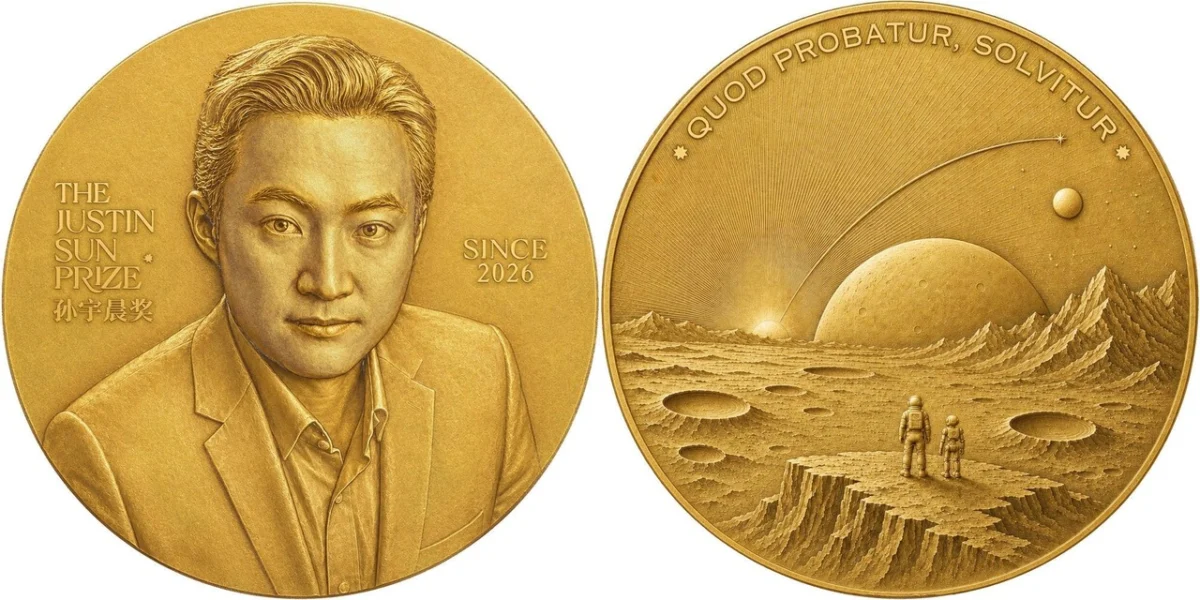
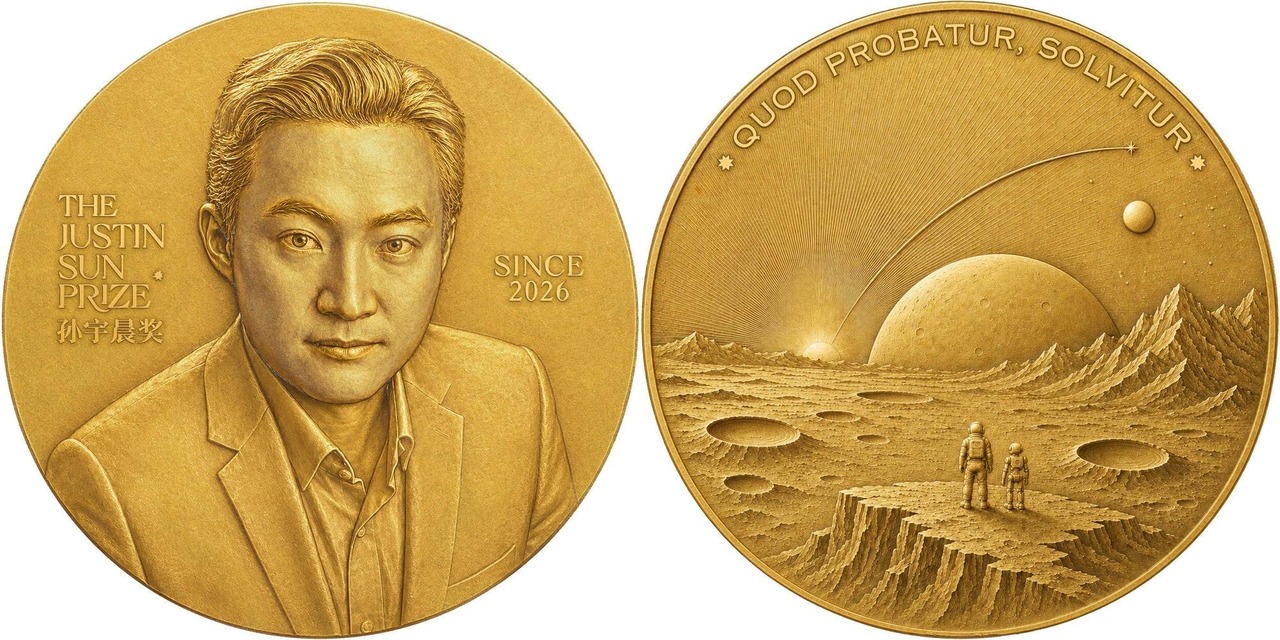
GENEVA, SWITZERLAND — In a move designed to completely reshape how fundamental scientific research is incentivized and rewarded, the Office of Justin Sun has officially announced the launch of the Justin Sun Prize. Operating as a zero-trust, decentralized academic bounty mechanism, the initiative pivots away from traditional, bureaucratic award structures. Instead, it relies on a definitive "problem list" where rewards are distributed based entirely on verified breakthroughs in fundamental disciplines and machine-formal verification. With a top payout of up to US$1 million for a single problem, the initiative aspires to become the "Nobel Prize of the AI Era," accelerating human-AI collaborative research on a global scale.
The announcement was accompanied by the historic disclosure of the prize’s inaugural cohort of winners. This initial round recognized solutions and formalized proofs spanning 66 complex mathematical problems. Most notably, the top US$1 million prize was awarded to the OpenAI research team for successfully solving and formally verifying the Existence and Smoothness of the Three-Dimensional Navier–Stokes Equations—one of the legendary Millennium Prize Problems outlined by the Clay Mathematics Institute. According to disclosures from OpenAI, the core proof was generated by its internal model, while the rigorous Lean formalization and verification process was completed by GPT-6 Astra.
Main Facts
The Justin Sun Prize introduces a revolutionary paradigm to scientific grant-making and academic recognition. Rather than relying on peer-review committees, traditional institutional nominations, credentials, or multi-year achievement cycles, the initiative establishes a direct link between unsolved mathematical challenges and machine-verifiable proofs.
The Core Mechanism: A decentralized bounty system where solutions are judged solely on mathematical rigor and machine-verifiable code.
The Inaugural Laureate: The OpenAI research team secured the $1 million grand prize for solving the Navier–Stokes existence and smoothness problem, verified using GPT-6 Astra.
The Problem List: The ongoing repository currently features 66 mathematical problems, including formal verification goals for the Poincaré Conjecture, the Riemann Hypothesis, Goldbach’s Conjecture, and numerous unsolved problems from the legacy of late mathematician and Wolf Prize laureate Paul Erdős.
Core Principles: Complete openness, public benefit, and open-source accessibility. Submissions are open globally to all contributors—making no distinction between human researchers and artificial intelligence systems.
Disbursement Structure: Prizes are paid out instantly in either USDT on TRON (TRC-20) or USDC on Ethereum (ERC-20), with reward records immutably anchored on-chain.
Chronology of the Initiative
The establishment of the Justin Sun Prize marks the culmination of years of technological evolution in both artificial intelligence and blockchain verification.
The 19th Century to 2000: The foundation of the initiative traces back to classical fluid dynamics. Formulated in the 1800s by French physicist Claude-Louis Navier and Irish-born British mathematician George Gabriel Stokes, the Navier–Stokes equations have governed fluid motion for two centuries. In May 2000, the Clay Mathematics Institute formally designated the Existence and Smoothness problem as one of the seven Millennium Prize Problems, attaching a $1 million bounty that remained unclaimed for over two decades.
Pre-2026 Philanthropic Foundations: Over his career, founder Justin Sun has directed more than $45 million toward global technology, environmental conservation, and disaster relief initiatives. Parallel to his humanitarian efforts, his career expanded across digital assets, space exploration (highlighted by his August 2025 flight aboard Blue Origin’s NS-34 mission), and international diplomacy as Grenada’s former Permanent Representative to the World Trade Organization.
September 16, 2026 (Launch Date): The Office of Justin Sun formally unveils the Justin Sun Prize in Geneva, Switzerland. Alongside the launch, the organization releases its inaugural problem list and confirms that OpenAI has claimed the first $1 million grand prize for its breakthrough on the Navier–Stokes equations utilizing GPT-6 Astra.
Supporting Data & Technical Framework
The operational integrity of the Justin Sun Prize relies on a strict zero-trust infrastructure designed to eliminate administrative bias and human subjectivity.
+-----------------------------------------------------------------+
|                    JUSTIN SUN PRIZE PIPELINE                    |
+-----------------------------------------------------------------+
          |                                       |
          v                                       v
[ Human Researchers ]                  [ Artificial Intelligence ]
                                                 /
                                                /
            v                                   v
        +-----------------------------------------------+
        |     Proof Generation & Lean Formalization     |
        +-----------------------------------------------+
                                |
                                v
        +-----------------------------------------------+
        |     GitHub Open-Source Repository Verification|
        +-----------------------------------------------+
                                |
                                v
        +-----------------------------------------------+
        |     On-Chain Immutable Record & Payout        |
        |     (USDT on TRON / USDC on Ethereum)         |
        +-----------------------------------------------+
The Navier–Stokes Breakthrough
The Navier–Stokes equations describe how fluids flow, governing everything from ocean currents to weather patterns and aerodynamic drag. Proving whether smooth, physically reasonable solutions always exist in three dimensions has stymied mathematicians for generations. OpenAI’s successful deployment of internal models paired with GPT-6 Astra for Lean formalization marks a watershed moment, proving that machine intelligence can independently navigate hyper-complex mathematical frontiers.
Immutable Rules and Governance
The architecture of the prize registry enforces strict permanence:
The Locked Repository: Problems can be added to the list only; they are never removed. Once a problem is published, the criteria are permanently locked.
Unconditional Payouts: Awarded prize funds do not need to be returned under any circumstances once a proof is successfully verified.
Open Access: All confirmation standards, proof code, and verification materials are hosted publicly via GitHub.
The Inscription: Every physical medal awarded to winners bears the Latin phrase "Quod probatur, solvitur"—meaning "Proved, then paid."
Official Responses and Perspectives
Speaking on the motivations behind the initiative, founder Justin Sun emphasized the philosophical and personal connection he holds with foundational sciences.
"An award named after a person is the least political thing in the world," Sun stated. "More importantly, it gives me an answer to myself—my wealth is rooted in mathematics. It came from mathematics, and it will return to mathematics."
Sun’s philanthropic footprint has long bridged emerging technologies with real-world utility. As the founder of TRON—a blockchain network that has processed over $13 trillion in volume and serves as a financial lifeline for emerging markets utilizing stablecoins—Sun has consistently championed decentralized infrastructures.
The integration of artificial intelligence into the award process has also drawn praise from technology analysts. By accepting proofs generated by AI models like OpenAI’s systems, the prize acknowledges a paradigm shift in how scientific discovery occurs. Rather than viewing machine intelligence as a threat to human academia, the Justin Sun Prize positions human-AI collaboration as the essential engine for solving humanity’s most enduring intellectual mysteries.
Broader Implications for Science and Technology
The launch of the Justin Sun Prize carries profound implications for the global scientific community, academic institutions, and the tech sector at large.
1. Disrupting Traditional Academic Gatekeeping
Conventional academic awards often require decades of career progression, institutional backing, and political navigation within elite societies. By stripping away credential thresholds and opening the bounty mechanism to anyone—regardless of nationality, institutional affiliation, or whether the contributor is human or artificial intelligence—the prize democratizes mathematical research.
2. Accelerating Formal Verification
Mathematics has entered an era where the sheer complexity of proofs often exceeds the capacity of human peer reviewers to check every line manually. By anchoring the Justin Sun Prize to machine-formal verification languages like Lean, the initiative establishes a new gold standard for mathematical certainty. A proof is no longer accepted merely because an esteemed professor says so; it is accepted because a machine has verified its logical consistency down to the foundational axioms.
3. A New Model for Tech Philanthropy
By utilizing blockchain rails (TRC-20 USDT and ERC-20 USDC) for instant, global, and transparent settlement, the initiative bypasses traditional banking frictions. Furthermore, recording prize disbursements immutably on-chain sets a benchmark for corporate and philanthropic accountability, ensuring complete transparency over how funds are distributed.
As the repository expands to include cryptographic hurdles, topological enigmas like the Poincaré Conjecture, and historical problems from the notebooks of Paul Erdős, the Justin Sun Prize stands ready to catalyze a renaissance in fundamental science—proving that when wealth generated by modern technology is channeled directly back into pure mathematics, the boundaries of human knowledge expand exponentially.
About the Office of Justin Sun
The Office of Justin Sun supports Justin Sun’s global business, philanthropic, and public initiatives across technology, blockchain, artificial intelligence, scientific research, investment, art, and space exploration.