

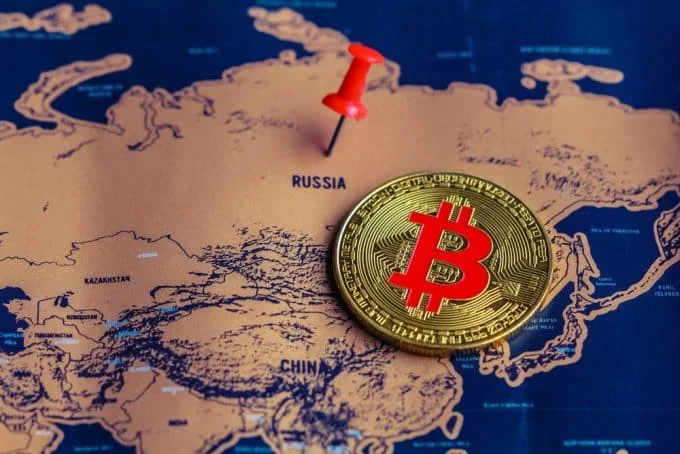
The global cryptocurrency market is currently grappling with a potent "perfect storm" of macroeconomic uncertainty and localized regulatory aggression. As geopolitical tensions escalate on the Russia-Ukraine border, investors are fleeing risk-on assets, leading to a significant contraction in the valuation of major digital currencies. This downturn is further exacerbated by shifting legislative stances in Russia, one of the world’s most significant hubs for digital asset mining and infrastructure.
As of Thursday, Bitcoin (BTC) is trading at approximately $43,352, shedding 0.7% in a single session and retreating significantly from the $47,000 threshold observed at the dawn of the year. Ethereum (ETH), the industry’s second-largest asset by market capitalization, has mirrored this decline, slipping 2.14% to $2,873. These figures represent a broader market capitulation, with the total cryptocurrency sector shedding roughly $200 billion in market value within a 24-hour window, bringing the total market cap to approximately $1.8 trillion.
Chronology of Escalation: From Border Standoffs to Market Retreats
The current market volatility cannot be viewed in a vacuum. It is the direct result of a rapidly evolving geopolitical narrative that has dominated international headlines throughout the month.
The Military Buildup
The conflict began to capture the attention of global financial markets as satellite imagery confirmed Russia had amassed more than 100,000 troops along its border with Ukraine. Western intelligence agencies, led by the United States, have consistently warned of an imminent "false flag" operation or a direct conventional invasion. This threat perception has moved beyond the realm of traditional diplomacy, impacting the risk appetite of institutional and retail investors alike.
Diplomatic Engagements
The tension reached a fever pitch earlier this week when U.S. President Joe Biden held an extensive, hour-long consultation with Ukrainian President Volodymyr Zelensky. The focus of the dialogue was the preservation of territorial integrity and the potential economic consequences of a Russian incursion. Simultaneously, U.S. National Security Adviser Jake Sullivan intensified the rhetoric, publicly reiterating that the window for a diplomatic resolution was narrowing.
The Market Reaction
Following these developments, Bitcoin and Ethereum experienced a sharp correction, falling over 9% to touch their lowest levels in six months. While markets often react to geopolitical news, the correlation between the "war jitters" and crypto price action has become more pronounced, leading analysts to conclude that digital assets are no longer shielded from the traditional "flight to safety" observed in bond markets or gold.
Supporting Data: Volatility and Market Sentiment
To understand the severity of the current market shift, one must look at the technical indicators. According to data from BuyBitcoinWorldwide, Bitcoin’s 30-day volatility index is currently experiencing a compression. While the current 30-day volatility sits at a decline of 3.35%, it is worth noting that it averaged 4.56% throughout the volatile 2021 calendar year.
Despite the recent sell-off, Bitcoin still maintains a level of resilience, having not yet surrendered all the gains accrued from its mid-January lows of $32,950. However, the technical charts on platforms like TradingView illustrate a troubling trend: the total Bitcoin market cap, now hovering around $817.95 billion, shows a pattern of lower highs and lower lows, suggesting that bearish sentiment currently holds the upper hand.
The sentiment among market participants is shifting from "buy the dip" to a more defensive posture. Analysts point to the Nasdaq Composite index’s 0.9% drop last December as a benchmark for risk-off sentiment; however, the current crypto sell-off is viewed by many as more aggressive, indicating that crypto investors are currently more sensitive to macroeconomic shocks than their equity-market counterparts.
Official Responses and the "Russian Ban" Narrative
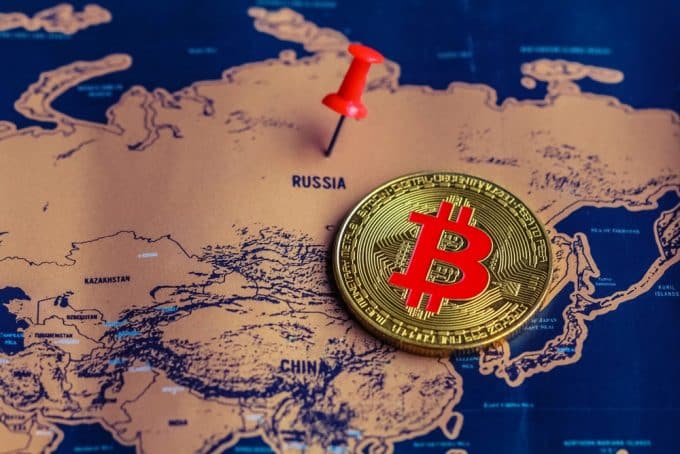
While the threat of war is the primary catalyst for the current malaise, a secondary—and perhaps more direct—threat to the crypto ecosystem has emerged from Moscow. The Central Bank of Russia has recently proposed a blanket ban on the use, trade, and mining of cryptocurrencies within the Russian Federation.
The Rationale Behind the Ban
The Russian regulatory stance, which aligns with a broader global trend of skepticism among central banks, argues that cryptocurrencies pose a threat to financial stability, citizen well-being, and monetary sovereignty. Russian authorities have expressed concerns that crypto could facilitate capital flight and provide a mechanism for money laundering.
The Mining Impact
The implications of a Russian ban are profound. Russia is currently one of the world’s most critical processing hubs for Bitcoin transactions, accounting for approximately 10% of the global mining hash rate. If the Russian government follows through with a total ban on mining operations, it would represent a significant blow to the network’s hash rate security and global decentralization.
Furthermore, Russia has recently signaled its intention to impound unlawfully acquired cryptocurrencies, suggesting that the government is moving toward a legal framework that treats digital assets as a target for state seizure. This regulatory hostility is forcing miners and exchanges to evaluate their long-term viability within the region, contributing to a sense of instability that is currently reflected in the price of major tokens.
Implications for the Future of Digital Finance
The confluence of the Russia-Ukraine crisis and the looming regulatory crackdown in Moscow presents a multi-faceted challenge for the cryptocurrency industry.
Interconnectedness of Markets
The vast majority of market specialists now concede that the cryptocurrency market is no longer an isolated or "uncorrelated" asset class. The "decoupling" theory—which posited that Bitcoin would act as a hedge against geopolitical chaos—is currently being tested and largely disproven. In the current environment, Bitcoin is trading as a high-beta technology stock, highly sensitive to interest rate hikes and geopolitical risk.
The Institutional Perspective
Institutional investors are watching the situation closely. While many hedge funds and family offices remain bullish on the long-term potential of blockchain technology, the short-term unpredictability caused by potential warfare and sovereign bans creates a "wait-and-see" environment. This lack of institutional conviction is likely to suppress upward price movement until the geopolitical fog clears.
The Path Forward
For the crypto industry, the path forward requires a focus on regulatory clarity and infrastructure resilience. If Russia does indeed ban mining, the industry will likely see a migration of hash rate to jurisdictions with more favorable or stable regulatory environments, such as the United States, Kazakhstan, or parts of Latin America. This "de-risking" process is standard in maturing industries but remains painful for investors in the interim.
In conclusion, the cryptocurrency market is undergoing a period of intense pressure. While the underlying technology remains robust, the combination of a potential conflict in Eastern Europe and a shift in the regulatory landscape of one of the world’s largest mining hubs has created a volatile environment. Investors are advised to remain cautious, as the correlation between geopolitical stability and digital asset valuations remains stronger than at any point in the history of the industry. The upcoming weeks will be crucial, as diplomatic efforts in Europe and legislative decisions in Moscow will likely dictate the next major trend for the entire digital asset space.
