

In the rapidly evolving landscape of Decentralized Finance (DeFi), Aave has long stood as a titan, consistently commanding nearly half of the total market share for crypto-backed loans. However, the protocol’s recent expansion onto the Arc network has highlighted a fundamental challenge in liquidity management: the stark divide between capital supply and genuine market demand.
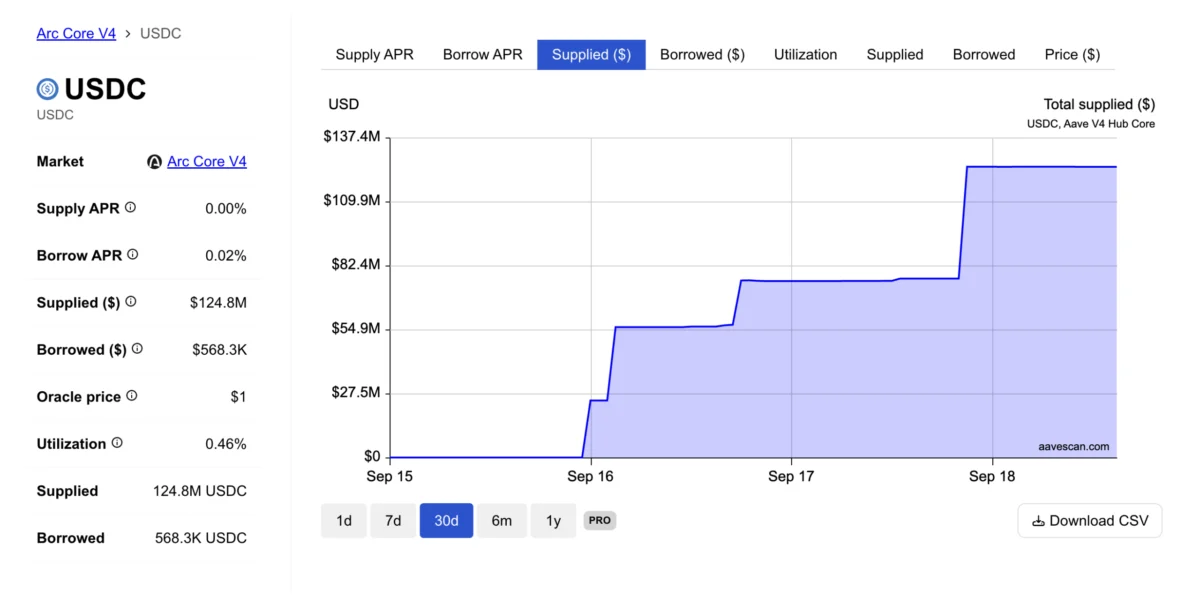
As of September 18, Aave’s new lending market on the Arc network has attracted a staggering $125 million in USDC. Yet, despite this influx of capital, the market is struggling to find its footing, with less than $600,000 currently being utilized by borrowers. This massive imbalance—where over 99.5% of deposited funds sit idle—serves as a compelling case study on the mechanics of liquidity-heavy but activity-light DeFi protocols.
Main Facts: The Liquidity Imbalance
The core issue facing Aave’s Arc V4 integration is a classic "chicken-and-egg" scenario. Liquidity providers have rushed to park their USDC in the protocol, likely seeking yield or positioning themselves for early-mover advantages. However, the borrower side of the ledger remains largely dormant.
With approximately $124.8 million in total supply and a meager borrowing volume of roughly $568,300, the protocol is currently suffering from a lack of "economic velocity." In a healthy lending market, capital is supposed to flow from those with excess funds to those with productive uses for that capital. In the current iteration of the Arc market, the capital is simply sitting in a digital vault, generating no meaningful returns for the suppliers.
The immediate consequence of this low utilization is a yield of 0.00% for depositors. When there is no borrowing demand, there are no fees generated to distribute to the lenders, rendering the $125 million in deposits functionally inert.
A Chronology of Capital Influx
To understand the speed at which this liquidity arrived, one must look at the data provided by Aavescan over the last few days. The growth has been nothing short of explosive, even if the utility has not followed suit.
- September 16: The market began to show signs of life, with excess reserves standing at approximately $24.5 million.
- September 17: A significant uptick occurred as deposits climbed to roughly $76 million. Even at this stage, borrowing was nearly non-existent, signaling that the supply side was far outpacing the demand side.
- September 18: The trend accelerated, with total USDC deposits reaching $124.8 million. This represents a 65% increase in a single day and a more than fivefold increase since the market began attracting excess liquidity earlier in the week.
Parallel to this, borrowing activity showed signs of a marginal increase. On the midnight of September 18, borrowing stood at $73,400. By the time the $125 million deposit milestone was reached, borrowing had ticked up to $568,300. While this is an upward trend, it remains a statistical rounding error compared to the total liquidity locked in the system.
Supporting Data: By the Numbers
The disparity between the supply and demand metrics is best illustrated by the utilization rate.
| Metric | Value |
|---|---|
| Total USDC Supplied | ~$124.8 Million |
| Total USDC Borrowed | ~$568,300 |
| Utilization Rate | 0.46% |
| Idle Capital | 99.54% |
| Deposit APY | 0.00% |
| Borrowing Rate | ~0.02% |
The data indicates that the market is currently "liquidity rich" but "utility poor." The borrowing rate of 0.02% is essentially a nominal figure, suggesting that the protocol is not yet priced or structured in a way that incentivizes the target demographic—likely institutional or permissioned participants—to take on debt.

The Role of Aave V4 and the Arc Network
Aave V4, the latest iteration of the protocol, is designed to optimize capital efficiency and user experience. By integrating with the Arc network, Aave is attempting to bridge the gap between traditional finance and DeFi by offering a permissioned environment.
The concept of "Arc" is inherently about compliance and security, catering to institutions that require KYC/AML (Know Your Customer/Anti-Money Laundering) checks before participating in DeFi. The recent surge in deposits suggests that institutional-grade liquidity providers are ready and willing to enter the ecosystem. However, the lack of borrowing suggests that the "borrowing" side of the equation—likely institutional entities looking for working capital or leverage—has not yet been successfully onboarded or sufficiently incentivized to utilize these specific vaults.
Implications for the DeFi Ecosystem
The situation on the Arc market carries several significant implications for the future of decentralized lending.
1. The Trap of "Yieldless" Liquidity
For many DeFi protocols, liquidity is the lifeblood of the operation. However, excessive liquidity without corresponding borrowing demand can be detrimental. When millions of dollars sit idle, they provide no value to the protocol, the governance token holders, or the depositors. If the 0.00% APY persists, there is a high probability that these liquidity providers will withdraw their capital and migrate to other markets where the capital-to-activity ratio is more balanced.
2. The Institutional Onboarding Hurdle
The disparity underscores the difficulty of institutional adoption. While institutions are often heralded as the "next wave" for DeFi, their capital deployment is far more methodical and risk-averse than that of retail "degen" traders. The fact that the money is present but not moving indicates that the infrastructure for borrowing—rather than just depositing—might be facing regulatory or operational friction.
3. The Test of Market Maturity
Lending markets are not built overnight. In the initial phases of any new market, supply must precede demand. Aave’s current position can be viewed as the "construction phase." Having $125 million on hand provides a stable foundation; now, the protocol must focus on business development, partnerships, and integrations that drive actual borrowing behavior. If Aave can successfully convert this stagnant liquidity into active loans, it will prove that the Arc network is a viable, high-capacity venue for institutional finance.
Conclusion: A Watching Brief
As we look toward the coming weeks, the most important metric to track is not the total value locked (TVL), but the rate of change in borrowing. A consistent, linear growth in borrowing will signal that the protocol is finding its market fit. Conversely, if the utilization rate remains below 1%, it will likely lead to a cooling of interest from liquidity providers.
The challenge for the Aave DAO and the developers behind the Arc implementation is clear: they have successfully built the "bank," but they have yet to attract the "borrowers." The next phase of this project will likely involve incentive programs, potentially subsidized borrowing rates, or aggressive outreach to institutional partners to ensure that the $125 million currently sitting in the shadows of the Arc network finds its way into the real economy of DeFi.
For now, the market remains a curious testament to the power of capital attraction, waiting for the equally powerful force of financial utility to catch up. Whether this is a temporary imbalance or a structural warning sign remains to be seen, but for the observant analyst, the numbers on Aavescan tell a story of a platform poised for takeoff, provided it can solve the mystery of the missing borrower.
