


In a significant evolution for the decentralized finance (DeFi) sector, Ethena Labs has announced a strategic expansion in the collateral backing for its yield-bearing stablecoin, USDe. By integrating Real-World Asset (RWA) perpetual futures into its reserve mechanism, the protocol aims to decouple its yield generation from the inherent volatility of the cryptocurrency markets. This move represents a calculated shift toward institutional-grade stability, positioning Ethena to capture a massive, untapped market of non-crypto assets.
The Evolution of USDe Collateral
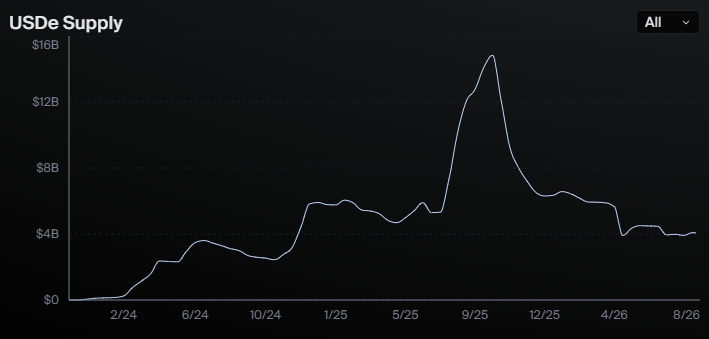
Ethena’s USDe has long relied on the "basis trade"—a strategy involving the simultaneous purchase of a spot asset and the sale of its corresponding perpetual futures contract to capture the funding rate spread. While this mechanism proved exceptionally lucrative during the 2024-2025 bull market, allowing USDe supply to climb toward $15 billion with yields exceeding 80%, it also exposed the protocol to the cyclical nature of crypto. When the market entered a "crypto winter," liquidity contracted, supply plummeted to $4 billion, and yields faced downward pressure, dipping below 0% at times.
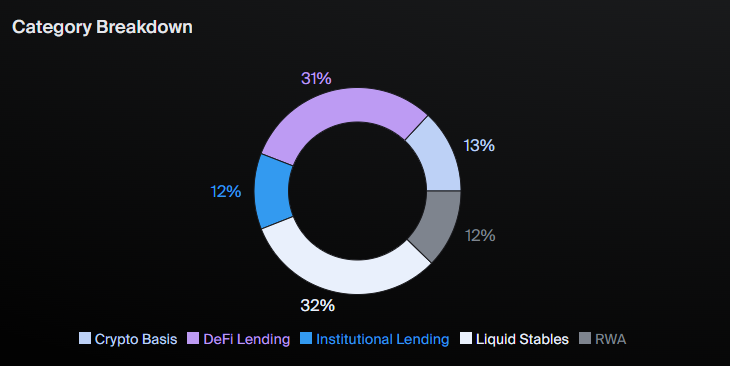
To mitigate these risks, Ethena is diversifying its backing. Currently, the reserve structure is heavily concentrated in liquid stablecoins (32%) and DeFi lending protocols like Aave and Morpho (31%). By incorporating RWA-backed perpetuals, Ethena is transitioning into a multi-asset collateral model that mirrors traditional financial structures.
Chronology: From Crypto-Native to Institutional Integration
The journey of USDe has been marked by rapid experimentation and a cautious approach to scaling.

- Early 2024: Ethena launches USDe, gaining immediate traction through its high-yield basis trade mechanism.
- Mid-2024: The protocol reaches its supply peak of ~$15B, proving the viability of synthetic dollar products in a bullish environment.
- Late 2024 – Early 2025: As the market cools, the protocol faces the limitations of crypto-only basis trades. Ethena begins exploring traditional credit, partnering with entities like Janus Henderson.
- Mid-2025: Traditional credit assets begin to account for 12% of the USDe backing, providing a more stable, non-cyclical floor for yields.
- August 2026: Ethena announces the integration of RWA-tokenized perpetuals, signaling a move toward deep-market, high-liquidity traditional assets.
Supporting Data: The Case for RWA Perpetual Growth
The pivot to RWA perpetuals is supported by compelling market data. According to Ethena, the volume of RWA-tokenized perpetuals has grown tenfold to $6 billion in Open Interest since March. This rapid expansion highlights a growing demand for on-chain derivatives that track the performance of traditional financial instruments, such as equities, commodities, and bonds.
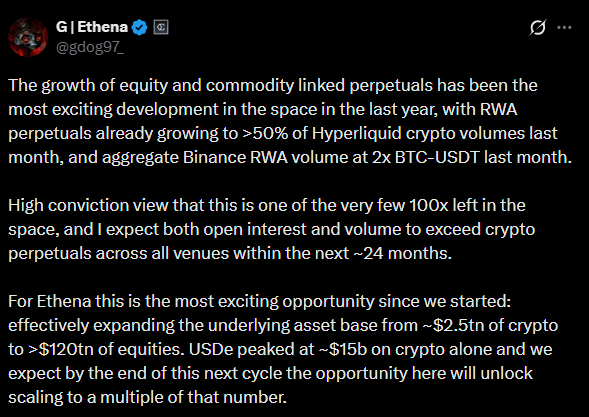
The scale of the underlying market is staggering. While the total crypto market cap hovers around $2.5 trillion, the addressable asset base for RWA tokenization exceeds $150 trillion. Ethena anticipates that this massive pool of liquidity will allow its RWA-backed perpetuals to eclipse crypto-native collateral within the next 12 to 24 months.
Yield Comparisons and Competitive Edge
The current yield environment forces protocols to compete not just with other DeFi platforms, but with traditional risk-free rates. Currently, USDe offers a 1.6% spread over short-term U.S. Treasury bonds. While this represents a premium for the added risk inherent in DeFi, Ethena’s move toward RWA perpetuals is intended to ensure that this yield remains competitive even when crypto markets are stagnant. By tapping into the massive equity and credit markets, the protocol aims to provide a reliable "base layer" of yield that is not dependent on the speculative fervor of retail crypto traders.
Official Responses and Strategic Rationale
Ethena founder Guy Young has been instrumental in framing this expansion as a necessary maturation of the protocol. In recent communications, Young addressed why the team waited to move into RWA perpetuals, noting that the sector was initially too "nascent" to support the scale required by USDe.
"We took a cautious approach to what was a nascent market and waited until we saw deep, liquid markets with a data history we could study before moving into the opportunity at scale," Young stated.
Young believes that RWA perpetuals represent one of the few remaining "100x" growth opportunities in the current financial landscape. He posits that the volume and Open Interest in these tokenized assets could eventually surpass the total crypto-native derivatives market, effectively transforming Ethena into a hybrid financial entity that serves as a bridge between TradFi (Traditional Finance) and DeFi.
Implications for the Future of DeFi
The implications of Ethena’s strategy are far-reaching. By diversifying into RWA perpetuals, the protocol is effectively building a "synthetic bank" that relies on the structural stability of real-world assets rather than the volatility of crypto-asset price action.
1. Decoupling from Crypto Cycles
The most immediate impact is the potential for consistent, non-correlated yield. If successful, USDe holders could see more stable returns, even during periods of market deleveraging. This stability is the "holy grail" for institutional investors, who have historically been wary of DeFi due to the high volatility of yield-bearing assets.
2. Scalability and Liquidity
The $150 trillion addressable market for RWAs provides a nearly infinite ceiling for USDe’s growth, provided the liquidity in tokenized derivatives continues to mature. As more institutions tokenize their balance sheets, Ethena is perfectly positioned to serve as the primary on-chain clearing house for these assets.
3. Increased DeFi Security Requirements
With the transition to RWA backing comes a new set of risks. Unlike crypto-native assets, which can be liquidated on-chain in seconds, RWAs often involve legal and custodial complexities. Ethena must ensure that its integration with RWA providers remains transparent and legally robust. The existing 31% allocation to DeFi lending protocols like Aave and Morpho suggests that Ethena is comfortable with smart contract risk, but the integration of traditional equities will require a new level of risk management focused on counterparty reliability and regulatory compliance.
4. A New Standard for Stablecoins
Ethena is not merely launching a product; it is defining a new category of "delta-neutral" stablecoins. By proving that a stablecoin can be backed by a mix of crypto, credit, and equity derivatives, Ethena is setting a precedent that other protocols will likely follow. The race is now on to see which stablecoin issuer can best bridge the gap between the speed of the blockchain and the depth of the global financial system.
Conclusion
As Ethena prepares to deploy its second wave of RWA-based diversification, the broader market is watching closely. The project’s aggressive posture—evidenced by its constant ecosystem upgrades and strategic partnerships—suggests that it is not content with being a niche crypto product. Instead, Ethena is positioning USDe as a viable alternative to traditional cash management tools.
Whether this pivot will successfully sustain demand for USDe during the next market cycle remains the ultimate test. However, by moving beyond the constraints of the crypto-native "basis trade" and embracing the vast, untapped potential of the $150 trillion RWA market, Ethena has signaled its intent to evolve from a DeFi experiment into a core component of the global financial architecture. The next 12 to 24 months will be critical, as the protocol attempts to prove that its synthetic, RWA-backed model can endure where others have faltered.
