

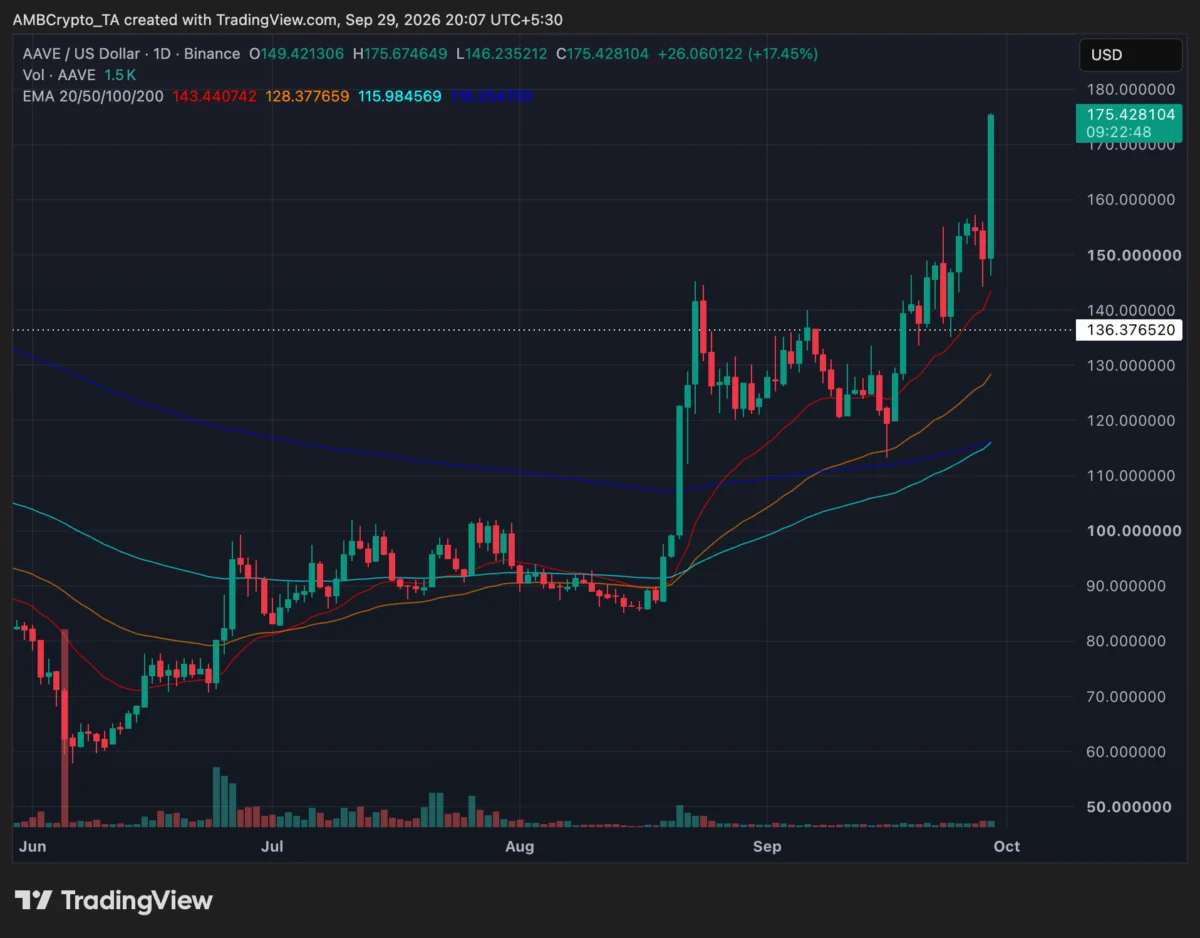
The decentralized finance (DeFi) sector has long been viewed as a high-risk, high-reward alternative to traditional financial instruments. However, as the global economic landscape shifts—marked by a notable resurgence in US Treasury yields—the resilience of leading protocols is being put to the test. Aave [AAVE], the prominent decentralized lending protocol, has recently defied conventional market wisdom. On September 29, 2026, AAVE delivered a staggering performance, climbing more than 17% in a single session, vaulting from the $149 support level to well above $175. This rally is not merely a transient price spike; it represents a fundamental shift in market sentiment, signaling that AAVE is successfully decoupling from traditional macro-economic pressures.
The Chronology of a Breakout
The recent surge in AAVE did not materialize in a vacuum. To understand the current momentum, one must analyze the trajectory of the token over the past six weeks. In mid-August, the protocol’s governance token was struggling to maintain traction, trading consistently below the $90 threshold. This period was characterized by market apathy and a general "risk-off" sentiment across the crypto-asset landscape.
However, the tide began to turn as the protocol demonstrated sustained growth. By late August and early September, AAVE began systematically dismantling resistance levels, crossing the $120, $140, and $150 milestones with conviction. The technical structure of this rally suggests a "stair-step" accumulation pattern rather than a speculative pump-and-dump.
The breakout on September 29 was the culmination of this upward pressure. By piercing the $150-$155 resistance zone—a region where previous rallies in 2026 had been soundly rejected—the token effectively converted a major ceiling into a support floor. As of the close of the trading session on September 29, the asset reached the $175 mark, currently trading well above its major moving averages. This alignment of price action over both short and long-term timeframes indicates a strong bullish consensus among market participants.
Supporting Data and Technical Analysis
The technical strength behind AAVE is supported by both on-chain volume and chart patterns. From a technical perspective, the $175 level serves as a psychological gateway. Analysts are now closely monitoring the $180 mark—a significant round figure where historical profit-taking typically occurs.
Should the asset experience a short-term correction, the critical focus for investors will be the $150-$155 range. In technical analysis, the "role reversal" principle dictates that former resistance levels must act as new support. If the price successfully holds this area during any potential pullback, it would solidify the bullish thesis, suggesting that the recent move was backed by genuine institutional and retail demand rather than ephemeral liquidity injections.
Furthermore, the integration of new features, such as Aave’s recent expansion into tokenized stocks as collateral for USDC loans on the Base network, has added a layer of utility that traditional lending protocols lack. This initiative, which turns real-world assets (RWA) into on-chain liquidity, is a testament to Aave’s ability to innovate even while the macro environment tightens.
The "5% Yield" Dilemma: A Test for DeFi
The most compelling aspect of Aave’s current rally is the macroeconomic context in which it occurs. We are currently witnessing a historic environment where the US 10-year Treasury yield has climbed above 5%, a level of risk-free return not seen since 2007.
In traditional financial theory, high Treasury yields act as a "gravity" force for risk assets. When investors can secure a 5% return on a "risk-free" government bond, the incentive to allocate capital to volatile DeFi platforms—which carry smart contract risk, market volatility, and liquidity risks—diminishes significantly. The fact that AAVE has managed to achieve a double-digit price increase in the face of such competition is a signal of the protocol’s growing maturity.
This divergence suggests that investors are no longer viewing DeFi purely as a speculative gambling arena, but as a legitimate alternative financial layer. The value proposition of Aave—instant liquidity, global accessibility, and permissionless lending—is proving to be an attractive alternative for those who find the traditional banking system too slow or inaccessible, even when the "risk-free rate" is high.

Governance and Institutional Adjustments
While the price rally is often driven by sentiment, the underlying governance of the Aave DAO remains a critical factor in its longevity. On September 28, a new risk proposal was introduced to the Aave governance forums, focusing on the optimization of borrowing conditions for the V3 protocol.
One of the key recommendations included in the proposal was an increase in the borrowing rate for USDe, moving from 6.3% to 6.6%. Such adjustments are the hallmark of a healthy, self-regulating ecosystem. These changes are determined by analyzing borrowing activity, the depth of available liquidity, and the overall health of open positions within the protocol. By proactively managing interest rates, the Aave community ensures that the protocol remains solvent and efficient, even during periods of extreme market volatility.
Though there is no direct correlation between the September 28 proposal and the immediate price surge, the market’s positive response suggests confidence in the DAO’s ability to manage risk. Investors are increasingly favoring protocols that demonstrate transparent, data-driven governance.
Implications for the Future of DeFi
The current performance of AAVE carries profound implications for the broader DeFi ecosystem.
1. Decoupling from Macro Trends
The rally proves that crypto-native assets are capable of independent price discovery. While Bitcoin and Ethereum often trade in lockstep with the S&P 500, utility-driven tokens like AAVE are increasingly being valued based on the growth and health of their specific protocols.
2. The Rise of RWA Integration
Aave’s push into tokenized commodities and stocks signifies a blurring of the lines between traditional finance (TradFi) and DeFi. By bridging these two worlds, Aave is capturing a larger Total Addressable Market (TAM), which helps buffer the protocol against the cyclical nature of pure crypto-trading.
3. The Institutional Appetite
The sheer volume behind the September 29 rally indicates that larger players are likely involved. The ability of the protocol to withstand the "5% Treasury yield" narrative suggests that capital is flowing into DeFi not just for yield farming, but for the fundamental utility of the lending infrastructure.
Conclusion
Aave stands at a critical juncture. Having broken through its September ceiling and established a new, higher floor, the protocol is signaling a level of maturity that is rare in the current crypto market. While the competition from traditional debt markets remains fierce, Aave’s focus on governance, utility expansion, and real-world asset integration has provided a robust foundation for growth.
As the market looks toward the $180 resistance level, investors must remain cognizant of the volatility inherent in the space. However, the data suggests that Aave is no longer just "another DeFi token." It has evolved into a cornerstone of the decentralized financial architecture, one that is increasingly capable of standing tall even when the global economic winds blow in the opposite direction. Whether this momentum can be sustained into the fourth quarter will depend on continued governance discipline and the protocol’s ability to maintain its competitive edge in an era of high interest rates. For now, the bulls are in control, and the market is listening.
