


Main Facts
The current market cycle has proven to be a major disappointment for cryptocurrency participants, primarily driven by a severe contraction in liquidity. From a technical standpoint, more than $10 billion has exited the broader crypto ecosystem year-to-date, marking the largest absolute liquidity contraction on record. This outflow mirrors a broader macroeconomic and sector-wide pullback, closely tracking a 25% drop in the total crypto market capitalization over the same period.
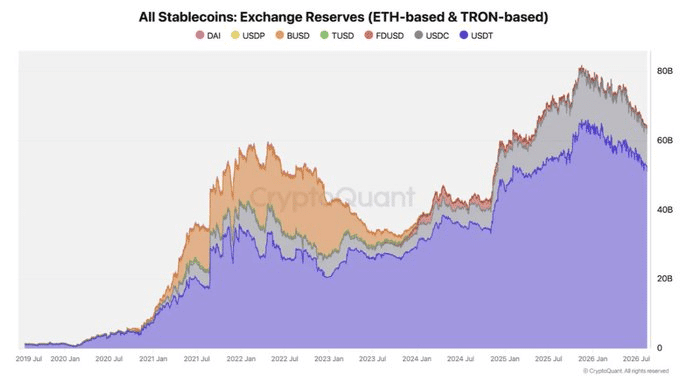
However, beneath the headline-grabbing capital flight lies an equally consequential shift: the internal redistribution of exchange-based liquidity. According to recent data from on-chain analytics platform CryptoQuant, stablecoin reserves parked on centralized exchanges peaked between $80 billion and $64 billion before initiating a steep downward trajectory.
Amid this broad contraction, exchange market share has fragmented unevenly. Binance, the world’s largest cryptocurrency exchange by volume, has actively consolidated its market position. While competitor platforms have suffered catastrophic stablecoin drains, Binance saw its share of exchange-held stablecoins expand from 60% to 68.5%.
While traditional market analysts view this centralization of liquidity as a bearish indicator that stifles buying power on secondary platforms, emerging on-chain data paints a more nuanced picture. Crucially, a decline in speculative leverage is colliding with a notable resurgence in organic spot demand. Bitcoin’s combined 30-day spot and futures demand recently touched a 2026 high of 10,883 BTC. This shift suggests that rather than signaling an impending market collapse, the ongoing stablecoin drainage may reflect a fundamental structural rotation: capital moving out of derivative speculation and directly into underlying crypto assets.
Chronology of the Liquidity Contraction
To understand how the digital asset market arrived at this delicate crossroads, it is necessary to trace the timeline of the 2026 liquidity cycle:
- Early Q1 2026: The broader crypto market entered a risk-off environment characterized by heightened macroeconomic uncertainty, regulatory friction, and waning retail participation. High volatility triggered widespread liquidations across major derivatives platforms, shaking investor confidence.
- Mid-Q1 to Q2 2026: Stablecoin reserves on centralized exchanges reached a local peak of approximately $80 billion. Shortly thereafter, institutional and retail capital began steadily exiting the ecosystem. Total ecosystem stablecoin supplies dropped by over $10 billion—a record absolute contraction.
- Late Q2 2026: As aggregate exchange liquidity shrank toward $64 billion, capital flight exposed deep disparities among trading platforms. While smaller and mid-tier exchanges experienced severe liquidity depletion, Binance bucked the industry trend by aggressively absorbing remaining capital flows. Its market share climbed from 60% to a dominant 68.5%.
- Early Q3 2026: Despite declining aggregate stablecoin balances—traditionally a harbinger of a broader market sell-off—on-chain metrics began registering an unexpected divergence. Speculative positioning flattened out, while organic spot market demand steadily recovered, pushing Bitcoin’s 30-day cumulative demand metric to 10,883 BTC, a yearly high.
Supporting Data and On-Chain Metrics
The health of the digital asset market is intrinsically tied to liquidity metrics, specifically stablecoins, which act as the "dry powder" required to acquire volatile cryptocurrencies like Bitcoin and Ethereum. The current cycle, however, has disrupted historical correlations.
1. The Record Liquidity Drain
Data compiled by CryptoQuant indicates that the crypto ecosystem has shed over $10 billion in stablecoin liquidity this year. This capital departure directly correlates with a 25% retracement in the total crypto market capitalization. When stablecoin supplies shrink, the market’s capacity to absorb new token issuances, protocol expansions, and leveraged positions diminishes rapidly.

2. Binance’s Increasing Market Monopoly
The contraction of exchange-based stablecoins from an $80 billion peak down to the $64 billion threshold did not impact all exchanges equally.
- The Winners: Binance cemented its position as the ultimate liquidity sinkhole in the centralized exchange (CEX) arena. By capturing inflows while competitors bled reserves, Binance expanded its stablecoin dominance from 60% to 68.5%.
- The Losers: Alternative exchanges witnessed an accelerated drain of their stablecoin reserves, severely impacting their order book depth and localized buying power.
3. The Rise in Spot Demand vs. Speculative Flush
While falling stablecoin balances typically signal an exit to fiat currency (and a bearish continuation), on-chain analysts are monitoring a vital offsetting metric: the return of spot-driven accumulation.
Historically, bull markets are fueled by a healthy mix of spot buying and derivative leverage. However, the first half of 2026 was defined by excessive speculation that alienated retail investors. As volatility purged leveraged long and short positions, speculative demand plummeted.
In its place, real spot accumulation has surged. Bitcoin’s 30-day combined futures and spot demand metric reached 10,883 BTC—its highest level of 2026. This indicates that participants are increasingly withdrawing their assets from exchanges into self-custody or accumulating spot tokens directly, absorbing the downward price pressure typically associated with liquidity contractions.
Official Responses and Market Analysis
Industry analysts and on-chain researchers hold divergent views regarding the dual phenomena of concentrated exchange liquidity and shifting spot demand.
Traditional market technicians initially interpreted the migration of stablecoins to Binance as an ominous sign. Several analysts noted that when liquidity concentrates exclusively on a single dominant platform, the broader market suffers from systemic fragility. Without distributed liquidity across secondary and tertiary exchanges, price discovery becomes heavily reliant on a single order book, leaving altcoins and mid-cap digital assets vulnerable to sudden flash crashes or prolonged consolidation.
Furthermore, prominent market commentators voiced concerns that the $10 billion exodus from the ecosystem highlights a systemic fatigue among institutional allocators who are rotating capital back into traditional financial instruments, such as US Treasury bills and high-yielding money market funds, amid persistently high interest rates.
Conversely, a growing cohort of on-chain researchers have pushed back against a purely bearish interpretation. Pointing to the expansion of spot demand, analysts emphasize that capital leaving stablecoins is not necessarily fleeing the asset class entirely; rather, it is being deployed directly into underlying crypto assets.
As noted by prominent ecosystem researchers, the purging of speculative leverage combined with an uptick in organic spot accumulation often serves as the foundational blueprint for a durable market bottom. If macro-driven fear, uncertainty, and doubt (FUD) continue to weigh on traditional risk assets, a localized rotation back into spot-held cryptocurrencies could lay the groundwork for the next structural expansion phase.
Implications for the Broader Crypto Ecosystem
The convergence of record-low stablecoin liquidity, exchange centralization, and rising spot demand carries profound implications for investors, traders, and protocol developers navigating the digital asset landscape.
1. Changing Dynamics for Altcoins and Secondary Exchanges
The severe drain of stablecoin liquidity from platforms outside of Binance presents a clear structural challenge for alternative centralized exchanges. With reduced order book depth, altcoins listed on smaller platforms face heightened slippage and increased susceptibility to market manipulation. Projects relying on these exchanges for liquidity bootstrapping may need to pivot toward decentralized finance (DeFi) liquidity pools or cross-chain bridges to sustain trading activity.
2. Regulatory and Concentration Risks
Binance’s expansion to 68.5% dominance over exchange-held stablecoins amplifies systemic concentration risks. Regulators and risk managers frequently scrutinize single points of failure within financial architecture. A high concentration of capital on a single platform increases systemic vulnerability to operational outages, regulatory crackdowns, or sudden liquidity crunches unique to that entity.
3. A Potential Macro Bottoming Process
For long-term investors, the shift from speculative leverage to spot accumulation is a welcome development. Speculative bubbles driven by excessive derivatives trading are historically unsustainable, often resulting in violent liquidations. Conversely, accumulation driven by spot buying—even amid a contracting stablecoin supply—suggests that "smart money" and disciplined retail participants are acquiring assets at lower valuations.
While the broader macroeconomic landscape remains fraught with uncertainty, the resilience of spot demand indicates that the crypto market may be successfully weathering the worst of the liquidity storm, setting the stage for a more mature and fundamentally sound recovery.
