

Main Facts
Global fintech giant Revolut has officially entered the digital asset tokenization arena with the launch of its euro-pegged stablecoin, EURR. Debuting on Wednesday, August 26, the asset marks the company’s inaugural push into the rapidly evolving stablecoin market. Revolut has indicated that EURR is merely the first step in a broader multi-currency tokenization strategy, with plans to introduce stablecoins pegged to other major global currencies in the near future.
The timing of Revolut’s entry is closely intertwined with regulatory changes sweeping across Europe. The European Union’s landmark Markets in Crypto-Assets (MiCA) regulatory framework has fundamentally altered the digital asset landscape within the bloc. Most notably, Tether’s USD-pegged stablecoin, USDT—the dominant force in the global stablecoin ecosystem—has faced widespread delisting across European exchanges and platforms after failing to secure the requisite MiCA licensing. Revolut confirmed it will officially drop USDT by the end of August, creating an immediate liquidity and product vacuum that financial platforms are rushing to fill.
While the stablecoin market remains overwhelmingly dominated by U.S. dollar-pegged assets like Tether’s USDT and Circle’s USDC, which collectively command over 90% of total market share, euro-denominated alternatives are experiencing a notable surge in adoption. Revolut’s EURR enters a nascent euro stablecoin sector currently spearheaded by Circle’s EURC, which boasts a circulating supply of $455 million, representing more than 50% of the total $772 million EUR-pegged market.
Despite this localized momentum, the product has sparked intense debate among industry analysts. Critics question the global utility and long-term competitiveness of euro-backed stablecoins compared to their dollar counterparts, even as blockchain analytics point to triple-digit percentage growth in non-USD token transfer volumes over the past month.
Chronology of Events
The events leading up to and immediately following the launch of Revolut’s EURR highlight a period of aggressive regulatory compliance and strategic positioning within the European fintech sector:
- Pre-August 2025: Regulatory pressure mounts across the European Union as the full implementation of the MiCA framework approaches, forcing digital asset platforms to review compliance standards for non-compliant algorithmic and fiat-backed tokens.
- August 2025 (Mid-Month): Industry reports confirm that major European-facing platforms, including Revolut, must phase out non-compliant assets like Tether’s USDT to adhere to strict MiCA guidelines by the end of the month.
- Wednesday, August 26: Revolut officially debuts its euro-based stablecoin, EURR, marking the fintech unicorn’s debut proprietary token issuance and signaling future multi-currency stablecoin offerings.
- Late August 2025: Revolut finalizes its planned delisting of USDT, aligning with the regulatory deadline and clearing operational pathways for proprietary and fully compliant alternatives like EURR.
- Ongoing (Post-Launch): Market analysts, crypto commentators, and institutional stakeholders actively debate the viability of EURR and the broader euro stablecoin market against the dominant backdrop of USD-pegged liquidity.
Supporting Data and Market Metrics
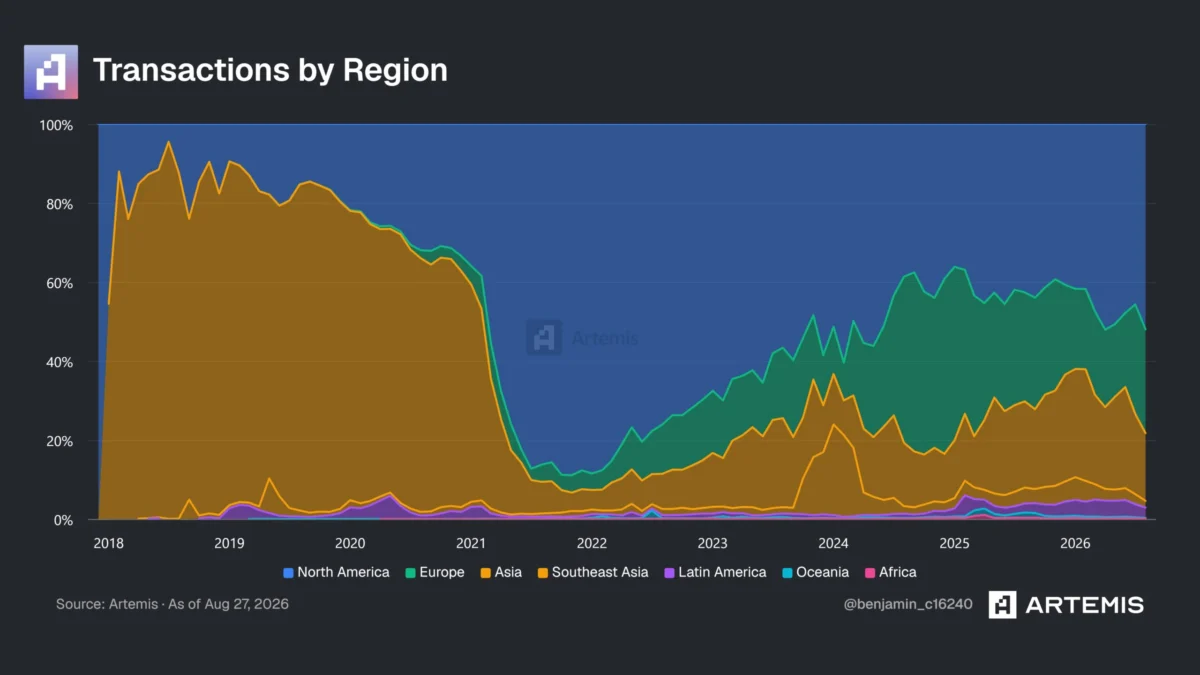
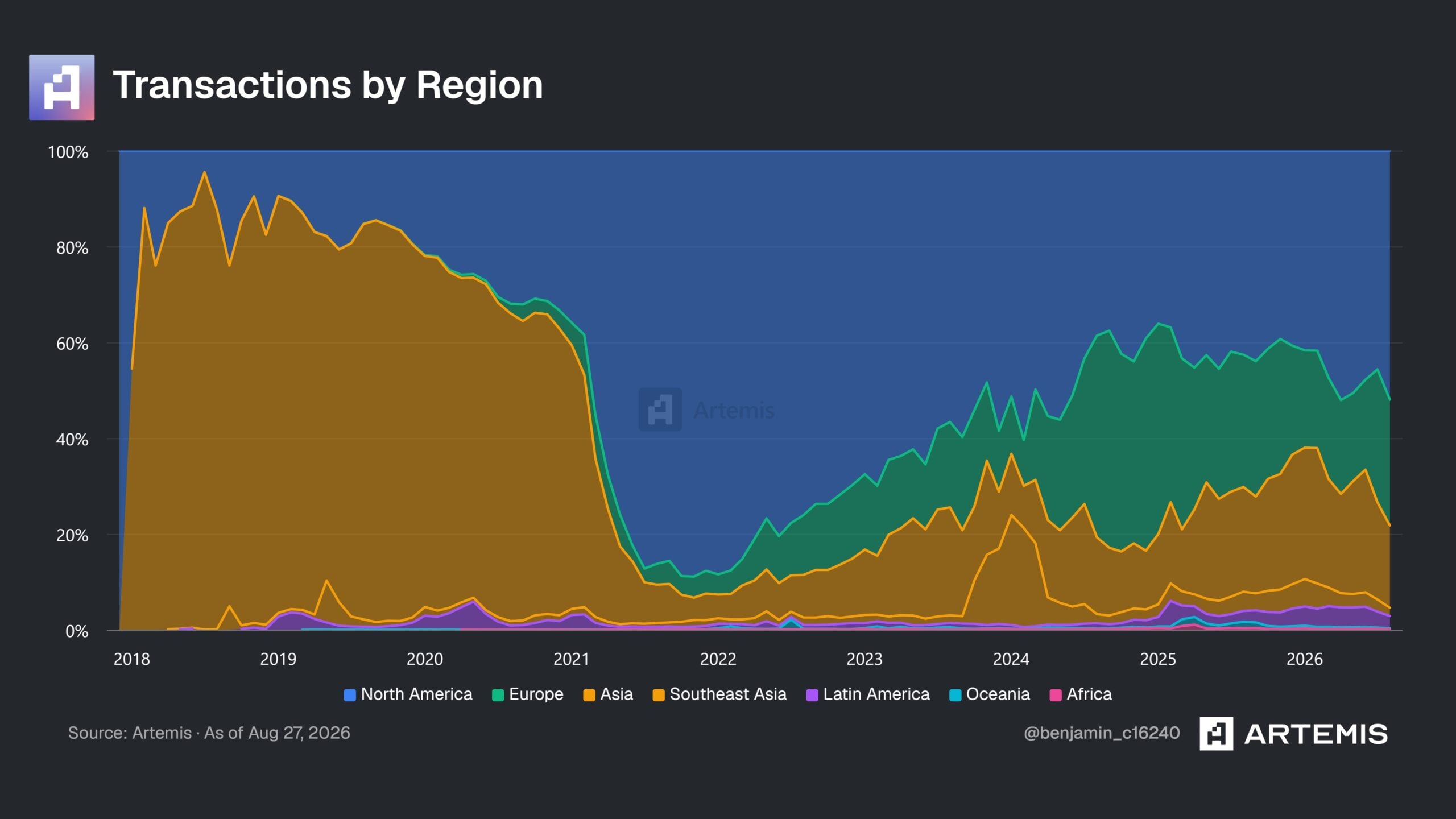
To understand the context of Revolut’s strategic pivot, it is essential to examine current macro-level data concerning regional stablecoin adoption and transactional volume growth. According to metrics compiled by blockchain data provider Artemis, the geographical distribution of stablecoin transactions highlights North America and Europe as the primary global hubs:

- Regional Transaction Share: North America retains the top spot for overall stablecoin transaction volume, followed closely by Europe in second place with a substantial 26% market share. Asia occupies the third position globally.
- USD vs. Non-USD Growth Trajectory: While USD-denominated stablecoins continue to account for more than 90% of the global market share—surging to nearly $7 trillion in 30-day transaction volume (representing a steady 22% growth rate)—non-USD stablecoins are expanding at a much faster relative pace.
- The Non-USD Surge: Artemis data reveals that non-USD stablecoin transaction volumes hit $15 billion over a comparable 30-day window. While absolute volume remains a fraction of the dollar-dominated market, this figure translates to a staggering triple-digit growth rate of 137%.
- Euro Market Breakdown: Within the specific niche of euro-denominated stablecoins, the total market capitalization sits at approximately $772 million. Circle’s EURC remains the dominant incumbent, accounting for $455 million—or well over 50%—of that total supply, leaving the remaining share to newer entrants like Revolut’s EURR and various localized banking and fintech tokens.
Official Responses and Industry Reactions
The introduction of EURR and the simultaneous regulatory purge of USDT have elicited polarized perspectives from market commentators, institutional leaders, and macroeconomic analysts.
Prominent crypto commentator and trader Scott Melker offered a deeply skeptical view of Revolut’s strategic timing and the broader utility of euro-backed digital assets. Pointing to the structural dominance of the U.S. dollar in global trade and decentralized finance (DeFi), Melker argued that EURR is primarily designed to capitalize on the vacuum left by Tether’s departure rather than genuine organic demand.
"Nobody wants euros anywhere outside of Europe, and they don’t really want them there either; they’re just forced to use them," Melker remarked. "So, it’s not like this is going to compete with dollar-backed stablecoins."
Conversely, institutional voices see the rise of alternative fiat-pegged tokens as an inevitable stepping stone toward a fully tokenized global economy. Zach Abrams, former CEO of institutional stablecoin transfer network Bridge, offered an optimistic outlook on the long-term structural integration of digital currencies:
"Our financial system will be increasingly tokenized over the next 5 years. First currencies, then treasuries, next stocks, and so on. Non-USD stablecoins will play a critical role in local settlement, collateral, FX, and more."
Abrams’ perspective highlights that while global cross-border crypto settlement is heavily denominated in U.S. dollars, regional settlement, foreign exchange (FX) hedging, and institutional collateral management will increasingly demand compliant, localized currency tokens.
Implications and Future Outlook
Revolut’s launch of EURR and the broader expansion of euro stablecoins carry profound implications for the future of European fintech, regulatory compliance, and central banking policy.
1. The Filling of the MiCA Regulatory Vacuum
With platforms across Europe forced to drop non-compliant assets like USDT to satisfy MiCA mandates, a significant liquidity gap emerged. Revolut’s introduction of EURR—alongside similar pushes by regulated issuers like Circle—demonstrates how private fintech firms are stepping in to supply compliant on-chain alternatives. By capturing users who previously relied on USD-backed or non-compliant tokens for immediate liquidity, Revolut can cement its ecosystem as a primary gateway for European digital asset holders.
2. The Global Relevance Dilemma
The central friction point for EURR and other euro stablecoins remains their limited global appeal. While the euro is a major fiat currency, the vast majority of international trade, decentralized finance protocols, liquidity pools, and crypto-native transactions are priced, settled, and collateralized in U.S. dollars. For EURR to achieve long-term success, Revolut will need to prove that its token offers unique utility—such as seamless integration with traditional European banking rails, reduced foreign exchange fees, and high-yield institutional savings products—that traditional dollar stablecoins cannot replicate.
3. The Looming Shadow of the Digital Euro
Perhaps the most significant long-term variable facing private euro stablecoins is the European Central Bank’s (ECB) ongoing development of a central bank digital currency (CBDC). The European Union has formally announced plans to introduce a digital euro by 2029, explicitly designed to protect commercial and central banks from the encroachment of private stablecoins and to ensure monetary sovereignty within the eurozone.
As the 2029 deadline approaches, it remains unclear how the ECB’s state-backed digital currency will coexist with—or potentially squeeze out—private euro stablecoins like Circle’s EURC and Revolut’s EURR. For now, however, private fintech firms have been handed a multi-year window of opportunity to capture market share, drive user adoption, and shape the early infrastructure of tokenized European finance.
