

By Financial Markets Newsdesk
Published: August 2026
Main Facts
In what is being hailed as a monumental turning point for the digital asset ecosystem, stablecoin issuer Tether has successfully finalized a comprehensive full-year audit conducted by KPMG—marking the historic inclusion of one of the prestigious "Big Four" accounting firms in auditing the cryptocurrency giant. According to official corporate statements, KPMG issued a "clean" audit opinion regarding Tether’s 2025 financial statements, representing the most favorable and rigorous validation an independent accounting firm can bestow upon a corporate entity.
For years, the cryptographic financial landscape has been clouded by speculation regarding Tether’s reserve mechanisms, corporate governance, and asset backing. The completion of this audit directly challenges those long-standing narratives. Tether’s leadership views the development as indisputable proof of financial health and operational integrity, silencing detractors who argued that the firm would never subject itself to top-tier institutional scrutiny.
Despite this milestone, the crypto community remains deeply polarized. While industry proponents celebrate the news as the death knell for USDT skepticism, prominent critics and traditional financial analysts point out structural limitations within the audit—such as its focus on offshore subsidiaries rather than the entire corporate umbrella—proving that the debate surrounding Tether’s unprecedented dominance is far from over.
Chronology of Scrutiny: The Road to a Big Four Audit
To fully understand the magnitude of KPMG’s clean audit opinion, one must look back at the arduous regulatory and public relations battles Tether has fought since its inception.
Years of Opacity and Attestations
Since launching its USDT stablecoin, Tether operated under a cloud of controversy regarding the true nature of its reserves. For much of its history, the company relied on regular quarterly "attestations" rather than full financial audits. While attestations offered a point-in-time snapshot of the company’s holdings, traditional financial institutions, regulatory bodies, and cynical market commentators routinely criticized these reports as insufficient. Critics argued that attestations failed to evaluate internal financial controls, liabilities, and the overarching corporate architecture—leaving the door wide open for systemic risk theories.
Late 2025: The S&P Global Downgrade
The pressure reached a boiling point in late 2025. Rating agency S&P Global dealt Tether a significant blow by downgrading USDT from a "constrained" rating to a "weak" rating. S&P cited concerns regarding asset allocation, noting that only roughly 77% of Tether’s reserves were held in ultra-conservative U.S. Treasury bonds and cash equivalents. The rating agency flagged Tether’s growing exposure to riskier alternative assets—such as Bitcoin (BTC) and physical gold—as well as persistent questions surrounding corporate transparency as primary drivers behind the downgrade.
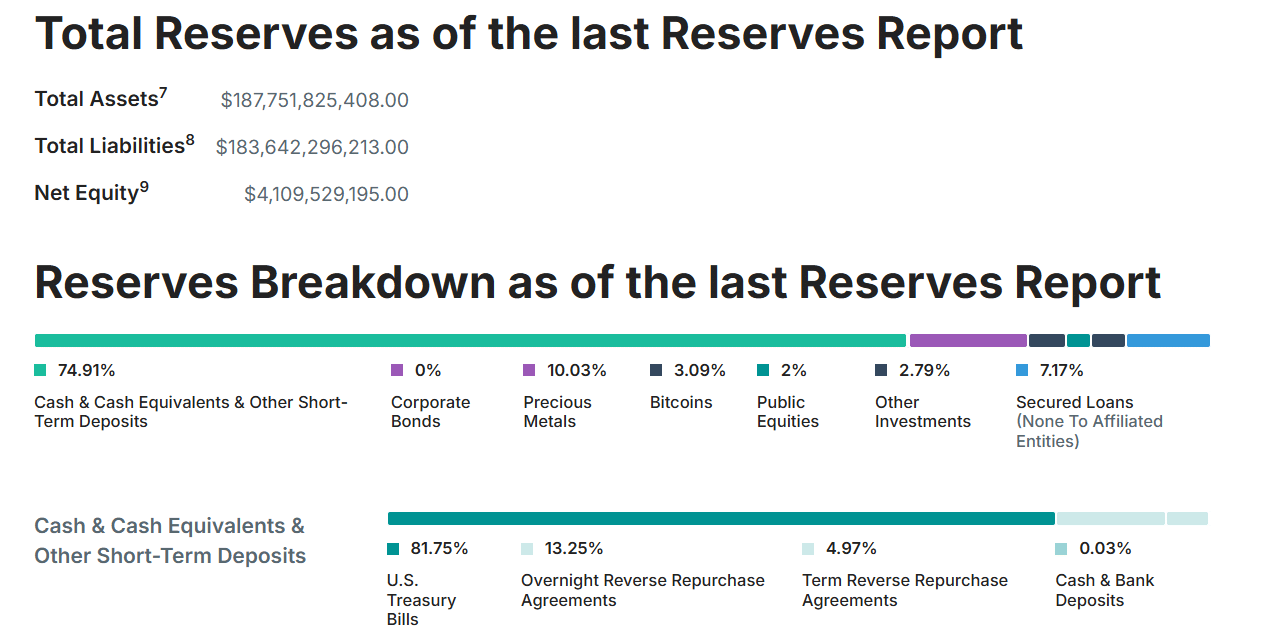
Data from mid-2025 indicated that Tether’s offshore product, USDT, maintained roughly 75% of its reserve exposure in T-bills and cash equivalents, while precious metals and gold accounted for approximately 10%, and Bitcoin holdings sat around 3%. To traditional finance (TradFi) analysts, holding volatile assets to back a token pegged 1:1 to the U.S. dollar introduced unacceptable tail risks.
August 2026: The KPMG Breakthrough
Breaking through years of resistance, Tether’s announcement in August 2026 alters the battlefield. By securing a clean opinion from KPMG for its 2025 financial statements, Tether has accomplished what many legacy financial commentators claimed was impossible: passing the rigorous examination of a Big Four accounting firm.
Supporting Data: Reserves, Profits, and Global Reach
While the audit report provides overarching comfort regarding Tether’s financial statements, the underlying mechanics of its balance sheet and explosive business model continue to attract granular analysis.
Reserve Composition and Product Splits
Tether’s asset management strategy bifurcates based on its target jurisdictions and product offerings:
- USDT (Offshore Product): Catering primarily to international markets, USDT’s reserve backing has evolved to include a diversified basket of assets. While traditional cash equivalents and U.S. Treasury bills form the bedrock—typically hovering between 75% and 77%—the inclusion of Bitcoin, precious metals, and secured loans has historically been a point of contention for conservative rating agencies.
- USAT (U.S.-Focused Product): Designed specifically to align with anticipated domestic regulatory frameworks, Tether’s U.S.-focused product operates under stricter constraints, aiming for a 1:1 backing profile consisting almost entirely of near-100% T-bills and cash equivalents.
Unprecedented Profitability
Beyond balance sheet composition, Tether functions as an economic powerhouse. The firm reported a staggering $1.5 billion in net profits during the second quarter alone, driven heavily by high yields on its massive portfolio of U.S. Treasury securities during a high-interest-rate environment.
Concurrently, adoption metrics continue to shatter ceilings. The total number of unique USDT holders recently surpassed the monumental milestone of 650 million users globally, cementing its status as the undisputed liquidity backbone of the digital asset economy.
Official Responses and Industry Reactions
The release of the KPMG audit report immediately triggered a wave of reactions across the financial spectrum, ranging from triumphant vindication to calculated skepticism.
Tether Leadership Fights Back
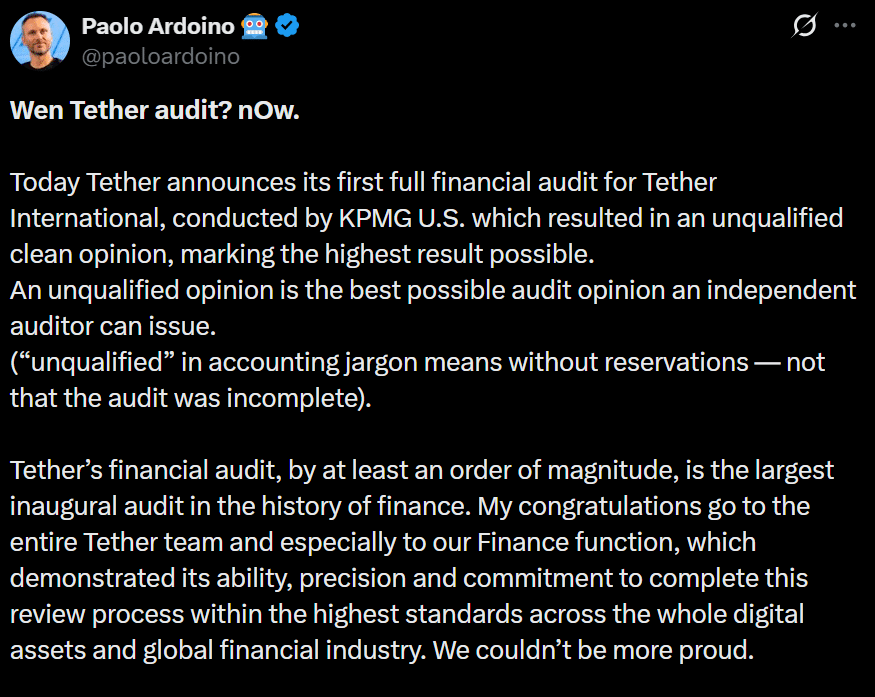
Paolo Ardoino, CEO of Tether, did not mince words when addressing the milestone, using the occasion to launch a direct counter-offensive against long-standing critics:
"This is a defining moment for the stablecoin industry," Ardoino stated. "For years, some detractors said an audit of Tether could not be completed. They said the Company refused to subject itself to the most rigorous scrutiny. We have once again proven them wrong."
Ardoino’s remarks highlight a deep-seated institutional grievance. For years, Tether executives felt unfairly targeted by Western financial institutions and rating agencies that held offshore crypto issuers to standards rarely applied to traditional shadow banking entities of similar scale.
The TradFi and Crypto Analytic Perspective
Market experts acknowledged the symbolic victory while immediately shifting the goalposts toward structural reform and competitive dynamics.
ETF expert Nate Geraci weighed in on the competitive landscape, emphasizing that scale remains Tether’s ultimate moat:
"Until that problem is shared—specifically, sharing stablecoin yield with end-users—Tether will never face any real competitive pressure given its sheer scale, in my opinion."
Conversely, hardline cryptocurrency advocates remained unconvinced. Swan CEO Cory Klippsten voiced reservations regarding the scope of the audit and ongoing opacity surrounding the company’s ultimate ownership structure, noting that the audit specifically evaluated Tether International rather than the entire opaque corporate holding structure.
Broader Implications for the Stablecoin Economy
The completion of a Big Four audit for the world’s largest stablecoin issuer carries profound implications for regulatory compliance, market stability, and the future of global finance.
Setting a New Regulatory Benchmark
For years, regulators across the globe—from Washington to Brussels—have eyed stablecoins with acute suspicion, warning that a "DeFi Black Monday" could be triggered by an unbacked stablecoin de-pegging event. By bringing in KPMG, Tether has voluntarily raised the compliance bar. Going forward, regulatory bodies will find it increasingly difficult to dismiss Tether as an unregulated black box. This move may well accelerate the creation of formal legislative frameworks for stablecoin issuers globally, as policymakers realize that major crypto firms can, and will, integrate with traditional institutional accounting standards.
Market Dominance and Liquidity Resilience
USDT is the circulatory system of the cryptocurrency markets. More than 70% of all crypto trading volume flows through USDT pairs. A systemic failure of Tether would have triggered a catastrophic liquidity crisis across global exchanges. By proving through a clean KPMG audit that its liabilities are fully accounted for and verified by a top-tier firm, systemic tail risk is materially reduced.
However, questions regarding yield sharing remain paramount. As traditional financial heavyweights—such as global asset managers and payment giants—enter the stablecoin arena with yield-bearing or natively compliant products, Tether’s ultimate defense will no longer rely merely on proving it has the money. It will need to compete on utility, transparency, and economic value distribution to its vast user base of over 650 million people.
Ultimately, while the KPMG audit may not silence every cynic in the digital asset sphere, it undeniably closes a contentious chapter in Tether’s history, establishing a new baseline of financial accountability for the entire cryptocurrency sector.
