


Main Facts
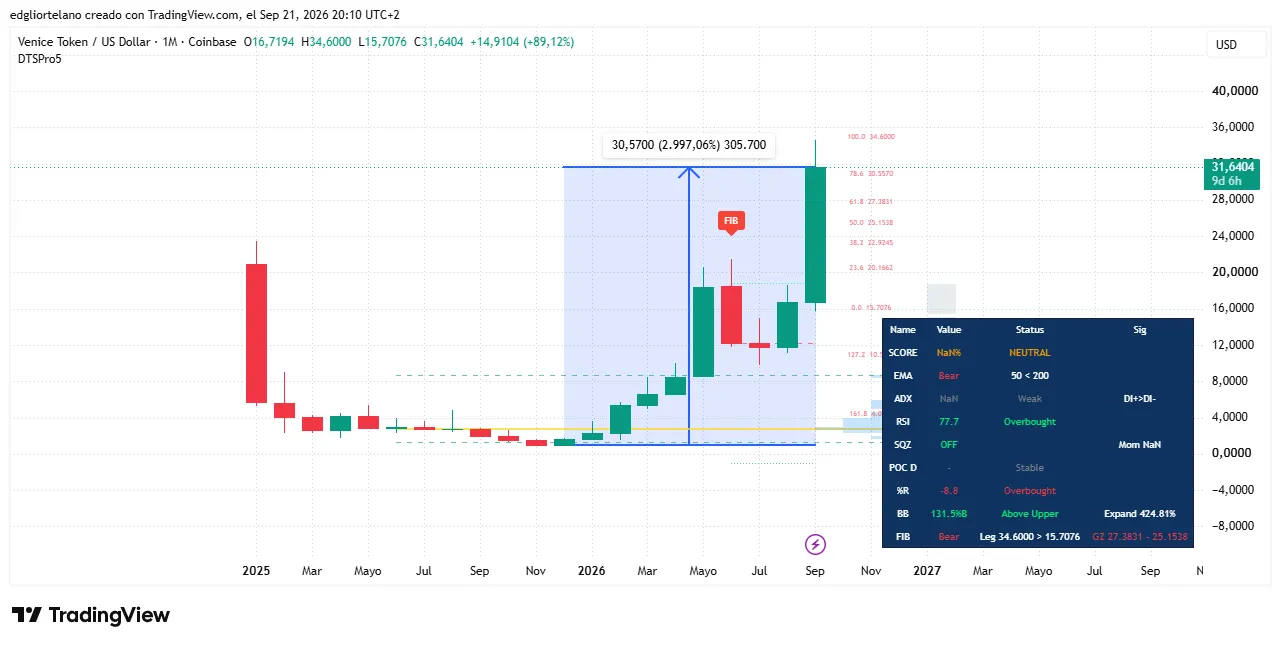
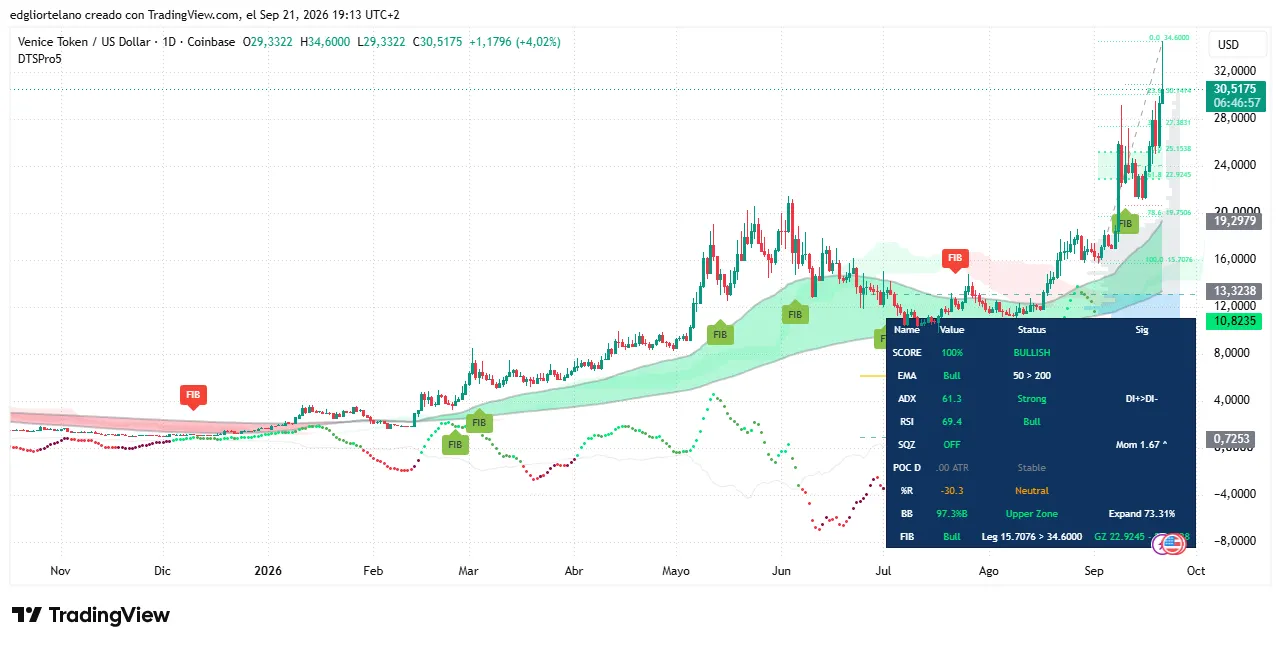
The native utility token of the privacy-focused artificial intelligence platform Venice AI—trading under the ticker VVV—reached a historic all-time high of $34.51 on Sunday. Demonstrating immense market momentum, the token surged roughly 17% over a single 24-hour window, compounding an astonishing 3,000% rally since bottoming out at $0.92 in December. With its market capitalization hovering near $1.6 billion, VVV has cemented its position as the third-largest AI-focused cryptocurrency in the digital asset ecosystem, trailing only Near and TAO.
Unlike consumer tokens designed for microtransactions or speculative hype, VVV functions primarily as an access key and computational stake within the Venice ecosystem. Founded by prominent early Bitcoin advocate and ShapeShift creator Erik Voorhees, Venice AI provides an alternative to mainstream models like ChatGPT by offering unmonitored, log-free chat and image-generation capabilities. Users stake VVV tokens in smart contracts to secure a daily allocation of computational "inference"—the processing power required to fulfill AI prompts—or lock them up to mint DIEM, a secondary token providing perpetual daily API credits.
Despite its impressive financial growth, Venice AI does not train its own frontier models. Instead, it routes prompts through existing open-source systems such as Llama and DeepSeek. Its valuation and token demand are driven entirely by its core value proposition: absolute digital privacy, zero chat logging, no mandatory account creation, and the absence of heavy-handed content filters. However, the token’s distribution warrants caution, as blockchain analytics reveal that the top 100 VVV wallets control approximately 98% of the total circulating supply.

Chronology
To understand how Venice AI and its native asset achieved a $1.6 billion valuation, it is essential to trace the platform’s rapid operational and financial evolution:
- Early 2024: Erik Voorhees officially launches Venice AI, introducing a decentralized, privacy-first alternative to centralized AI monoliths like OpenAI and Google.
- December 2024: VVV hits its cyclical bottom at $0.92, setting the stage for an extraordinary multi-month bull run fueled by growing market weariness regarding centralized data collection.
- July 2025: Venice AI secures a major milestone by closing a $65 million Series A funding round led by crypto-native venture firm Dragonfly. This financing values the young startup at an impressive $1 billion, marking its first injection of outside institutional capital.
- August 2025: Venice reports staggering business growth, crossing a $100 million annualized revenue run rate—a dramatic leap from the $70 million recorded just a month prior.
- Early September 2025: A high-profile public dispute erupts between an NYU mathematician and OpenAI over intellectual property rights concerning a fluid-dynamics proof. Although unrelated to data leaks, the controversy ignites viral debates across X (formerly Twitter) and Hacker News regarding whether major AI providers might absorb user prompts into proprietary research.
- Mid-September 2025: Spurred by heightened anxieties over corporate data harvesting, VVV spikes 34% in a single day, catalyzing a broader market surge. Token emissions are systematically reduced, dropping to an annualized rate of 2.5 million VVV as part of a deflationary supply schedule.
- Sunday, September 21, 2025: VVV smashes previous resistance levels to hit a fresh all-time high of $34.51, accompanied by a 17% 24-hour gain and a total market cap touching $1.6 billion.
- Upcoming October 1, 2025: Venice’s programmed token issuance schedule dictates another supply reduction, lowering annual emissions from 2.5 million to 2 million VVV—an event heavily anticipated by market speculators.
Supporting Data
The growth trajectory of Venice AI and the financial mechanics of VVV are defined by distinct metrics spanning tokenomics, revenue expansion, and supply distribution:
- Price and Market Capitalization: VVV climbed from a December low of $0.92 to a peak of $34.51, representing a roughly 3,000% appreciation. Its total market cap stands near $1.6 billion, making it the third-largest AI cryptocurrency globally.
- Revenue Acceleration: Venice AI scaled its annualized revenue run rate from $70 million to over $100 million within a matter of weeks during the summer of 2025.
- Institutional Funding: The platform’s Series A round in July 2025 brought in $65 million, spearheaded by Dragonfly, establishing a $1 billion baseline valuation.
- Tokenomics and Deflationary Mechanics:
- Staking & DIEM: Users lock VVV to earn AI inference capacity or mint DIEM, which generates one dollar of daily API credit indefinitely.
- Token Burns: A designated portion of Venice’s platform revenue is systematically used to purchase VVV on the open market and permanently burn it, reducing circulating supply.
- Emission Reductions: Annual token issuance has steadily dropped from 14 million VVV at launch to 2.5 million on September 1, with a subsequent reduction to 2 million scheduled for October 1.
- Wallet Concentration Risk: According to on-chain data from Basescan, the top 100 VVV holders control roughly 98% of the total token supply, highlighting significant centralization among top-tier wallets.
Official Responses and Industry Perspectives
The rapid ascent of Venice AI has forced a broader industry conversation regarding user sovereignty, intellectual property, and the ethical boundaries of generative AI training methods.
Industry analysts and cypherpunk advocates have praised Venice for pioneering alternative monetization strategies that bypass traditional subscription models. By tying token value directly to platform utility—where staked assets yield compute resources and corporate revenues actively buy back and burn tokens—Venice has built a self-sustaining economic loop. Supporters argue that the platform provides a vital safe haven for developers, researchers, and creators who wish to experiment with advanced prompts without inadvertently feeding proprietary ideas into commercial training datasets.
Conversely, mainstream AI developers and enterprise compliance officers maintain that strict content filtering and data retention practices are necessary safeguards against illicit activities, misinformation, and copyright infringement. While OpenAI, Google, and Anthropic emphasize safety protocols and model alignment, Venice’s hands-off, unfiltered approach has drawn scrutiny from regulatory watchdogs concerned about the potential misuse of decentralized AI tools.
Erik Voorhees and the Venice AI team have consistently defended their architecture as a necessary counterweight to the creeping surveillance capitalism of modern tech monopolies, maintaining that privacy should be a default right rather than an enterprise add-on.
Implications
The explosive performance of the VVV token and the commercial traction of Venice AI carry profound implications for both the artificial intelligence and cryptocurrency sectors:
1. The Intersection of Privacy and AI Demand
The catalyst behind VVV’s sudden price surge—sparked by public anxiety over OpenAI’s data handling—demonstrates that consumer demand for privacy-preserving AI is not merely theoretical; it is economically potent. As mainstream AI models become increasingly integrated into professional workflows, the fear of intellectual property leakage is pushing a lucrative segment of users toward decentralized, log-free alternatives.
2. Token Utility vs. Pure Speculation
While many crypto-AI tokens function primarily as speculative vehicles detached from underlying products, Venice has successfully engineered a utility-driven model. The integration of DIEM credits, smart contract staking, and revenue-backed token burns creates a direct link between platform usage and asset valuation. However, the extreme concentration of supply among the top 100 wallets introduces structural vulnerability, leaving the asset exposed to sharp volatility if early whales decide to liquidate positions.
3. Regulatory and Compliance Crossroads
Venice AI’s commitment to unmonitored outputs and a lack of content filtering places it on a collision course with emerging global AI regulations. As governments worldwide push for stricter oversight, liability frameworks, and safety guardrails on generative technologies, platforms operating without filters or KYC requirements may face mounting pressure from international regulators.
4. A Shift in Business Models
If Venice AI can sustain its $100 million annualized revenue run rate while scaling its user base, it may validate alternative web3 business models for artificial intelligence. By utilizing tokenized compute allocation instead of traditional SaaS subscriptions, Venice offers a blueprint for how decentralized networks can challenge Silicon Valley’s centralized data dominance in the years ahead.
