


Global technology leaders Google and Apple are quietly building out digital-asset expertise through strategic recruitment initiatives. While neither tech titan has formally announced an upcoming crypto-native consumer product, their recent job listings underscore a broader industry reality: stablecoins, blockchain infrastructure, and Real-World Asset (RWA) tokenization are rapidly transitioning from experimental niches to core operational capabilities for the world’s most influential corporations.
Main Facts: The Silicon Valley Pivot Toward Digital Assets
In the fast-evolving landscape of financial technology, corporate intent is rarely broadcasted through traditional press releases first. Instead, a company’s strategic roadmap is frequently revealed through its hiring pipelines. Recent developments from two of Silicon Valley’s most dominant players—Alphabet’s Google Cloud and consumer electronics giant Apple—demonstrate a renewed, tangible interest in the underlying architecture of digital currencies, stablecoins, and decentralized ledgers.
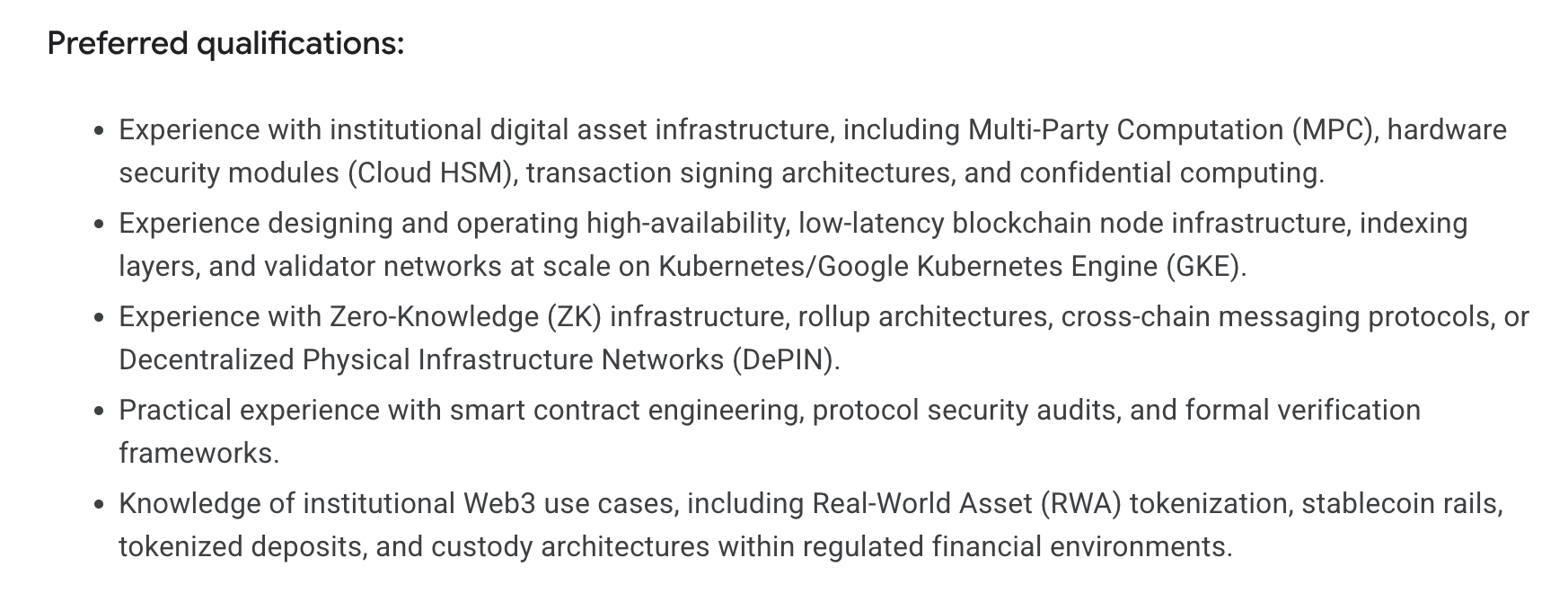
Google Cloud has initiated a targeted search for an Industry Principal Architect based in Hong Kong. According to the official job description, the primary mandate of this role is to collaborate directly with traditional financial institutions, including major regional banks, digital asset exchanges, and institutional custodians, to facilitate the tokenization of Real-World Assets (RWAs) across the Asia-Pacific (APAC) region.
The qualifications for the Google Cloud position explicitly call for hands-on experience with:
- Distributed ledger and blockchain networks
- Smart contract development and execution environments
- Stablecoin payment infrastructure
- Enterprise-grade digital asset custody technology
Concurrently, Apple has posted a strategic opening for an Apple Pay Financial Product Strategy Lead to oversee core financial services, including Apple Card, Apple Cash, and peer-to-peer (P2P) payment ecosystems. While Apple’s listing does not explicitly feature buzzwords like "blockchain" or "crypto," industry analysts note that the evolution of modern P2P networks and next-generation mobile wallets increasingly intersects with distributed ledger technology and tokenized settlement layers.
These recruitment drives do not exist in a vacuum. They arrive alongside mounting institutional adoption, sweeping regulatory shifts, and growing competition from mobile hardware manufacturers like Samsung, which recently integrated native stablecoin features into the Samsung Wallet interface for its flagship Galaxy smartphone lineup.
Chronology: The Timeline of Corporate and Institutional Crypto Integration
To understand the weight of Google and Apple’s recent hiring strategies, it is necessary to examine the steady accumulation of milestones that have brought blockchain technology to the doorstep of Big Tech:

- Late 2023 – Throughout 2024: Global financial hubs, particularly Hong Kong, Singapore, and parts of Europe, establish clear regulatory sandboxes for digital assets. Financial institutions begin actively testing tokenized commercial bank money and permissioned stablecoin issuance.
- March 2025: Google Cloud announces a landmark partnership with CME Group, the world’s leading derivatives marketplace. The collaboration aims to introduce advanced tokenization technology to enhance capital markets and test blockchain-based institutional payments.
- Mid-to-Late 2025: Consumer electronics integration accelerates. Samsung announces plans to embed stablecoin functionality directly into its Samsung Wallet ecosystem on Galaxy devices, bridging mobile operating systems with digital currencies.
- Late 2025 – Early 2026: Central banks ramp up their own digital infrastructure. The European Central Bank (ECB) launches Pontes, a specialized platform designed to enable institutional banks—such as Deutsche Bank and Santander—to settle tokenized asset transactions using central-bank digital euros.
- Present (2026): Google Cloud and Apple post high-level digital asset and financial product strategy roles, signaling that tech behemoths are formalizing internal frameworks to capture market share in the burgeoning tokenized economy.
Supporting Data: The Rising Tide of Tokenization and Stablecoin Adoption
The strategic focus on stablecoins is backed by staggering market metrics. Over the past several years, stablecoins have evolved from being mere trading pairs for volatile cryptocurrencies like Bitcoin and Ethereum into a primary global settlement rail for cross-border B2B transactions, remittances, and inflation hedging in emerging markets.
- Transaction Volume: Global stablecoin settlement volumes regularly rival or exceed traditional legacy payment networks like Visa and Mastercard on certain metrics, highlighting a massive, organic user demand for fiat-pegged digital cash.
- Institutional Infrastructure Spend: According to enterprise cloud data, spending on blockchain-as-a-service (BaaS) and cloud-native tokenization platforms has grown exponentially year-over-year. Google Cloud’s expansion into APAC tokenization directly targets this burgeoning enterprise demand.
- The RWA Market: Tokenized Real-World Assets—ranging from U.S. Treasury bills and private credit to real estate and commodities—have surged into a multi-billion-dollar asset class, drawing heavy interest from traditional asset managers and cloud infrastructure providers alike.
Despite these bullish indicators, the ecosystem faces friction from traditional financial regulators. Major central banks, particularly the ECB, have repeatedly issued warnings regarding the systemic risks posed by privately issued, dollar-backed stablecoins. Regulators fear that widespread adoption of commercial stablecoins could cannibalize traditional bank deposits, drain retail liquidity, and complicate monetary policy transmission.
While the ECB pushes forward with state-sponsored alternatives like the digital euro and institutional settlement tools like Pontes, commercial tech giants are building infrastructure that leans toward borderless, private-sector digital dollars.
Official Responses and Industry Perspectives
Because neither Google nor Apple has officially declared a consumer-facing crypto product launch, official corporate commentary remains cautious and measured. Executives at both firms continue to frame these hires within the context of broader digital transformation, financial inclusion, and next-generation mobile commerce.
However, industry insiders and financial analysts have been vocal about the underlying implications:
"You don’t hire an Industry Principal Architect specializing in blockchain and stablecoin custody just to draft theoretical whitepapers," notes a senior fintech strategist based in Singapore. "Google Cloud is positioning itself as the foundational plumbing for Asian banks that want to tokenize assets compliantly. They are capturing the picks and shovels market of the Web3 economy."
Meanwhile, traditional banking bodies maintain a watchful eye. Central bankers across the globe are attempting to balance innovation with financial stability. The dual track—where central banks build tightly controlled wholesale central bank digital currencies (CBDCs) while Big Tech explores flexible, consumer-friendly payment rails—sets the stage for a compelling showdown over the future of money movement.
Implications: What This Means for the Future of Finance
The quiet convergence of Big Tech and stablecoin infrastructure carries profound implications for multiple sectors of the global economy:
1. Mainstream Normalization of Digital Assets
When companies of Google and Apple’s caliber invest human capital into blockchain architecture, the social stigma and regulatory fear historically associated with crypto begin to dissolve. For everyday consumers, interacting with a stablecoin backend via Apple Pay or Google Cloud-powered banking apps will likely feel indistinguishable from traditional fiat transactions.
2. The Battle for the Global Payment Rail
Traditional payment processors face a structural threat. Stablecoins offer instantaneous settlement, near-zero transaction fees, and 24/7 availability. If Big Tech successfully embeds stablecoins into mobile wallets, it could bypass legacy card networks entirely, compressing profit margins for traditional financial intermediaries.
3. Geopolitical and Regulatory Fragmentation
Google’s focus on Hong Kong for its RWA tokenization architect highlights the geographic bifurcation of digital asset adoption. While Western regulators grapple with strict compliance frameworks and enforcement actions, Asian markets are actively leaning into public-private partnerships to foster tokenized capital markets. Tech giants are strategically positioning themselves to navigate these divergent regulatory environments.
Conclusion
Google and Apple may not have issued splashy press releases announcing their entry into cryptocurrency, but their recruitment actions speak louder than words. Stablecoins and tokenized assets are no longer fringe financial instruments—they are the critical next phase of digital commerce. As tech giants build out the infrastructure, the line between Silicon Valley and Wall Street blurs further, pointing toward a future where digital dollars move as effortlessly as sending an email.
