

In the fast-evolving landscape of Decentralized Finance (DeFi), "capital efficiency" has long been the gold standard for success. However, a jarring new report from Dune Analytics suggests that the industry’s primary mechanism for efficiency—concentrated liquidity—is failing to live up to its promise. Instead of optimizing capital for maximum trade velocity, a significant portion of liquidity provided to major decentralized exchanges (DEXs) sits dormant, effectively sidelined and excluded from the profit-generating activity of the market.
The Promise of Concentrated Liquidity
To understand the gravity of the current situation, one must look at the structural shift introduced by protocols like Uniswap v3. Traditional Automated Market Makers (AMMs) allowed liquidity providers (LPs) to deposit assets across an infinite price range, from zero to infinity. While simple, this was notoriously inefficient, as most capital remained idle at price levels the market would never realistically reach.
"Concentrated liquidity" was the industry’s answer to this stagnation. By allowing LPs to allocate their funds within specific, narrow price ranges where trading activity is most frequent, protocols aimed to provide deeper liquidity with less total capital. In theory, this maximizes the return on investment for LPs by ensuring that every dollar deposited is actively earning trading fees.
However, the reality in 2026 paints a different picture. The Dune study, which analyzed the first half of the year across four major protocols—Uniswap v3, Uniswap v4, PancakeSwap v3, and Aerodrome Slipstream—revealed that this efficiency mechanism is being undermined by human error, lack of active management, and systemic underutilization.

Chronology of a Capital Crisis
The findings are the result of an exhaustive review of data from the first six months of 2026. The timeline of this issue is not a sudden anomaly but a persistent trend that has grown alongside the complexity of DeFi protocols.
- Q1 2026: Initial data collection began, showing that despite the high-tech nature of concentrated liquidity pools, a vast majority of capital was failing to track the "active range"—the price zone where swaps actually occur.
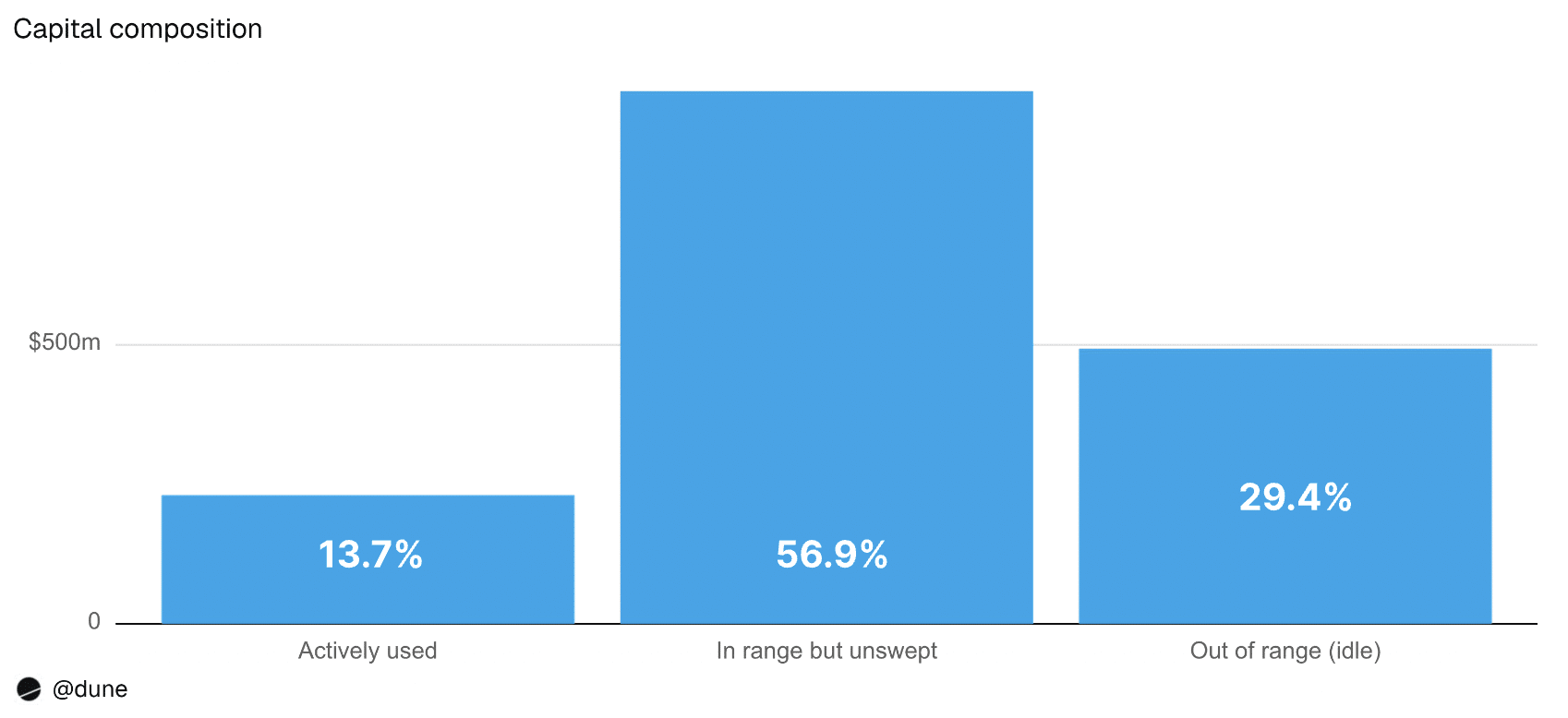
- Q2 2026: As market volatility increased, the discrepancy between "total liquidity" and "active liquidity" widened. The study observed that nearly 30% of total liquidity was consistently outside the active trading range, rendering it completely inert.
- Mid-2026 Analysis: The final synthesis of data confirmed that approximately $542 million in capital was sitting idle on a weekly basis, representing a staggering $150 million in lost annual fee revenue for providers across the four surveyed protocols.
Supporting Data: The Magnitude of Underutilization
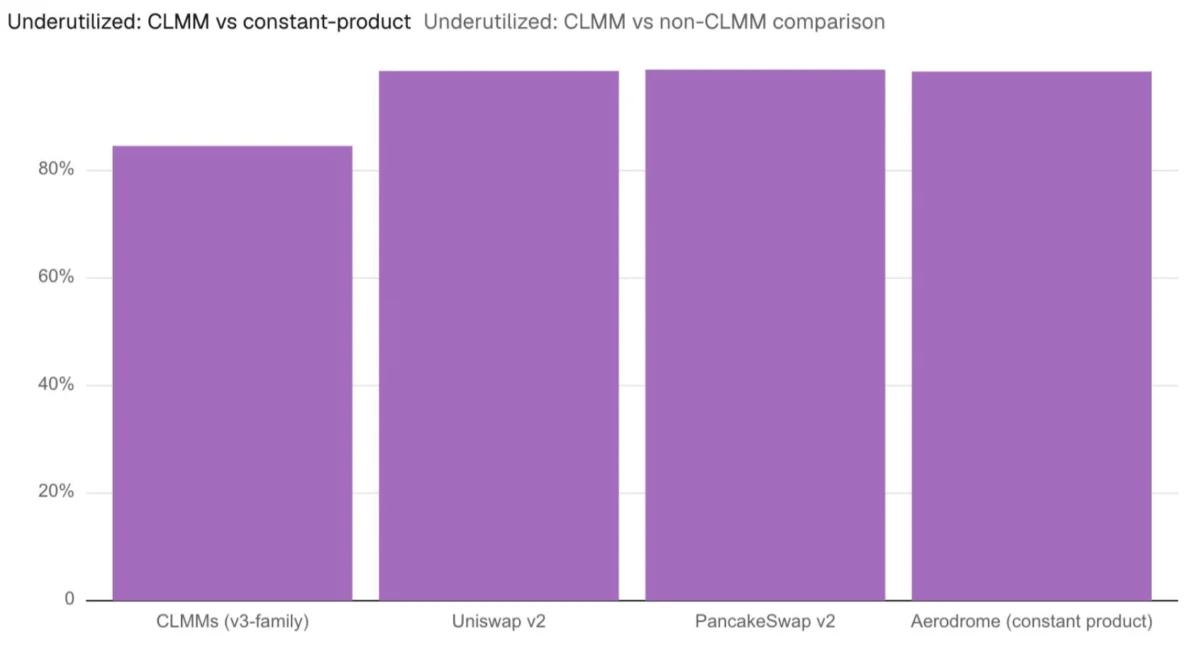
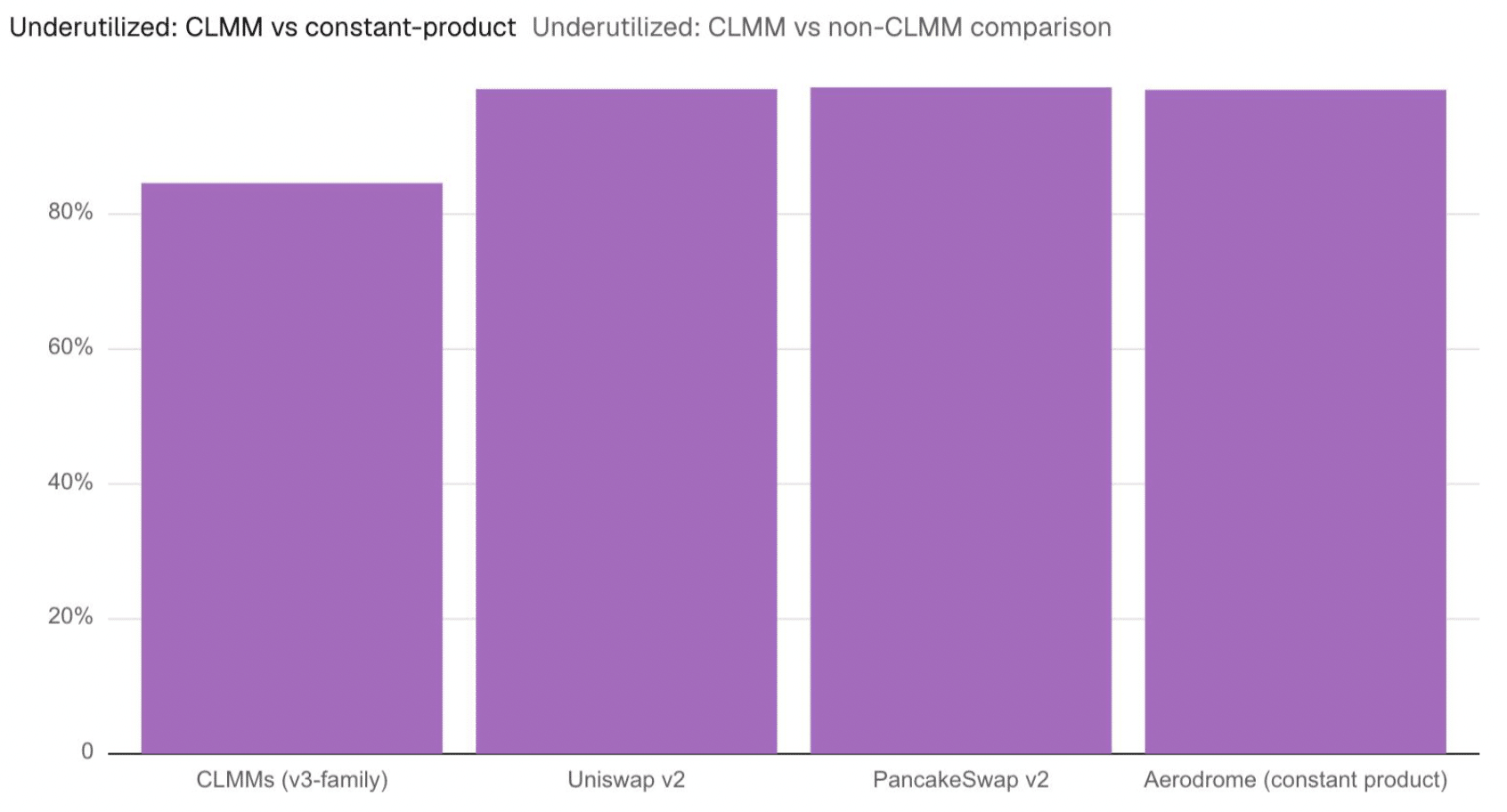
The numbers provided by Dune are nothing short of sobering for the DeFi ecosystem. When considering the liquidity that is technically available but functionally unusable, the report estimates that a massive 85% of capital is underutilized.
This is not merely a matter of a few misplaced positions. The report highlights that over $200 million in idle liquidity has remained untouched for more than 90 days. In the high-stakes, rapid-fire environment of crypto trading, a 90-day period of inactivity is an eternity. This suggests that a significant cohort of LPs—likely individual retail investors—are either unaware of the need for active management or lack the technical tools to keep their positions aligned with volatile market prices.
Regional and Protocol-Specific Disparities
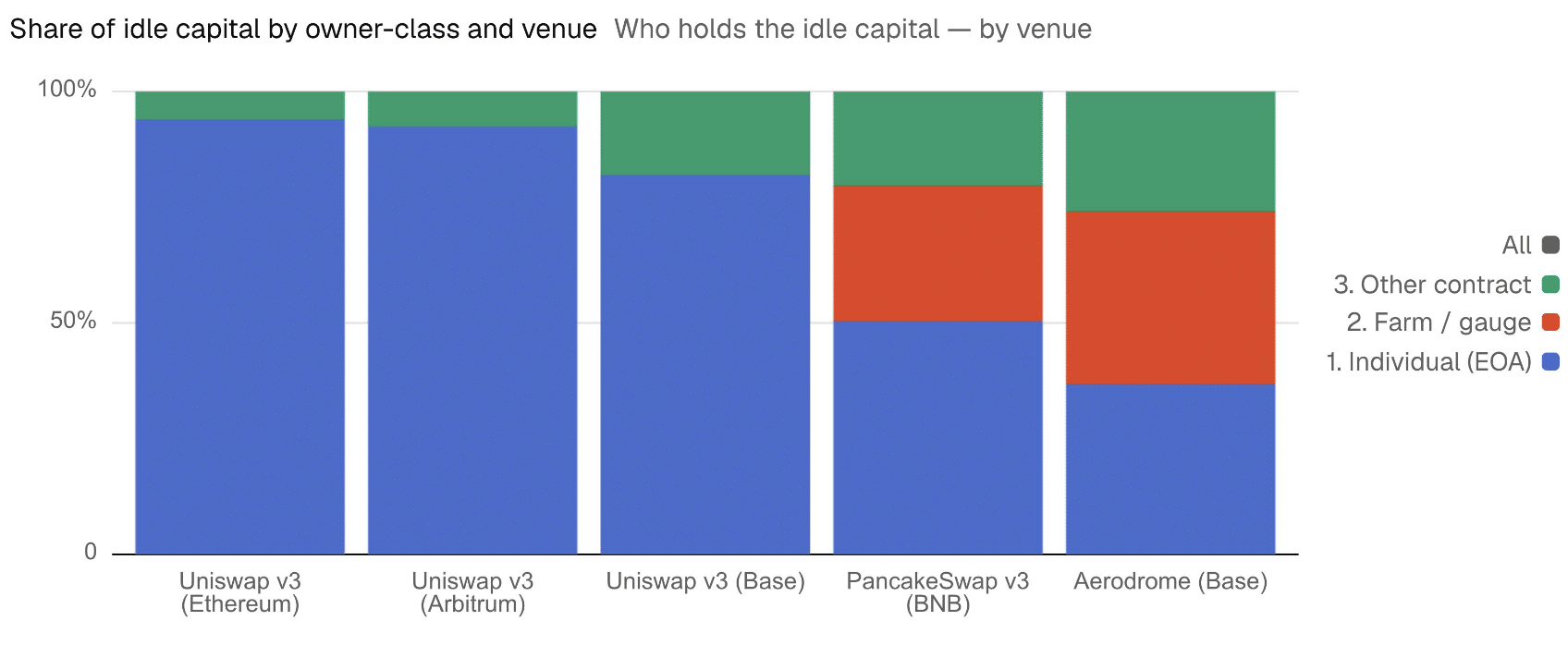
The burden of this inefficiency is not shared equally. The study breaks down the distribution of idle capital across different blockchain networks, revealing that individual users—as opposed to sophisticated smart-contract-based managers—bear the brunt of these losses.
- Ethereum: The network, often considered the heart of DeFi, saw 94% of its idle capital and 91% of its Uniswap v3 liquidity held in individual wallets rather than automated, professional management systems.
- Arbitrum: On this Layer 2 scaling solution, 92% of idle liquidity was managed by individuals, who also controlled 78% of the total liquidity pool.
- Base: A unique case where smart contracts hold approximately 50% of the total liquidity. However, individual users still oversaw 82% of the idle capital, highlighting a massive gap in professional versus retail management efficiency.
In stark contrast, automated liquidity managers—algorithms designed to rebalance positions in real-time—showed significantly higher efficiency. Only 6.5% of their positions were found to be out of range, compared to the ~30% failure rate observed in individual, manual-managed wallets.
The Uniswap v4 Dilemma: Unmet Expectations
One of the most anticipated upgrades in the DeFi space was the introduction of Uniswap v4. Designed to be more modular and flexible, many expected v4 to finally solve the "idle liquidity" problem through the introduction of "hooks"—custom code that could theoretically put idle capital to work in external yield strategies.
Yet, the Dune report offers a sobering assessment: the problem persists. Despite the technological advancements of v4, approximately 30.5% of its liquidity remains out of range—a figure strikingly similar to its predecessor, v3. Furthermore, the report notes that only 10% of v4’s Total Value Locked (TVL) is currently utilizing hooks, and more importantly, none of those hooks are currently generating yield from the idle capital that sits outside the active range. The "v4 promise" remains, for the moment, largely unfulfilled.
Implications for the Future of DeFi
The implications of these findings are profound for the future of decentralized finance.
1. The Death of "Set and Forget"
The primary takeaway is that concentrated liquidity is not a "set and forget" product. For individual investors, the complexity required to maintain a profitable position is arguably higher than in traditional finance. The "passive income" narrative of liquidity provision is being challenged by the reality of active, algorithmic competition.
2. The Rise of Institutional Dominance
As the market matures, the efficiency gap between retail LPs and automated managers will likely force a consolidation. If individual investors cannot keep pace with the market, they will likely move their capital into managed vaults or automated strategies, further centralizing the management of liquidity. This shift may be beneficial for overall market efficiency but could alienate the retail base that DeFi was originally built to empower.
3. A Call for Protocol-Level Solutions
If the community wants to prevent the erosion of capital, the burden of proof is now on the protocol developers. Simply providing the tools for concentration is insufficient. Future iterations of AMMs must consider native, "set-and-forget" features that allow liquidity to move automatically without requiring the end-user to have advanced technical skills or high-frequency trading capabilities.
4. Economic Drag on the Ecosystem
The $150 million in lost annual fee income is not just a loss for LPs; it is a loss for the entire ecosystem. That capital, if properly managed, could have provided deeper liquidity, lower slippage, and a more robust trading environment for all participants. By allowing this capital to remain idle, the current architecture is effectively taxing the users of these exchanges through higher slippage and less optimal pricing.
Conclusion: Bridging the Efficiency Gap
The Dune report serves as a critical wake-up call for the DeFi sector. While the industry has made monumental strides in creating complex financial instruments, it has yet to overcome the friction of human management. Concentrated liquidity, while theoretically superior, has created a "management cliff" that the average investor is currently ill-equipped to climb.
As we move into the latter half of 2026, the focus must shift from purely technological innovation to "usability-centric" design. If the industry cannot bridge the gap between the sophisticated tools available and the reality of how capital is actually managed, it risks alienating the very liquidity providers who keep the ecosystem afloat. The future of decentralized exchanges will not be defined by how much liquidity they attract, but by how much of that capital they can effectively put to work. For now, the "liquidity paradox" remains a multi-million dollar challenge waiting for a solution.
