


Is the ghost of the Q1-Q2 market collapse returning to haunt the decentralized finance (DeFi) sector? As capital began to flow back into protocols and Total Value Locked (TVL) started to show signs of a robust July recovery, a fresh wave of security breaches has sent shockwaves through the ecosystem. With over $35 million drained in a single day of coordinated attacks, the industry is once again grappling with the inherent fragility of cross-chain infrastructure and the persistent threat of "DeFi FUD" (Fear, Uncertainty, and Doubt).
The Anatomy of the Latest Exploits: A Vulnerable Infrastructure
The recent wave of hacks, while smaller in absolute dollar value compared to the catastrophic losses seen earlier this year, has hit a nerve within the crypto community. On a single day, three distinct protocols fell victim to attackers, all utilizing a common and historically notorious attack vector: cross-chain bridges.
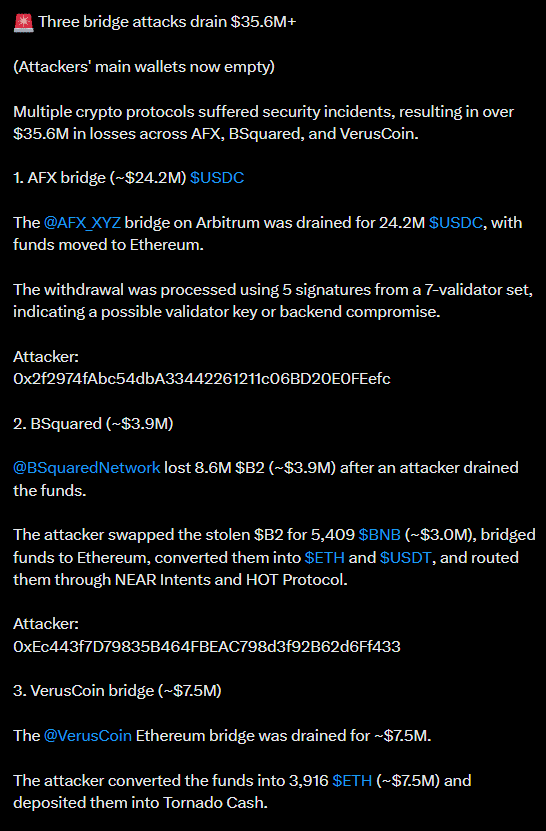
The Breakdown of Losses
The scale of the damage across the three protocols underscores a systemic weakness in how assets are transferred between disparate blockchain networks:
- AFX Protocol: The largest casualty of the spree, AFX saw a devastating drain of $24.2 million in USDC. Attackers successfully compromised the protocol’s Arbitrum bridge, facilitating the illicit transfer of funds to the Ethereum mainnet.
- VerusCoin: This protocol suffered an exploit amounting to approximately $7.5 million. Once again, the breach was localized within the bridge infrastructure, highlighting that even established projects are not immune to the complexity of multi-chain interoperability.
- BSquared Network: Rounding out the grim trio, BSquared Network lost roughly $3.9 million after an attacker successfully drained 8.6 million B2 tokens.
Collectively, these incidents have resulted in $35.55 million in stolen assets. While this figure is substantially lower than the $600 million wiped out during the peak of the Q1-Q2 security crisis, the psychological impact on investors remains significant. For many, these events serve as a grim reminder of the "bridge problem"—a persistent architectural challenge where the complexity of verifying transactions across different consensus mechanisms creates lucrative loopholes for malicious actors.
The Drift Protocol Complication: Ghost from the Past
The timing of these bridge exploits could not be more unfortunate. Just as the market was attempting to process the news of these recent thefts, on-chain activity indicated that the hacker behind the massive Drift Protocol exploit—which siphoned $285 million earlier this year—has resumed moving stolen funds.

According to data from Onchain Lens, the perpetrator of the Drift hack has begun funneling ETH through the Tornado Cash router. The method of movement is methodical and evasive: the hacker is executing multiple transactions every minute, each involving 100 ETH batches.
While the movement of these funds does not necessarily imply an immediate market sell-off, it serves as a "black swan" reminder of the vulnerability of major protocols. The resurgence of the Drift funds in the public eye acts as a force multiplier for market anxiety, compounding the fear generated by the new bridge exploits. Investors are now forced to consider two fronts: the risk of new, ongoing hacks and the liquidation pressure from past, unresolved crimes.
Chronology of the 2026 DeFi Crisis
To understand the severity of the current situation, one must look at the timeline of the broader DeFi narrative in 2026:
- Q1-Q2 2026 (The Great Deleveraging): A series of high-profile hacks, headlined by the $285 million Drift Protocol heist, triggered a massive liquidity exodus. DeFi TVL plummeted from its highs to roughly $65 billion. Ethereum alone witnessed a $10 billion outflow within 48 hours as panic selling ensued.
- July 2026 (The Hopeful Recovery): DeFi appeared to be turning a corner. July saw a $10 billion increase in TVL, marking the strongest monthly growth since the start of the year. Sentiment began to shift from "risk-off" to "cautiously optimistic."
- Late July 2026 (The Bridge Breach): The sudden exploitation of AFX, VerusCoin, and BSquared Network halted the momentum.
- Present Day: The market is currently in a state of hyper-vigilance. With the Drift hacker moving funds and bridge security under extreme scrutiny, the ecosystem is waiting to see if this is an isolated incident or the start of a broader, systemic contagion.
Supporting Data: The Bridge Security Paradox
The centralization and complexity inherent in cross-chain bridges remain the "Achilles’ heel" of the DeFi sector. Bridges operate by locking assets on one chain and minting "wrapped" versions on another. This creates a massive honeypot of liquidity that requires absolute smart-contract perfection to remain secure.
Data from DeFiLlama suggests that whenever bridge exploits occur in clusters, the immediate market reaction is a contraction in TVL. Investors tend to withdraw liquidity from peripheral, high-yield protocols in favor of more stable, "blue-chip" assets. This migration of capital often leads to a decline in protocol activity, reduced trading volumes, and, ultimately, a decrease in the overall health of the DeFi ecosystem.
Industry Implications and Official Responses
As of this writing, the affected protocols are in the process of incident response.
- AFX and VerusCoin have issued statements urging users to refrain from interacting with the compromised bridge contracts.
- Security Auditors: Leading firms in the space are calling for a "security-first" reset. The consensus among analysts is that the current model of rapid, experimental bridge development is unsustainable.
- Regulatory Pressure: With $35 million drained in hours, market observers anticipate renewed interest from regulatory bodies regarding the oversight of cross-chain protocols. Critics argue that without standardized security audits and institutional-grade insurance, DeFi protocols will continue to be targets for sophisticated state-sponsored and independent hacking syndicates.
Looking Ahead: Is a Full-Scale Selloff Imminent?
The critical question for the coming weeks is whether the current FUD will translate into a broader market downturn.
If the current trend of bridge exploits continues, the market will likely see a renewed flight to quality. We may observe:
- Increased Audit Scrutiny: Protocols will be under immense pressure to undergo multiple, third-party security audits before launching new features or cross-chain capabilities.
- Liquidity Fragmentation: If users lose trust in bridges, they may return to siloed ecosystems, which would hinder the vision of a truly interoperable, multi-chain Web3.
- Insurance Innovation: The demand for on-chain insurance products will likely spike, as developers seek to provide peace of mind to users in a volatile environment.
In conclusion, the events of the past 48 hours have served as a harsh wake-up call for the DeFi sector. While the industry has shown resilience in the past, the recurring nature of these bridge exploits suggests that until security catches up to innovation, the market will remain susceptible to these periodic waves of panic. For now, all eyes remain on the movement of the Drift funds and the defensive measures taken by the current victims of this latest security crisis. Investors are advised to maintain caution and prioritize protocols with battle-tested security frameworks during these periods of heightened uncertainty.
