


In the evolving landscape of digital finance, a new category of financial instrument is beginning to capture the attention of institutional heavyweights and retail innovators alike: the "on-chain vault." Often described as the next frontier for decentralized finance (DeFi), these automated yield-generating structures are increasingly viewed as the logical successor to the legacy systems that have governed global asset management for decades.
According to Zach Pandl, Head of Research at Grayscale, on-chain vaults represent a paradigm shift in how credit is managed, tracked, and monetized. By replacing traditional, opaque intermediaries with transparent smart contracts and digital "curators," these vaults are poised to bridge the gap between niche crypto experiments and the multi-trillion-dollar traditional finance (TradFi) sector.
The Evolution of On-Chain Asset Management
The concept of a "vault" in the crypto space is essentially a programmable liquidity pool. Investors deposit assets—be it stablecoins, wrapped tokens, or real-world assets (RWAs)—into a smart contract. These funds are then deployed into various yield-generating strategies, such as lending, market making, or delta-neutral hedging, governed by predefined code rather than human fund managers.
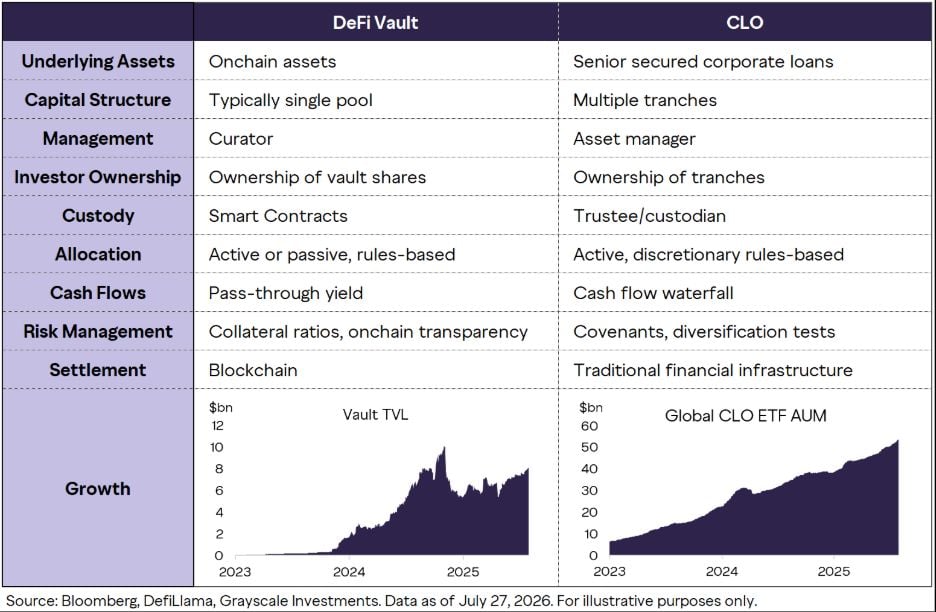
Grayscale’s analysis draws a direct parallel between these vaults and Collateralized Loan Obligations (CLOs). In the traditional world, a CLO is a security backed by a pool of loans, typically corporate debt. These assets are sliced into different tranches based on risk and return, managed by large financial institutions that act as custodians and arbiters.
In the on-chain vault model, the "middleman" is dismantled. Instead of a bank or a legacy asset manager, investors rely on specialized curators—entities like Steakhouse, Gauntlet, and Sentora. These curators utilize sophisticated algorithms to optimize the yield of the underlying assets, providing a level of transparency and auditability that is virtually impossible in the fragmented, manual world of traditional banking.
Chronology: From Niche Experiment to Institutional Interest
The path to the current state of on-chain vaults did not happen overnight. It is the result of years of maturation within the DeFi ecosystem:
- The DeFi Summer (2020): The initial "yield farming" craze introduced the concept of liquidity pools to the masses. While rudimentary, it laid the groundwork for automated yield strategies.
- The Rise of Stablecoins (2021-2022): As stablecoins became the backbone of crypto-liquidity, the demand for yield on these dollar-pegged assets grew exponentially, forcing the industry to build more robust infrastructure.
- The Bear Market Pivot (2023): With crypto-native yields crashing alongside token prices, protocols like Ethena and others began looking for "Real World Asset" (RWA) diversification, integrating treasury bills and eventually CLOs to ensure yield stability.
- Institutional Discovery (2024-2025): Major research firms, including Grayscale and S&P Global, began formalizing the analysis of vault structures, recognizing them as a legitimate financial product rather than just speculative tech.
- The Regulatory Spotlight (Mid-2026): The U.S. Securities and Exchange Commission (SEC) moved to clarify the status of these products, signaling that the era of "wild west" experimentation is giving way to institutional-grade compliance.
Supporting Data: A Market in Its Infancy
The current metrics surrounding the vault market reveal both its scale and its massive untapped potential. As of the latest industry data, the total value locked (TVL) in the vault market sits at approximately $7.3 billion.

While $7.3 billion is a significant milestone, it is a drop in the ocean compared to the $1.5 trillion global CLO market. The dominance of current curators is notable: the top three players—Steakhouse, Sentora, and Gauntlet—control over 70% of the market share. This concentration suggests that the sector is currently in a "consolidation phase," where early movers are establishing trust and brand equity before a broader wave of competition enters the space.
With over 57 active curators managing more than 3,000 distinct vaults, the ecosystem is already highly specialized. Investors can now choose vaults tailored to specific risk appetites, ranging from low-yield, low-risk lending to highly complex, aggressive yield strategies.
The S&P Global Perspective: The Path to Dominance
S&P Global, in a recent report on digital asset infrastructure, echoed the optimism of Grayscale but added a layer of caution. Their analysis suggests that the "killer app" for vaults will be the tokenization of real-world assets.
"We expect real-world asset applications of vaults to expand and ultimately become their dominant use case," S&P Global noted. The rationale is simple: traditional financial institutions are desperate for yield in a high-interest-rate environment, and blockchain technology offers a more efficient settlement layer for debt products. By tokenizing assets like corporate loans or real estate, vaults can bring traditional yield opportunities on-chain, accessible to anyone with a digital wallet.
Official Responses and Regulatory Challenges
The most significant hurdle to the mainstream adoption of on-chain vaults remains the regulatory "gray zone." In July 2026, the SEC issued guidance that sent ripples through the DeFi community. The agency stated that most vault products would likely fall under federal securities law.
However, the SEC stopped short of a "blanket ban," opting instead for a case-by-case review. This is a critical distinction. It suggests that if curators and protocol developers design their vaults with compliance in mind—implementing KYC (Know Your Customer) protocols, transparent disclosures, and investor accreditation—they could potentially operate within the U.S. regulatory framework.
Many institutional investors have been sitting on the sidelines, waiting for this clarity. As S&P Global noted: "It’s unclear, for example, whether vault tokens are subject to U.S. federal securities laws. Many institutional investors are avoiding direct investment in vault tokens as they can’t be certain which regulatory regime they fall under."
The SEC’s pivot toward case-by-case review is a tacit acknowledgement that these products have utility that cannot be ignored. By creating a pathway to compliance, the regulator is essentially inviting these innovators to come "inside the tent."
Implications: The Future of Capital Markets
If on-chain vaults successfully bridge the regulatory gap, the implications for global capital markets are profound:
- Increased Efficiency: By removing the heavy administrative overhead of traditional CLOs, vault curators can lower fees and increase the share of interest passed on to investors.
- Global Accessibility: Traditional CLOs are restricted to sophisticated, high-net-worth institutional investors. On-chain vaults, through the democratization of DeFi, could eventually allow a broader range of global investors to participate in previously gated markets.
- Real-Time Transparency: Unlike traditional finance, where audits happen quarterly or annually, on-chain vaults provide real-time visibility into the underlying assets and risk exposure. This level of transparency could act as a significant buffer against the types of systemic shocks that characterized the 2008 financial crisis.
- Programmable Compliance: The future of vaults may include "embedded compliance," where regulatory requirements—such as tax reporting or anti-money laundering checks—are written directly into the smart contract, automating the most cumbersome aspects of asset management.
Conclusion
The transition of on-chain vaults from niche crypto tools to institutional financial instruments is not a matter of "if," but "when." The infrastructure is being built, the curators are gaining experience, and the regulatory environment is slowly crystallizing.
For the traditional finance industry, the rise of vaults presents a dual challenge: adapt to the efficiency of on-chain management or risk being sidelined by more agile, technologically superior alternatives. As the gap between DeFi and TradFi continues to shrink, the $1.5 trillion CLO market serves as the ultimate benchmark. Whether vaults can reach that scale depends on the industry’s ability to maintain the balance between radical transparency and the rigorous compliance standards that institutional capital demands.
The next decade of finance will likely be defined by this integration. As Zach Pandl and his contemporaries suggest, we are witnessing the early stages of a fundamental rewrite of the financial plumbing that connects the world’s capital.
