

Uniswap, the decentralized exchange (DEX) titan that has long served as the bedrock of the DeFi ecosystem, has initiated a pivotal shift in its operational model. The protocol has officially submitted three comprehensive governance proposals aimed at activating protocol fees across multiple blockchain networks and various iterations of its exchange architecture. This move marks a significant evolution in how Uniswap balances the interests of liquidity providers (LPs), the longevity of the protocol, and the deflationary mechanics of its native governance token, UNI.
As the DeFi sector continues to face heightened competition from automated market makers (AMMs), request-for-quote (RFQ) systems, and burgeoning order-book-based decentralized exchanges, Uniswap’s decision to monetize its protocol infrastructure is as much a defensive maneuver as it is a long-term sustainability strategy.
The Core Proposals: Expanding the Fee Horizon
The proposed fee activation is not a blanket change but a strategic rollout across specific chains and versions of the DEX. The primary focus of the first proposal is the activation of fees on Uniswap V2 and V3, specifically on the recently launched Robinhood chain.
The Robinhood chain has proven to be a fertile ground for Uniswap. Since its debut earlier this month, the L2 solution has seen rapid adoption, with Uniswap crossing the $1 billion threshold in trading volume in a mere 10 days. This immediate traction underscores the importance of the L2 narrative in modern crypto-trading, prompting Uniswap to prioritize this ecosystem for its inaugural fee implementation.
Furthermore, a secondary, broader proposal seeks to activate protocol fees on Uniswap V4 across a comprehensive suite of networks, including Ethereum, Base, Arbitrum, the Robinhood chain, BNB Chain, Polygon, and Optimism. Hayden Adams, the CEO of Uniswap, has indicated that a third proposal targeting the remaining V4-compatible chains is currently in the works, signaling a unified, cross-chain approach to revenue generation.
The financial logic behind these proposals is rooted in the UNI burn mechanism. Adams emphasized that both proposals are designed to funnel new protocol fees directly into the established UNI burn treasury. Given the current velocity of trading volume—particularly on the Robinhood chain—the protocol anticipates that the impact on the total supply of UNI could be substantial, effectively transforming the exchange’s revenue into a deflationary engine for its token holders.
A Chronology of the Fee Debate
The debate surrounding protocol fees is not new to the Uniswap ecosystem; it has been a recurring theme in governance forums for years. To understand the current climate, one must look at the evolution of these discussions:
- The Early Years (2018–2021): During its foundational years, Uniswap operated as a pure utility protocol, with virtually all swap fees distributed to liquidity providers to incentivize deep liquidity. The focus was entirely on growth and user acquisition.
- The Governance Shift (2022–2023): As the protocol matured, community members began to question the sustainability of a model where the core infrastructure generated minimal direct revenue compared to its massive trading volume. Several "fee switch" proposals were introduced to test the community’s appetite for protocol-level taxation.
- The V4 Era (2024–Present): With the rollout of V4, which introduced "hooks" and a more modular architecture, the conversation shifted toward how fees could be integrated into the protocol’s core logic without alienating LPs or pushing users toward competitors.
- The July 2026 Milestone: The latest proposal represents the most aggressive push toward revenue capture in the history of the protocol, timed strategically with the surge in volume from the Robinhood L2 integration.
Supporting Data: The Disparity Between Revenue and Liquidity
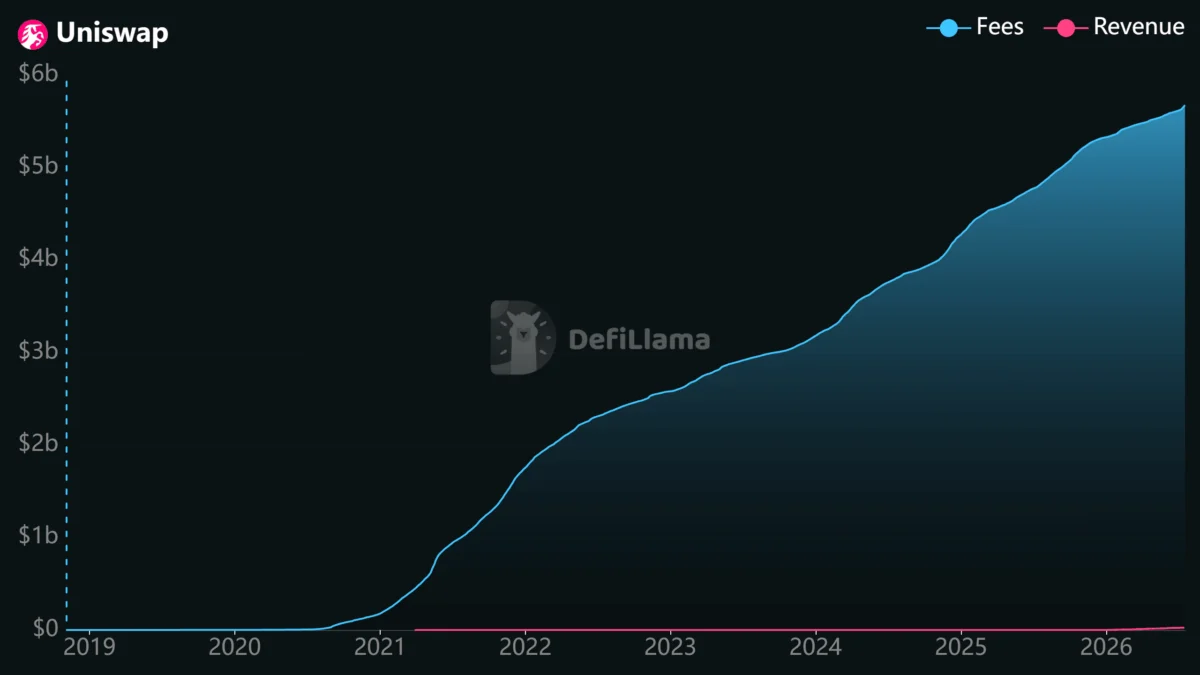
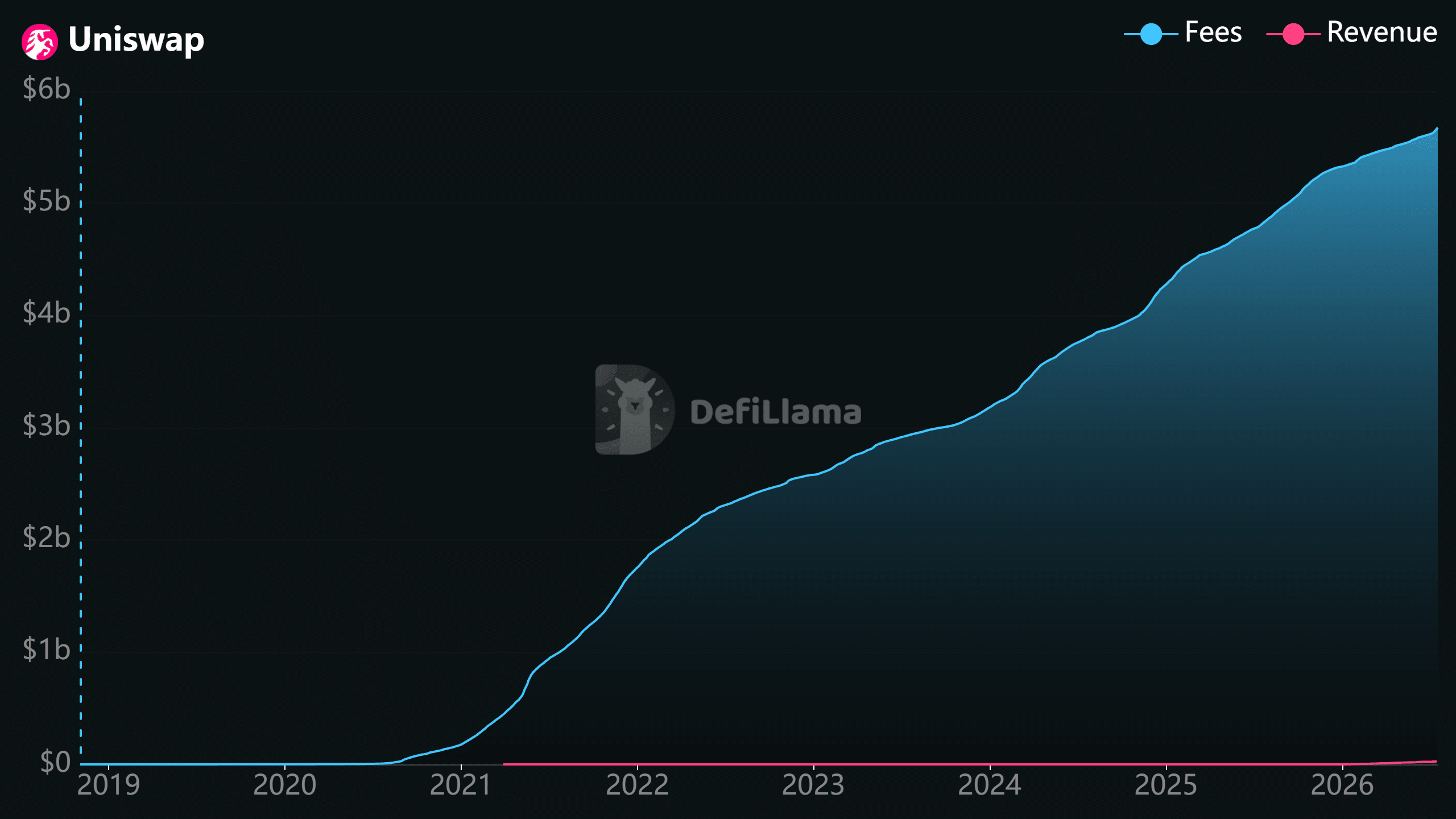
To grasp the magnitude of the current shift, one must look at the historical data. Since its inception in 2018, Uniswap has been an incredibly efficient machine for its users. Liquidity providers have collectively earned over $5 billion in swap fees, a testament to the immense value the platform provides to the DeFi ecosystem.
However, the contrast between these earnings and the revenue generated for the Uniswap protocol itself is stark. The protocol has only accrued approximately $25 million in cumulative revenue during that same period. This discrepancy—where the infrastructure provider captures less than 0.5% of the total fees generated—has led analysts and governance participants to argue that the protocol is "under-earning" relative to its market dominance.
The recent spike in the UNI burn rate provides a glimpse into what a more aggressive fee model could achieve. In the past week alone, the burn rate surged threefold, rising from $51,000 to over $160,000. With a cumulative total of 107.49 million UNI tokens already removed from circulation, the community is watching closely to see if this trend accelerates once the new fee structures are implemented across all proposed chains.
Stakeholder Perspectives: The Clash of Interests
The proposals have not been met with universal acclaim. The fundamental friction lies between two distinct groups: those who want to see the UNI token capture more value through buybacks/burns, and the liquidity providers who rely on swap fees as their primary source of yield.
The Case for the Fee Switch
Proponents argue that by capturing a fraction of the swap fees, Uniswap can secure the long-term financial independence of the DAO. They contend that a stronger treasury allows for better development, marketing, and competitive positioning against centralized exchanges. For them, a successful fee switch is a validation of the tokenomics that underpin the governance of the world’s largest DEX.
The Opposition: The Liquidity Provider’s Dilemma
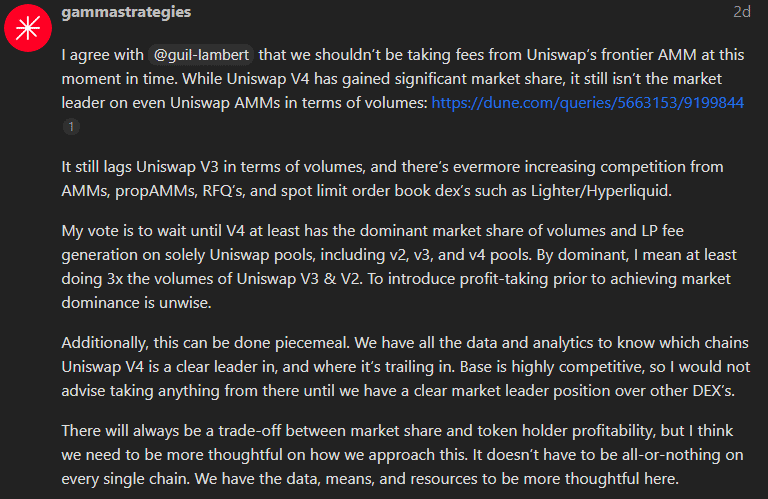
Critics, such as Gamma Strategies, have raised valid concerns regarding the competitiveness of the platform. Their argument is centered on the reality of the current market: Uniswap V4 is still in the process of building liquidity and volume, and any increase in costs for the end-user—or any decrease in yield for LPs—could lead to a migration of capital toward rivals.
Gamma Strategies specifically noted that the landscape has become increasingly crowded. With the rise of specialized AMMs, high-frequency prop-AMMs, and the growing efficiency of Request-for-Quote (RFQ) systems and limit order book DEXs like Lighter or Hyperliquid, Uniswap is no longer the only option for sophisticated traders. They argue that if Uniswap increases costs, it may inadvertently accelerate the loss of market share to these emerging alternatives.
Market Implications and the Price of UNI
The market’s reaction to the news has been complex. The announcement of the Robinhood L2 integration, combined with the prospect of increased UNI burn, fueled a significant rally in July. The price of UNI jumped 41%, moving from $2.70 to a peak of $3.80. This move was largely front-run by institutional and retail traders anticipating a more deflationary future for the token.
However, the bullish momentum has recently faced resistance. The price has stalled beneath the 200-day Moving Average, a key technical indicator that often separates bearish trends from bullish ones. Currently, the asset remains in a state of consolidation, with potential support levels sitting at $3.50. Should the momentum from the Robinhood integration stabilize or if the governance proposals encounter significant hurdles, analysts suggest the price could see a retracement toward the $3.00 level.
The technical outlook remains tied to the fundamental news cycle. If the governance proposals are passed and successfully implemented, the resulting increase in burn rates could provide the catalyst needed to push UNI past its current resistance. Conversely, if the community decides that the proposed fees are too high, or if the competition succeeds in luring away liquidity, the token may struggle to maintain its July gains.
Conclusion: A Delicate Balance
Uniswap finds itself at a defining moment. The transition from a "growth-at-all-costs" protocol to a mature, revenue-generating entity is a natural progression for a project of its size. However, the path is fraught with challenges. By attempting to balance the needs of liquidity providers—who are the lifeblood of any DEX—with the desire of token holders to see a more robust and deflationary UNI, the Uniswap DAO is essentially conducting a high-stakes economic experiment.
If successful, this strategy could set a new standard for how decentralized protocols manage their internal economies. If it fails, it could serve as a cautionary tale about the perils of premature monetization in an environment where competition is only a click away. As the governance process unfolds over the coming weeks, all eyes will be on the voting tallies and the subsequent impact on the protocol’s total value locked (TVL) and trading volume. For now, the crypto community awaits a decision that will likely reshape the future of the largest decentralized exchange in existence.
