

The decentralized finance (DeFi) landscape is undergoing a significant transition as the team behind Odos, a prominent liquidity aggregator, officially announced the permanent cessation of its operations. This development marks the end of a chapter for a protocol that had positioned itself as a critical infrastructure piece for traders seeking optimal execution across decentralized exchanges. As the operating entity prepares to exit the market, users, investors, and stakeholders are left to navigate a tightly compressed timeline to secure their assets and reconcile with the implications of a decentralized project losing its central development support.
The Chronology of the Wind-Down
The transition period for Odos is defined by a rapid, phased shutdown, leaving little room for error for those still interacting with the protocol. According to the official announcement, the roadmap to decommissioning is as follows:
- Immediate Effect: The company has already ceased several core functions. New account registrations, the creation of new wallets, and the submission of new limit orders have been strictly disabled. This effectively freezes the onboarding of any new liquidity or users into the platform’s ecosystem.
- July 27, 2026: The application is scheduled to enter "Read-Only" mode. During this phase, users will retain the ability to view their transaction history and current balances, but all interactive functionality will be permanently stripped.
- July 30, 2026: This serves as the "hard stop." All services operated by the Odos team will be permanently shuttered. The company has made it clear that after this date, there will be no further development, technical support, or maintenance provided for the interface.
This timeline serves as a critical warning for users who have utilized social or email-based logins to create wallets via the Odos interface. The team has explicitly urged these users to transfer their assets to self-custodial wallets or export their private keys well before the July 30 deadline. While the team has promised that wallet access instructions will remain hosted on the official support page post-shutdown, the underlying infrastructure that facilitates these logins will no longer be under the active oversight of the original developers.
The Structural Anatomy of a Decentralized Exit
A central point of contention and clarification in the wake of this news is the distinction between the "operating company" and the "protocol." The team has gone to great lengths to emphasize that Odos is, at its core, a non-custodial platform. In the language of DeFi, this means that the smart contracts and the assets held within them remain on-chain, independent of the front-end interface provided by the company.
The Role of the ODOS Token and DAO
Crucially, the shutdown of the company does not imply the "death" of the protocol’s underlying assets or governance. The ODOS token will remain operational on the blockchain, and the Odos DAO (Decentralized Autonomous Organization) is positioned to continue its existence independently of the company’s corporate structure.
The team has effectively "divorced" the project from its creators. By maintaining this separation, the project is theoretically capable of being governed or steered by its community moving forward. However, the lack of a centralized development team poses significant questions regarding how the DAO will manage technical maintenance, security audits, and future updates—tasks that were previously handled by the now-departing company.
Market Reaction and Investor Sentiment
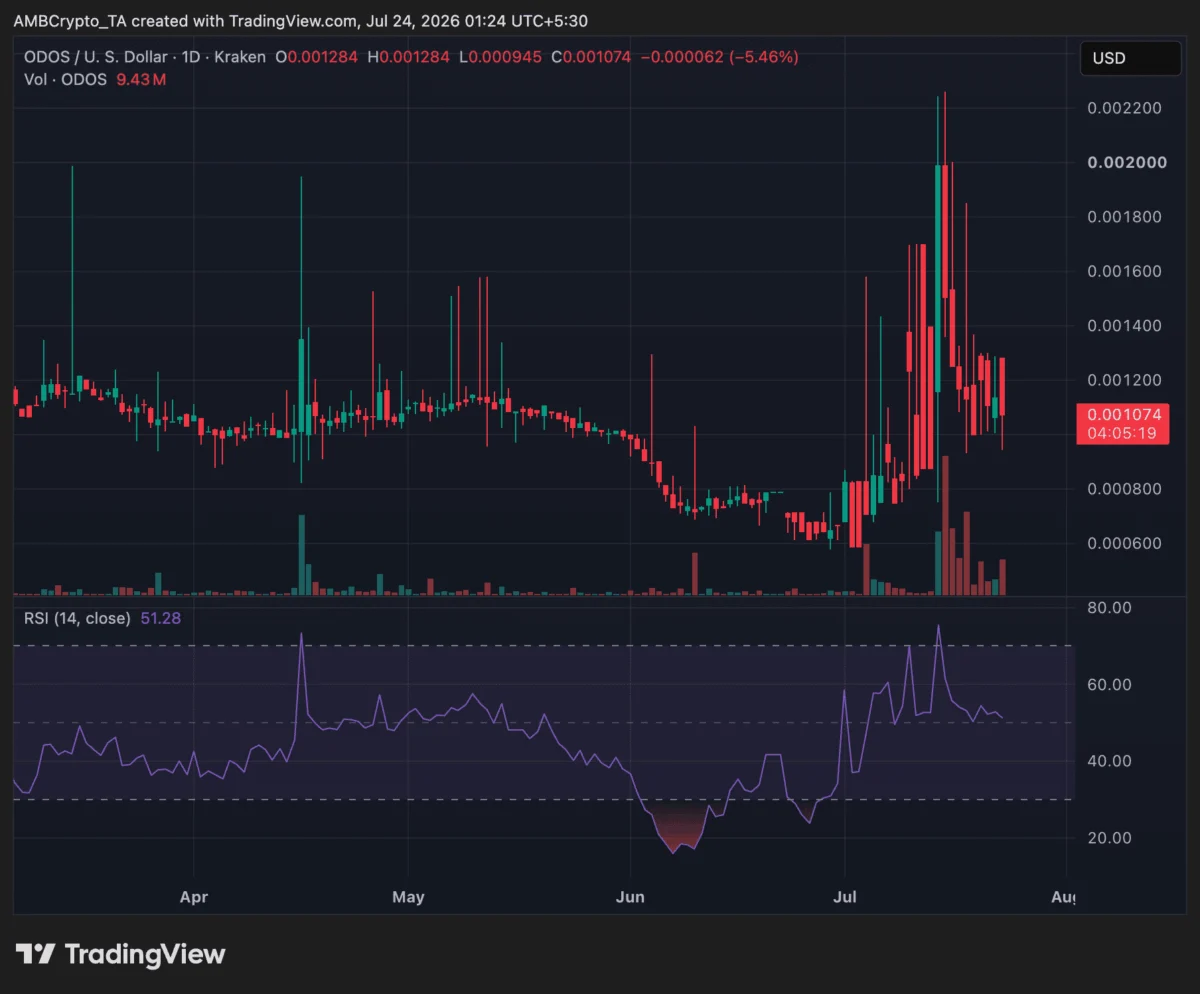
The news of the shutdown triggered an immediate, albeit measured, negative reaction in the financial markets. TradingView data captured the volatility as the ODOS token experienced a 5.5% decline in value within 24 hours of the announcement, trading at approximately $0.00107.
The price action was accompanied by a noticeable spike in trading volume, reflecting a market in flux. While the downward pressure was clear, technical indicators suggest a degree of market stabilization. The Relative Strength Index (RSI), a common metric used to determine if an asset is overbought or oversold, hovered near 51. This reading suggests that the market is currently in a state of neutral momentum, avoiding a panic-induced sell-off while simultaneously lacking the bullish sentiment required to absorb the news of the company’s exit.
The persistence of the token’s value indicates that the market is pricing in the continued existence of the DAO, rather than treating the project as a total loss. However, the long-term viability of the token remains inextricably linked to the DAO’s ability to define its new, post-company purpose.
Security Warnings and the Threat of Opportunism
Perhaps the most vital aspect of the team’s communication is the aggressive stance against potential bad actors. When a protocol closes, it often creates a vacuum of information that scammers are eager to fill. The Odos team has been explicit in its warnings to the community:
- No Migrations or Airdrops: The team has categorically denied any plans for token migrations, new product launches, or future airdrops. They have explicitly stated: "There will be NO new Odos products, token migrations, token claims, or airdrops from us."
- The "Scam" Alert: Any message, email, or social media post claiming that users must "migrate" their tokens to a new platform to avoid loss should be treated as a malicious attempt to steal funds.
- Seed Phrase Security: The golden rule of crypto remains the focal point: Never share seed phrases or private keys. The team has warned users that any website claiming to facilitate a "relaunch" or "migration" of Odos is likely a phishing site designed to drain wallets.
These warnings highlight the inherent risks of the DeFi space, where the absence of a central authority (or the departure of one) creates opportunities for bad actors to exploit user confusion.
Implications for the Future of DeFi Aggregators
The shutdown of Odos raises broader questions about the sustainability of the DeFi aggregator model. These platforms are designed to bridge disparate liquidity sources, providing the best possible prices for traders. However, the cost of maintaining such complex, cross-chain infrastructure is significant. If the revenue generated from transaction fees cannot sustain the development team, the project reaches a crossroads: pivot to a new model, decentralize entirely, or cease operations.
The decision by the Odos team to walk away, while leaving the DAO and the protocol’s underlying mechanics intact, is a testament to the "decentralized" ethos. Yet, it also underscores the reality that "decentralized" does not always mean "self-sustaining." A protocol that relies on a specific company to maintain its front-end, manage its servers, and provide user support is inherently fragile.
The Path Forward for the DAO
The Odos DAO now faces an existential challenge. Can it organize, fund, and execute a strategy to maintain the protocol without the original company’s resources? If the community fails to coalesce around a new direction, the protocol may drift into obsolescence, remaining as a static, on-chain entity that no longer sees meaningful use.
If, however, the DAO proves successful in securing funding or volunteer contributions to maintain the interface and security, it could serve as a model for how projects can survive the departure of their founders. This is a crucial test case for the resilience of community-governed protocols.
Final Summary of Key Takeaways
As the July 30 deadline approaches, the situation surrounding Odos serves as both a case study in corporate responsibility and a cautionary tale for DeFi participants:
- Direct Action Required: Users must act before July 27 to ensure their assets are moved, as the platform will move to a restricted, read-only state.
- Corporate vs. Protocol: The operating company is ceasing all activity, but the DAO and the token remain on-chain. The "product" is not being deleted, but it is being orphaned from its original creators.
- Vigilance is Mandatory: The period surrounding a high-profile shutdown is the most dangerous time for user security. The community must ignore any "official" announcements of migrations or airdrops, as these are unequivocally scams.
- Market Resilience: While the token price has dipped, the neutral RSI suggests that investors are waiting to see what the DAO does next. The future value of the project now rests entirely on community governance.
Ultimately, the Odos shutdown is a reminder that in the world of decentralized finance, users are their own custodians. While companies may come and go, the smart contracts live on—but so does the responsibility for the user to safeguard their own digital assets in the face of institutional change.
