


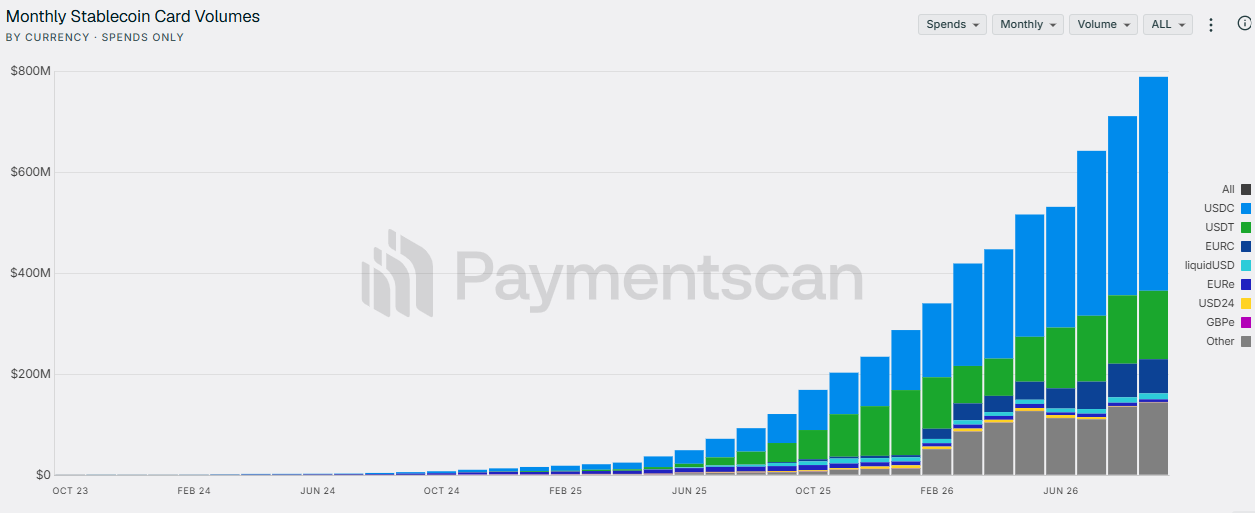
Global Financial Markets — The utility of digital currencies has officially crossed a major psychological and practical threshold. According to the latest data compiled through September, monthly spending via stablecoin-backed payment cards skyrocketed to an unprecedented all-time high of $788.9 million.
For the past two consecutive years, activity across stablecoin cards has traced an aggressive, unbroken upward trajectory, printing new volume records month after month. What was once viewed primarily as a speculative instrument or an internal trading vehicle within digital asset exchanges is rapidly transforming into everyday fiat-replacement money.
Main Facts
The latest payment metrics underscore an extraordinary paradigm shift in how consumers interact with blockchain-based assets. Since the beginning of 2025, aggregate stablecoin card volumes have surged by a staggering 49-fold, rocketing from a modest $16 million per month to nearly $789 million.
This acceleration highlights a profound change in user behavior. As leading venture capital firm a16z has frequently noted, crypto-linked payment cards have quickly matured into one of the most frictionless, practical conduits for spending digital dollars in the physical and digital retail economy.

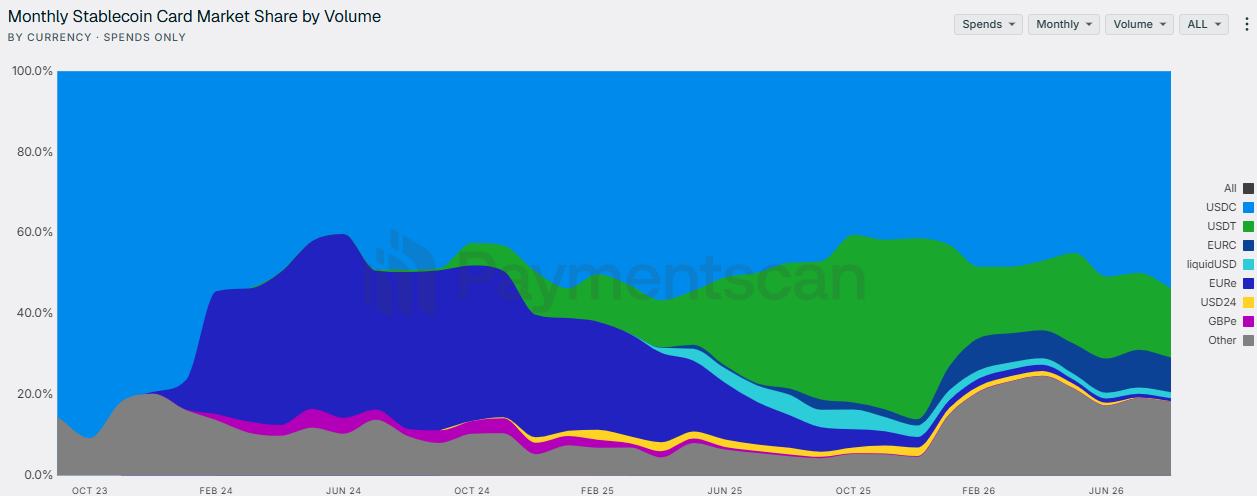
However, beneath the headline growth numbers lies a fascinating internal divergence within the stablecoin ecosystem. While Tether’s USDT continues to maintain an ironclad grip on total on-chain transfer volumes globally, Circle’s USDC has aggressively captured the lion’s share of the regulated consumer card market. In September alone, USDC-powered card volumes hit $423 million, tripling Tether’s $135 million and securing a commanding 57% market share of total stablecoin card expenditures.
Chronology
To understand how the stablecoin payment landscape reached this historic juncture, it is vital to trace the evolution of card adoption and regulatory shifts over the past 24 months:
- 2024–2025 (The Genesis Phase): Stablecoin card activity begins its unbroken monthly record-breaking streak. Volumes scale rapidly from marginal figures up to tens of millions, driven by neobanks integrating crypto-funding rails.
- Early 2025: Total monthly volume sits near $16 million. Major fintech application layers begin partnering with card-issuing infrastructure providers like Rain to streamline crypto-to-fiat conversions at point-of-sale terminals.
- January 2026: Tether (USDT), which saw its card market share climb from near-zero over the preceding two years to peak at roughly 49%, begins a noticeable downward correction in the card sector.
- Mid-2026: The transition window for Europe’s landmark Markets in Crypto-Assets (MiCA) regulatory framework officially concludes. Compliant platforms—such as prominent neobank Revolut—begin delisting non-compliant stablecoin offerings, heavily impacting regional card rails.
- September 2026: Monthly stablecoin card spending officially hits a watershed record of $788.9 million. USDC dominates consumer card rails with $423 million (57% share), while Visa data reveals USDT maintains overall global transfer dominance with $182 billion (84% share).
Supporting Data & Market Analysis
A deeper dive into the statistical breakdown reveals a deeply bifurcated global market—often described by analysts as "one dollar, two worlds."
The Card Spending Breakdown (Paymentscan Data)
- Total September 2026 Volume: $788.9 million
- USDC Card Volume: $423 million (57% market share)
- USDT Card Volume: $135 million (17% market share, down from a peak of 49% earlier in the year)
- Growth Velocity: A 49x increase since early 2025.
The steep decline in USDT’s card market share throughout 2026 coincides heavily with regulatory milestones in Europe. With the full implementation of the MiCA framework closing its transition window, European-facing platforms have been forced to prioritize regulatory compliance. Assets lacking transparent, localized backing structures have faced systematic delistings from consumer-facing fintech applications, directly impacting USDT’s viability as a card-funding asset in strictly regulated jurisdictions.
The Global Transfer Hegemony (Visa Data)
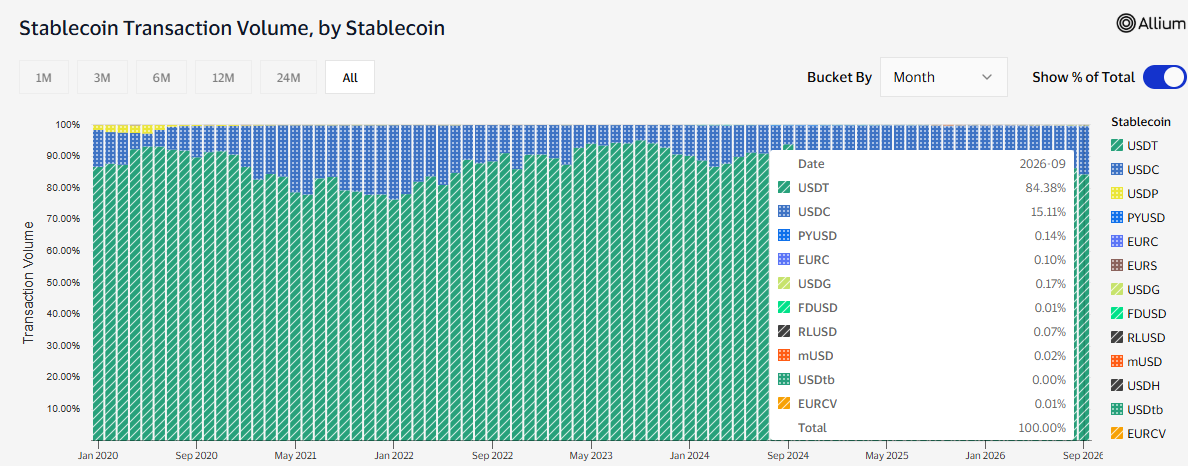
Conversely, looking beyond consumer plastic cards to raw on-chain transfer volumes paints an entirely different picture. Visa metrics for September show that USDT completely dominates global blockchain utility:
- Total USDT Transfer Volume: $182 billion (84% market dominance)
- Total USDC Transfer Volume: $32.6 billion (15% market dominance)
This stark contrast highlights distinct geographic and functional use cases. USDT remains the undisputed king of emerging markets, serving as an essential savings vehicle, an inflation hedge for citizens in hyperinflationary economies, and the preferred asset for cross-border B2B settlements. Meanwhile, USDC has successfully carved out an unshakeable moat within regulated Western fintech rails, consumer banking applications, and traditional payment networks.
Official Responses and Industry Reactions
The unprecedented acceleration of stablecoin card spending has drawn widespread commentary from traditional finance observers and crypto-native market participants alike.
Frank Chaparro, a senior executive at prominent digital asset market maker GSR, expressed astonishment at the transition of stablecoins from speculative tools to real-world currency. Reacting to the September metrics, Chaparro stated:
"Stablecoins are increasingly moving beyond trading and settlement into everyday payments. Wow."
Industry analysts point out that the integration of digital dollars into Visa and Mastercard rails via neobanks has removed the cognitive friction historically associated with crypto spending. Consumers no longer need to manually execute complex decentralized exchanges or navigate volatile native tokens; they simply swipe a card backed by a 1:1 USD-pegged digital asset, while backend infrastructure handles the instant fiat conversion.
Implications and Systemic Risks
While the milestone of $788.9 million in monthly card spending marks a monumental victory for mainstream crypto adoption, industry stakeholders are also sounding alarms regarding underlying structural vulnerabilities.
Infrastructure Concentration Risk
A critical vulnerability exposed by the recent data is the heavy concentration of backend infrastructure providers. As of September, a single entity—Rain—powerfully underpins the vast majority of stablecoin card issuance and settlement infrastructure across multiple neobanks.
This centralization introduces a severe single-point-of-failure or contagion risk to the entire sector. If Rain were to suffer a catastrophic software bug, severe exploit, or regulatory shutdown, a massive swath of neobanks and retail users relying on stablecoin cards could find their funds instantly frozen or inaccessible.
This theoretical concern manifested in reality during a recent security incident involving the Rain-powered Avici neobank, which suffered a $500,000 exploit. While Avici successfully moved to refund all impacted card balances in full after Rain patched the vulnerability, the episode served as an urgent wake-up call for the fintech community. As stablecoin card volumes scale toward billions of dollars, diversifying backend infrastructure and hardening smart contract and API security will be paramount to preventing systemic contagion.
Looking Ahead
The data from September 2026 confirms that stablecoins are no longer confined to the digital walled gardens of centralized and decentralized exchanges. They have infiltrated daily commerce. As regulatory clarity hardens in regions like Europe and the United States, the battle lines between compliant rails (led by USDC) and emerging-market liquidity (led by USDT) will continue to shape the future of global money movement. Yet, as the infrastructure supporting these cards scales exponentially, mitigating centralization and operational risks will ultimately dictate whether this multi-million dollar boom can safely evolve into a multi-trillion-dollar global standard.
