

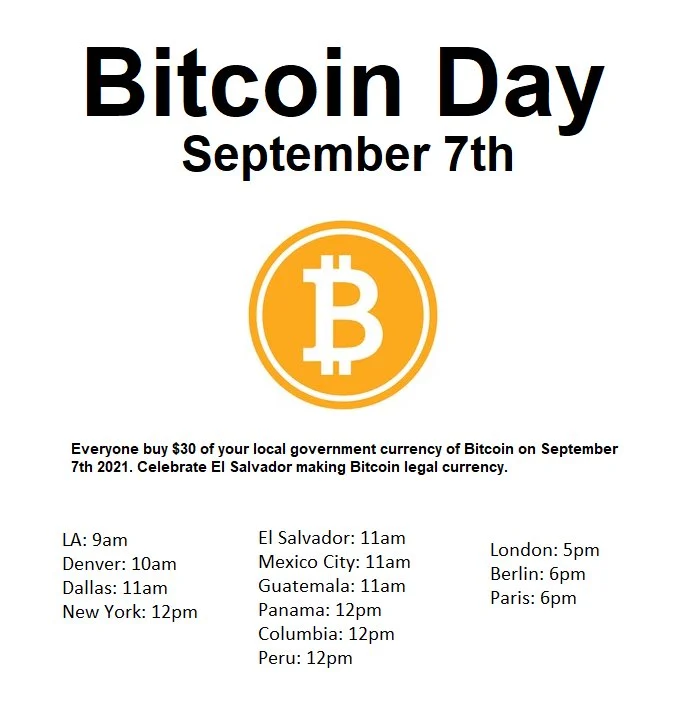
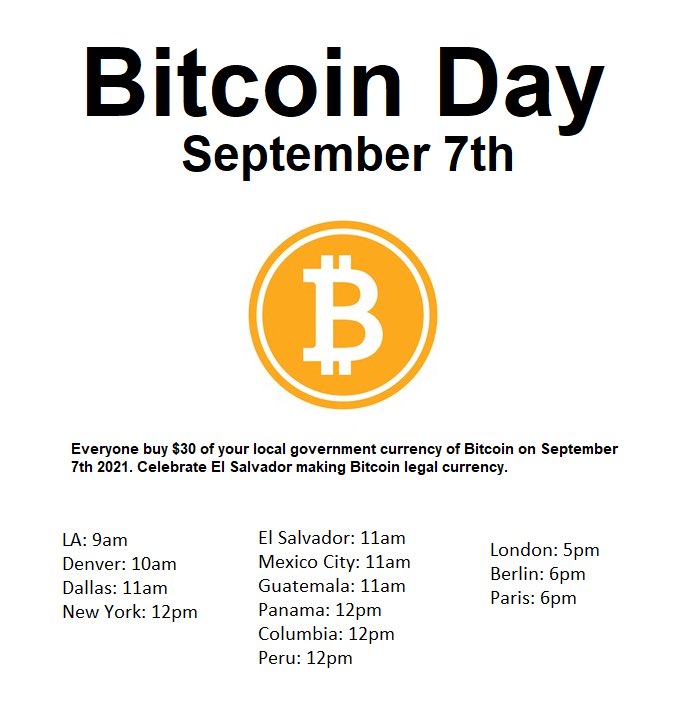
The world is currently witnessing a paradigm shift that many once deemed impossible. As of today, El Salvador has officially transitioned into a new economic era, becoming the first sovereign nation to adopt Bitcoin as legal tender alongside the U.S. dollar. This watershed moment, catalyzed by the vision of President Nayib Bukele, has not only sent shockwaves through the halls of traditional finance but has also ignited a global grassroots movement among the digital asset community. In a show of unprecedented solidarity, Bitcoin enthusiasts worldwide have organized a synchronized effort to mark this occasion: the purchase of $30 worth of Bitcoin, a symbolic gesture intended to honor the country’s bold move toward monetary sovereignty.
The Genesis of a Global Movement
The origins of this collective action are as decentralized as the asset itself. What began as a modest thread on the /r/Bitcoin subreddit—a digital town square for crypto-enthusiasts—quickly evolved into a global phenomenon. A user posed a simple, provocative question: "So… We all buying $30 worth of Bitcoin on Tuesday?"
The response was immediate and overwhelming. Within hours, the post had garnered thousands of upvotes and a flurry of activity, reflecting the passionate, borderless nature of the Bitcoin community. The choice of $30 is deliberate; it is a sum accessible to the average retail investor, ensuring that the movement is inclusive rather than an attempt at market manipulation. As the idea gained traction, it transcended Reddit, migrating to the hyper-active ecosystem of "Bitcoin Twitter" and beyond, reaching corners of the globe ranging from South Korea to Brazil.
Chronology: From Reddit Thread to Global Solidarity
The timeline of this event demonstrates how quickly decentralized movements can coalesce in the digital age.
- The Inception: The initial call to action appeared on Reddit, tapping into the excitement surrounding the impending implementation of El Salvador’s "Ley Bitcoin."
- The Viral Spread: Within 48 hours, the initiative had migrated to social media platforms, bolstered by memes, educational threads, and endorsements from influential figures within the industry.
- The Global Expansion: By the eve of the law’s enactment, the movement had gone international. Korean crypto communities and Brazilian Bitcoin advocates—the latter noting the auspicious coincidence of the event falling on their own Independence Day—began coordinating their own purchase efforts.
- The Main Event: Today, as the clock struck the designated time, retail investors worldwide began executing their purchases, creating a visual and statistical record of the community’s support for El Salvador’s experiment.
The Spectrum of Sentiment: Solidarity vs. Skepticism
The community response has been a complex tapestry of altruism, humor, and healthy skepticism. Many users have gone above and beyond the requested $30. One Reddit user famously pledged to purchase $3,000 worth of Bitcoin, explicitly stating that the extra funds were intended to "cover 99 others who aren’t able to pay." This sentiment of solidarity—the idea that the community is "stacking sats" together to support fellow Bitcoiners in El Salvador—has been the driving narrative for the majority of participants.
However, the movement has not been without its detractors. Critics within the community have raised concerns about the optics of such an event. "Let’s just coordinate a 100 mil pump of BTC. Correct me if I’m wrong, but this sounds greasy," one user noted, highlighting the fine line between a commemorative gesture and market manipulation.
Others have adopted a more cautious, analytical approach. Some traders expressed anxiety that the organized buy-in could be a "trap" for retail investors, potentially setting them up for a sharp market correction. "Everyone needs to be aware that this could possibly be leading the sheep to their death," one commentator warned, pointing to recent technical charts that suggested a high-risk period for price volatility.
Institutional Influence and the Role of Michael Saylor
The involvement of high-profile figures has added a layer of legitimacy and scrutiny to the day’s events. Michael Saylor, the CEO of MicroStrategy and a vocal proponent of Bitcoin, became a central figure in the discourse. By amplifying the message to his millions of followers, Saylor bridged the gap between retail enthusiasts and the institutional world.
Saylor’s endorsement, however, has intensified the debate regarding the potential for market manipulation. While he has consistently maintained that MicroStrategy is a long-term "HODLer" with no intention of selling, the skepticism remains. In the world of decentralized finance, transparency is the ultimate arbiter. If large institutional players choose to divest or increase their positions on this day, the market will reflect those actions in real-time, providing a transparent record that no participant can obscure.
Implications for Global Finance
The adoption of Bitcoin as legal tender in El Salvador is not merely a technical update to the country’s financial system; it is a fundamental challenge to the status quo of global monetary policy. By integrating a decentralized, censorship-resistant asset into the state apparatus, El Salvador has effectively decoupled itself from the traditional constraints of the IMF-backed financial system.
For the international community, the implications are profound:
- Remittance Revolution: One of the primary goals of the Bitcoin Law is to facilitate cheaper and faster remittances for Salvadorans living abroad. If successful, this could set a template for other developing nations to bypass expensive legacy payment processors.
- Financial Inclusion: A significant portion of El Salvador’s population remains unbanked. By providing a digital wallet and a medium of exchange that requires only a smartphone, the government is attempting to bring millions into the formal economy.
- The "Bitcoin Standard" Test: The world is watching to see if a small nation can successfully manage the volatility of Bitcoin while maintaining economic stability. Should the experiment thrive, it could accelerate the adoption of Bitcoin by other sovereign entities looking for an alternative to fiat-heavy economic models.
- Regulatory Precedent: The international response, particularly from regulatory bodies like the IMF and the World Bank, has been one of concern. The success or failure of El Salvador’s initiative will likely dictate the regulatory environment for digital assets in the coming decade.
The Philosophical Weight of the Day
Beyond the price charts and the debates over market volatility, there is a distinct philosophical undertone to the events of this week. As Tomer Strolight, a noted Bitcoin commentator, recently remarked: "Have you ever felt such benevolence to strangers from different nations, religions, and other affiliations as you do toward Bitcoiners?"
This event has demonstrated that Bitcoin acts as a "focal point" for a diverse, global collective. It has created a sense of shared destiny among individuals who, under normal circumstances, would never interact. The act of buying $30 of BTC is, in this context, more than a transaction; it is a symbolic vote of confidence in a new, neutral, and decentralized financial future.
Looking Forward: A Legacy in the Making
As the sun sets on the first day of El Salvador’s new monetary reality, the long-term impacts remain to be seen. Will the "pleb" movement, as the community affectionately calls itself, be remembered as a footnote in the history of the digital asset, or as the spark that ignited a global transition toward a Bitcoin-based economy?
The data provided by the blockchain will be the final judge. Every purchase, every transaction, and every movement of capital will be recorded in an immutable ledger, available for all to see. Whether the price of Bitcoin surges, retraces, or remains steady is secondary to the fact that the experiment has begun.
The world is witnessing the first real-world, large-scale stress test of a decentralized currency as a national legal tender. For the Bitcoin community, the message is clear: they are no longer just passive observers or speculative traders. They are active participants in a historic shift, and for one day, at least, the eyes of the world are fixed on the small, volcanic nation of El Salvador.
In the final analysis, the significance of this day lies in the unprecedented nature of the collaboration. It is a moment where the "hardest money ever created" meets the sovereign will of a nation, supported by a global digital tribe that believes in the potential for a more inclusive and efficient financial future. As we move forward, the lessons learned in the coming months will likely shape the trajectory of finance for generations to come. Whether or not this specific "buy" effort succeeds in moving the needle, the cultural impact of this collective action is already an indelible part of the Bitcoin narrative.
