

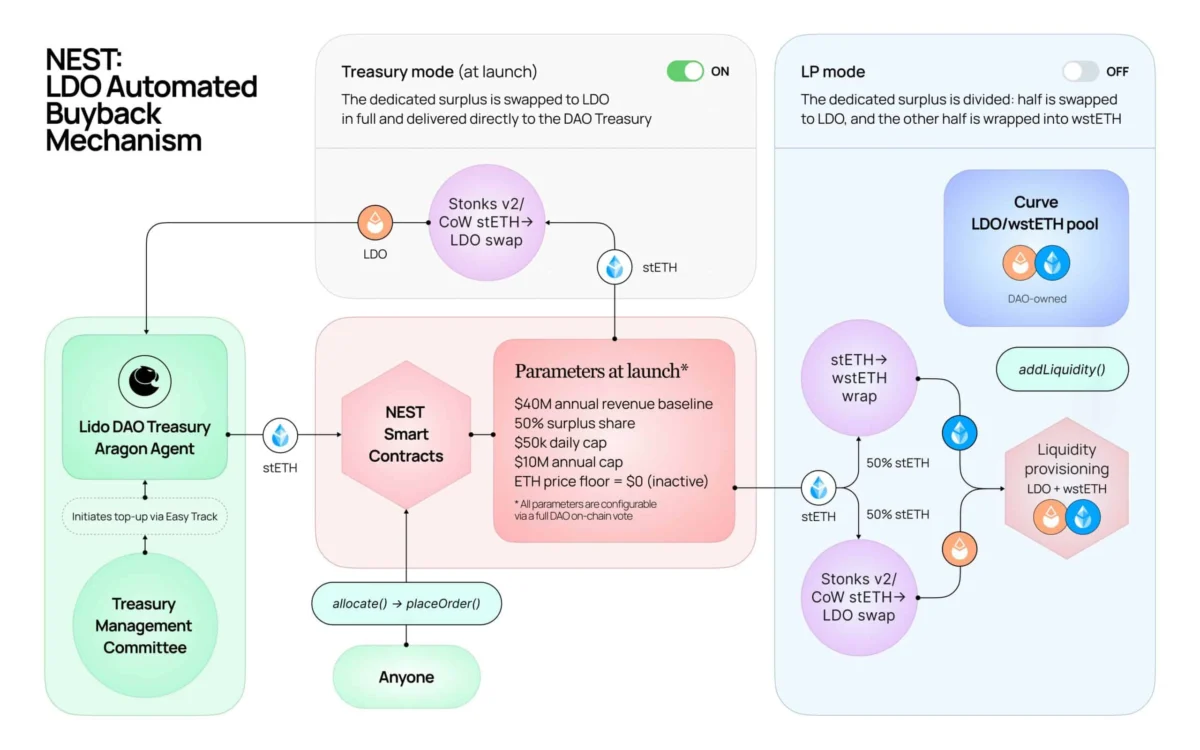
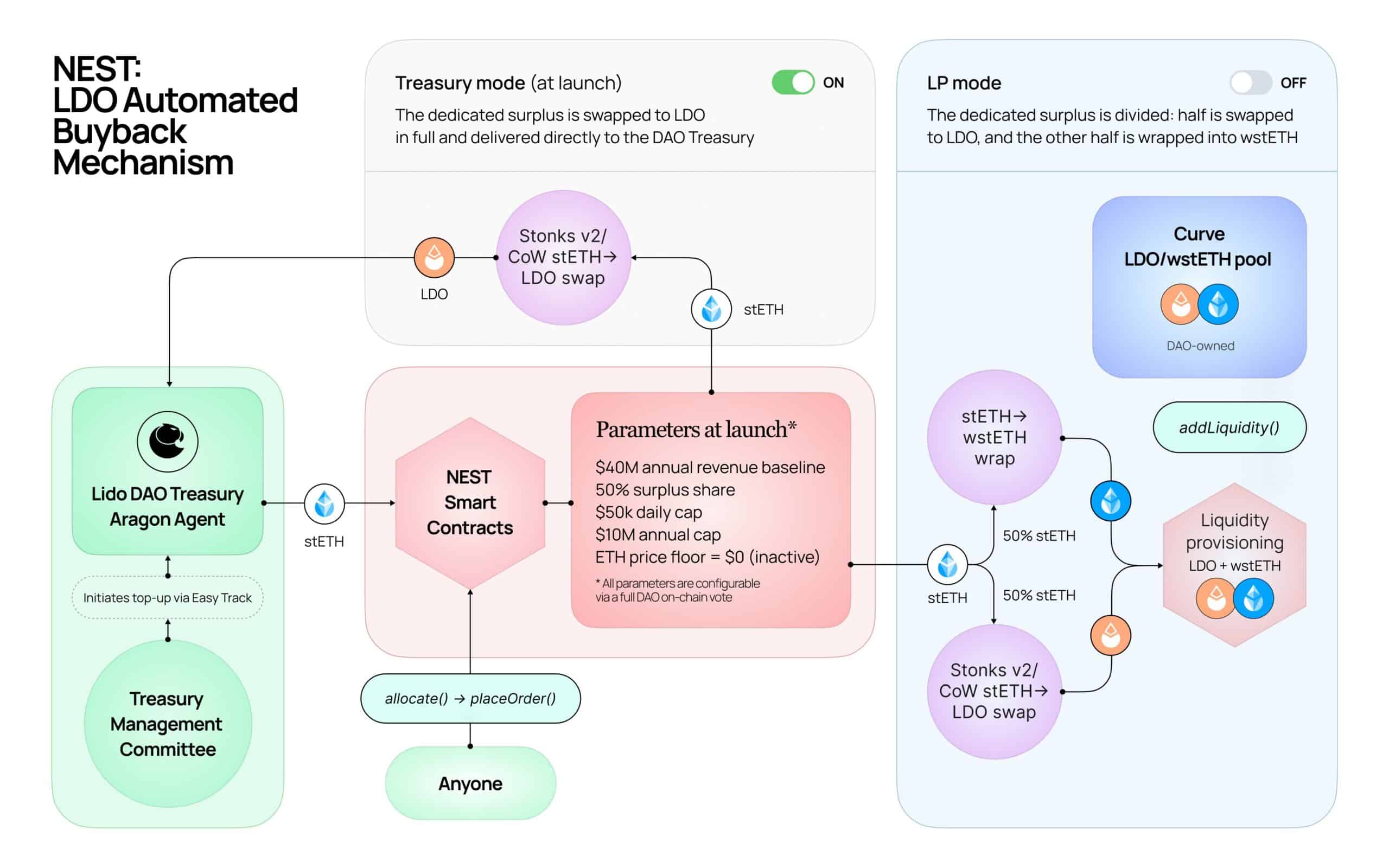
Lido Finance, the dominant force in the liquid staking ecosystem, has officially activated its long-awaited Network Economic Support Token (NEST) program. This strategic move, which had been in development since last year, marks a significant shift in how the protocol manages its treasury and interacts with its native governance token, LDO. By introducing an automated, revenue-linked buyback mechanism, Lido is attempting to align its internal treasury management with broader market performance, creating a transparent, algorithmic approach to capital allocation.
However, the rollout has arrived during a period of relative market stagnation for the protocol, leading to a complex landscape of optimism, skepticism, and technical nuance. While industry observers praise the efficiency of the design, current revenue levels mean the program remains in a "dormant" state, waiting for the next market cycle to fully trigger its potential.
The Mechanics of NEST: How the Buyback Works
The NEST program is designed to be a "dynamic" liquidity support mechanism. Unlike static buyback programs that operate regardless of profitability, NEST is strictly tethered to the protocol’s daily staking revenue.
The Mathematical Threshold
The core of the program is a revenue-based trigger. Lido has set a baseline daily revenue threshold of $109,000. Under the current governance-approved parameters:
- The Baseline: Revenue below $109,000 per day results in zero buyback activity.
- The Trigger: When daily revenue exceeds $109,000, 50% of the excess revenue is automatically funneled into the LDO buyback program.
- The Caps: To ensure treasury sustainability and market stability, the program enforces a daily cap of $50,000 in buybacks, with an annual ceiling of $10 million.
This structure creates an annual revenue requirement of approximately $40 million before the mechanism even initiates. It is a conservative, risk-adjusted approach that ensures the DAO does not deplete its treasury during lean market periods, while simultaneously signaling a commitment to supporting the token’s ecosystem when the protocol is performing at its peak.
Crucially, the LDO tokens acquired through this program are not burned. Instead, they are directed into the DAO treasury. This distinction is vital; by retaining the tokens, the DAO maintains its long-term voting power and flexibility, rather than permanently removing tokens from circulation via a deflationary burn mechanism.

Chronology: From Concept to Mainnet Deployment
The journey to the activation of NEST has been a lengthy process characterized by rigorous debate within the Lido governance forums.
- Mid-2025: Initial proposals regarding "Protocol Revenue Utilization" began circulating within the Lido community. As liquid staking became a crowded market, stakeholders pushed for a more explicit mechanism to return value to the LDO ecosystem.
- Late 2025: The "NEST" proposal gained formal traction. It was designed to address concerns regarding the protocol’s treasury management, which had previously been criticized for lacking a structured plan to handle excess revenue.
- Early 2026: Technical audits and community consensus-building took place. Governance votes were held to finalize the $109,000 daily trigger and the $10 million annual cap.
- April 2026: During a broader Q2 recovery in the crypto markets, Lido’s daily revenue briefly surged, crossing the $109,000 threshold. This period provided the proof-of-concept for the NEST model.
- August 2026: The program was officially deployed to the Ethereum mainnet, marking the transition from theoretical governance to on-chain reality.
Industry Benchmarking: Is $10M Enough?
Since the announcement, the $10 million annual cap has been a subject of intense scrutiny. Critics argue that compared to the broader DeFi landscape, Lido’s commitment is conservative—some would argue, too low.
To contextualize this, we can look at other major protocols:
- Hyperliquid: Currently operates a buyback program exceeding $100 million annually.
- Uniswap & Aster: Both manage programs in the $40 million range.
- PUMP: Targets a $35 million annual buyback.
Compared to these figures, Lido’s $10 million cap is roughly 3 to 10 times smaller than its peers. This has sparked a debate: Is Lido being fiscally responsible by protecting its treasury, or is it failing to provide the aggressive price support that its large, liquid market cap arguably requires?
Proponents of the current plan argue that Lido is a different beast—it is a utility-heavy infrastructure protocol rather than a speculative trading platform. They contend that the $10 million is a "starting point" that can be adjusted via future governance votes if the protocol’s revenue grows exponentially.
Official Responses and Expert Sentiment
The reaction from the crypto legal and analytical community has been largely positive regarding the structure of the move, even if the magnitude is debated.
Gabriel Shapiro, a prominent attorney in the crypto space, lauded the mechanism, stating, "This is how buybacks should be." His sentiment reflects a growing preference in the DeFi space for rules-based, transparent, and algorithmic treasury management, which removes the "human error" factor often associated with discretionary buyback programs.
Conversely, the "Anti-Buyback" camp remains vocal. Critics—including those who have seen projects like Helium abandon their buyback programs—argue that during market downturns, spending treasury funds to buy back tokens is a suboptimal allocation of capital. They argue that these funds would be better spent on:
- Ecosystem Grants: Incentivizing developers to build on top of Lido.
- Security Audits: Funding the next generation of protocol safety.
- L2 Expansion: Investing in bridging technology to capture market share on emerging Layer 2 networks.
Implications: The "Staking" Reality Check
The most immediate implication of the NEST launch is the current reality of the market. As of August 2026, data from DeFiLlama indicates that Lido’s daily revenue is hovering around $75,000—well below the $109,000 trigger.
This means that for the time being, the NEST program is effectively "sleeping." This creates an interesting psychological dynamic for LDO holders. The program acts as a "sleeping giant," where the buyback pressure will only manifest during periods of high network activity and strong market performance. It acts as a counter-cyclical stabilizer, but it is not a direct price manipulation tool in the current sluggish market.
Technical Outlook for LDO
On the price charts, LDO has struggled to regain its former momentum. After a significant dump in July, the token found a support floor at $0.28 in August. However, technical indicators remain bearish. The token is currently trading below its 50-day Exponential Moving Average (EMA) and the 200-day Moving Average (MA).
Analysts suggest that a sustained recovery will require more than just the existence of the NEST program. To see a trend reversal, the market needs to see:
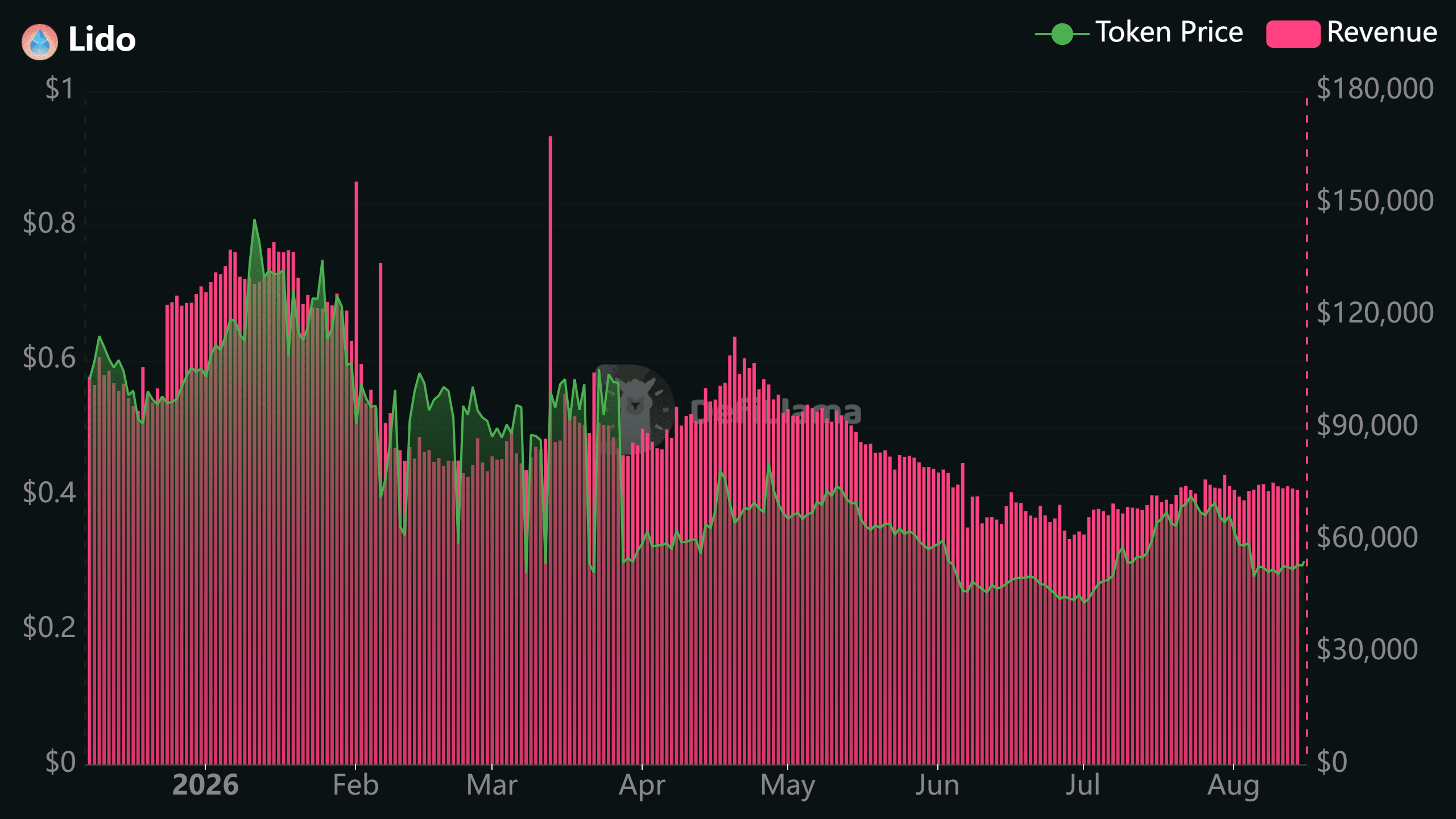
- A sustained move above $0.33: This would signal that the 50-day EMA has been reclaimed as support.
- Increased Revenue: A return to the $109,000+ daily revenue levels would provide the fundamental "buy pressure" required to excite the market.
Final Summary: A Strategic Pivot
Lido’s implementation of the NEST program is a milestone for decentralized governance. It demonstrates that the DAO is capable of transitioning from abstract discussions to complex, on-chain execution.
While the $10 million annual cap may seem modest to traders looking for immediate price catalysts, it represents a mature, long-term approach to protocol health. By tethering the buyback to revenue, Lido has created a system that is fundamentally tied to the success of its liquid staking product.
Key Takeaways for Stakeholders:
- Sustainability over Speculation: The program is designed to protect the treasury, not to pump the price of LDO during market downturns.
- Revenue-Dependent: Investors should watch DeFiLlama revenue data; this is now the primary leading indicator for potential buyback activity.
- Future Scalability: The current $10M cap is a floor, not a ceiling. Future governance proposals could scale this program as the protocol matures.
As the market enters the latter half of 2026, the success of NEST will likely be judged not by the volume of tokens purchased today, but by the protocol’s ability to scale its revenue enough to make the $10 million buyback a routine occurrence. For now, the "sleeping giant" waits for the market to provide the necessary fuel.
