

The world’s largest technology conglomerates rarely make strategic shifts through formal, triumphant press releases. More often than not, their overarching ambitions are revealed in the quietest corners of the corporate internet: the job board.
Recent recruitment activity from tech titans Google and Apple has sent ripples through the financial technology and cryptocurrency sectors. By actively seeking out specialized talent in digital assets, blockchain infrastructure, and modern fintech strategy, these corporate heavyweights have handed stablecoins and tokenized real-world assets (RWAs) an undeniable vote of confidence.
While neither company has formally announced a consumer-facing crypto product, the implications of these hires stretch far beyond human resources. They suggest that the infrastructure underpinning Web3—specifically stablecoins, tokenized deposits, and blockchain settlement layers—is rapidly transitioning from a speculative fringe market into an essential corporate competency.
Main Facts: Decoding the Corporate Hiring Signals
At the heart of this evolving narrative are two distinct yet deeply telling job postings from Google Cloud and Apple.
Google Cloud’s APAC Expansion
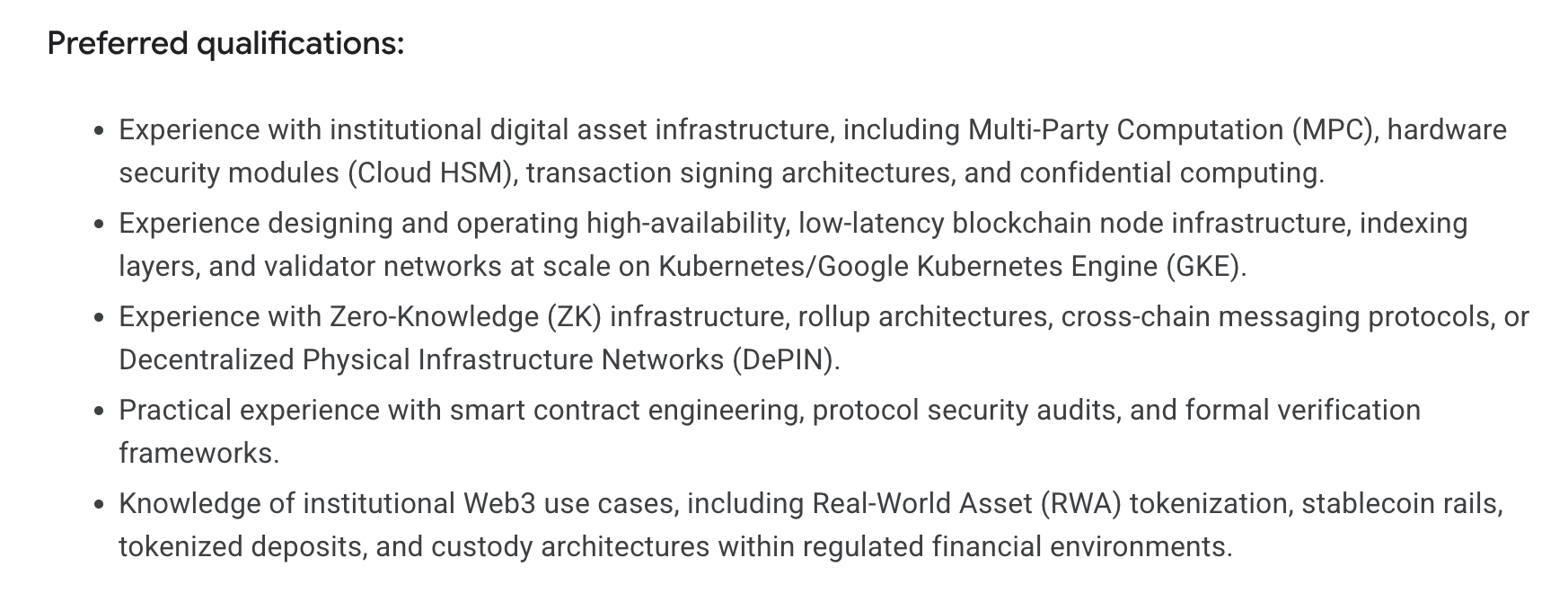
Google Cloud is aggressively expanding its footprint in the digital asset space, evidenced by a targeted job listing for an Industry Principal Architect based in Hong Kong. According to the official description, this high-level role is tasked with spearheading initiatives to help traditional banks, cryptocurrency exchanges, and institutional custodians tokenize Real-World Assets (RWAs) across the broader Asia-Pacific (APAC) region.
Crucially, the qualifications for the position leave little room for ambiguity. Google is explicitly demanding hands-on experience with:
- Distributed ledger and blockchain networks
- Smart contract development and execution
- Stablecoin infrastructure and settlement mechanisms
- Advanced digital custody technology
This strategic hire is widely viewed by industry analysts as a cornerstone of Google Cloud’s expanding Web3 roadmap. It positions the tech giant not merely as a passive cloud service provider, but as an active infrastructural bridge connecting traditional legacy finance with decentralized ledger technology.
Apple’s FinTech Evolution
In contrast, Apple’s recent recruitment drive is more nuanced. The Cupertino-based giant is searching for an Apple Pay Financial Product Strategy Lead to oversee critical financial services, including Apple Card, Apple Cash, and peer-to-peer (P2P) payment ecosystems.
While the initial text of Apple’s job listing does not explicitly feature buzzwords like "blockchain," "crypto," or "stablecoins," industry veterans note that the role sits directly at the intersection of modern payment rail innovation. Apple’s ongoing quest to optimize low-cost, high-speed, borderless peer-to-peer transactions naturally aligns with the efficiencies offered by stablecoin technology. As Apple continues to iterate on its proprietary financial products, integrating decentralized rail efficiencies—or at least preparing for a tokenized financial future—remains a logical trajectory for the payments division.
Chronology of Institutional Adoption: From Speculation to Standardization
To understand the weight of Google and Apple’s recent moves, one must view them within the broader timeline of institutional blockchain adoption over the past few years. The integration of distributed ledger technology into mainstream corporate finance has not happened overnight; rather, it has been a methodical, step-by-step progression.
- The Early Infrastructure Laying (2022–2024): Cloud providers began quietly building out enterprise node hosting services, offering developers the ability to run Ethereum, Solana, and Polygon nodes with enterprise-grade security and reliability. Google Cloud notably introduced a BigQuery crypto dataset expansion, signaling an early data-driven interest in blockchain activity.
- The Strategic Partnerships (2025): The corporate embrace of tokenization took a massive leap forward when Google Cloud partnered with financial derivatives giant CME Group in March 2025. This collaboration was designed to test and implement cutting-edge tokenization technology aimed at modernizing capital markets and streamlining asset settlement.
- Consumer Hardware Integration (Late 2025–Early 2026): Moving beyond backend cloud infrastructure, consumer hardware manufacturers began directly embedding Web3 capabilities into everyday devices. Samsung notably announced that upcoming iterations of its Galaxy smartphones would feature native stablecoin functionality built directly into the Samsung Wallet ecosystem.
- Regulatory and Institutional Counter-Moves (2026): As big tech pushes toward tokenized consumer rails, central banking authorities are racing to establish their own digital settlement layers. A prime example is the European Central Bank’s (ECB) launch of "Pontes," a institutional platform designed to allow major European commercial banks—such as Deutsche Bank and Santander—to settle tokenized asset transactions using central bank digital euros.
Supporting Data: The Rising Tide of Stablecoins and Tokenization
The shifting employment priorities at Google and Apple are backed by overwhelming macroeconomic and sector-specific data. Stablecoins—digital tokens pegged to fiat currencies like the U.S. Dollar—have evolved from a niche trading pair mechanism on crypto exchanges into a multi-billion-dollar global settlement network.
- Volume Outpacing Legacy Networks: On-chain data routinely demonstrates that stablecoin settlement volumes rival, and occasionally exceed, those of traditional legacy payment processors like PayPal and regional banking networks. Their appeal lies in 24/7/365 availability, near-instantaneous cross-border settlement, and minimal transaction fees.
- RWA Tokenization Market Growth: According to various financial sector reports, the tokenization of Real-World Assets—ranging from U.S. Treasury bills and commercial real estate to private equity—is projected to become a multi-trillion-dollar market over the next decade. Financial institutions are discovering that wrapping traditional financial instruments into programmable tokens drastically reduces administrative friction and operational costs.
- The APAC Hotspot: Google Cloud’s decision to base its Industry Principal Architect in Hong Kong highlights the strategic importance of the Asia-Pacific region. Jurisdictions like Hong Kong, Singapore, and Japan have established progressive, clear regulatory frameworks for digital assets and stablecoin issuance, making them global incubators for Web3 banking innovation.
Official Responses and Market Perspectives
Despite the clear direction signaled by these job postings, corporate communication departments remain tightly tight-lipped. Neither Google nor Apple has issued formal press releases confirming plans to launch proprietary stablecoins or decentralized payment apps.
However, industry leaders and regulatory bodies have been vocal about the broader tectonic shifts occurring beneath the surface.
The Central Banking Dilemma
While big tech firms and consumer electronics giants drift toward dollar-backed and commercially viable stablecoin frameworks, central monetary authorities are viewing this development with a mixture of fascination and caution.
The European Central Bank (ECB) has repeatedly issued warnings regarding the rapid rise of privately issued, dollar-backed stablecoins. Regulators fear that widespread adoption of commercial stablecoins could erode traditional commercial bank deposits, shifting financial liquidity away from central oversight and into private digital ecosystems. This tension explains why institutional solutions like the ECB’s Pontes platform are being fast-tracked—central banks are eager to provide a state-sanctioned alternative to prevent private tech giants from monopolizing the future of digital currency settlement.
Implications: What This Means for the Future of Asset Classes
The quiet recruitment drives by Google and Apple carry profound implications for the digital asset class and the global financial landscape at large.
1. The Normalization of Web3 Engineering
When companies the size of Google and Apple begin hiring for roles touching blockchain, smart contracts, and tokenized custody, it permanently removes the lingering stigma of "fringe technology" from the sector. Web3 development is officially being absorbed into mainstream software engineering and corporate financial architecture.
2. Bridging TradFi and DeFi
Google Cloud’s focus on helping banks and exchanges tokenize RWAs in APAC signals that the wall separating Traditional Finance (TradFi) and Decentralized Finance (DeFi) is crumbling. Institutional adoption is no longer about experimental proofs-of-concept; it is about production-grade infrastructure capable of handling trillions of dollars in real-world assets.
3. The Battle for the Consumer Payment Interface
With Samsung integrating stablecoins into mobile wallets and Apple continuously refining Apple Pay and Apple Cash, the battleground for the next generation of consumer payments is taking shape. If tech giants successfully abstract the complexity of blockchain technology behind seamless, consumer-friendly user interfaces, stablecoins could soon become the invisible plumbing powering everyday global commerce.
Conclusion
Google and Apple may not have issued triumphant press releases declaring their entry into the crypto arena, but their hiring actions speak far louder than words. Stablecoins and tokenized assets are no longer speculative experiments—they are the foundational tools that the world’s most dominant technology corporations are arming themselves with to build the financial infrastructure of tomorrow.
