

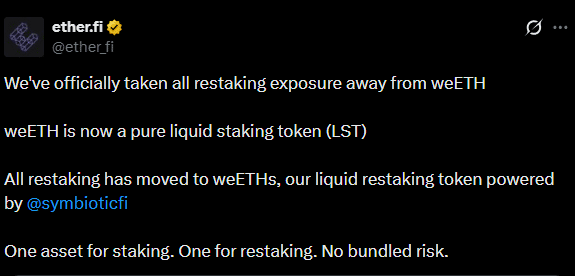
In a move that signals a significant cooling of the "yield-chasing" fervor that has defined the Ethereum ecosystem over the past year, Ether.fi, one of the premier liquid restaking platforms, has announced a structural overhaul of its flagship token, weETH. As of August 7, 2026, the project has effectively stripped all restaking exposure from the asset, reverting it to a "pure" liquid staking token (LST). This strategic withdrawal represents more than a mere technical adjustment; it marks a watershed moment for the decentralized finance (DeFi) sector as it grapples with the complexities of systemic risk and the limits of leveraged yield strategies.
The Core Shift: Decoupling Risk from Reward
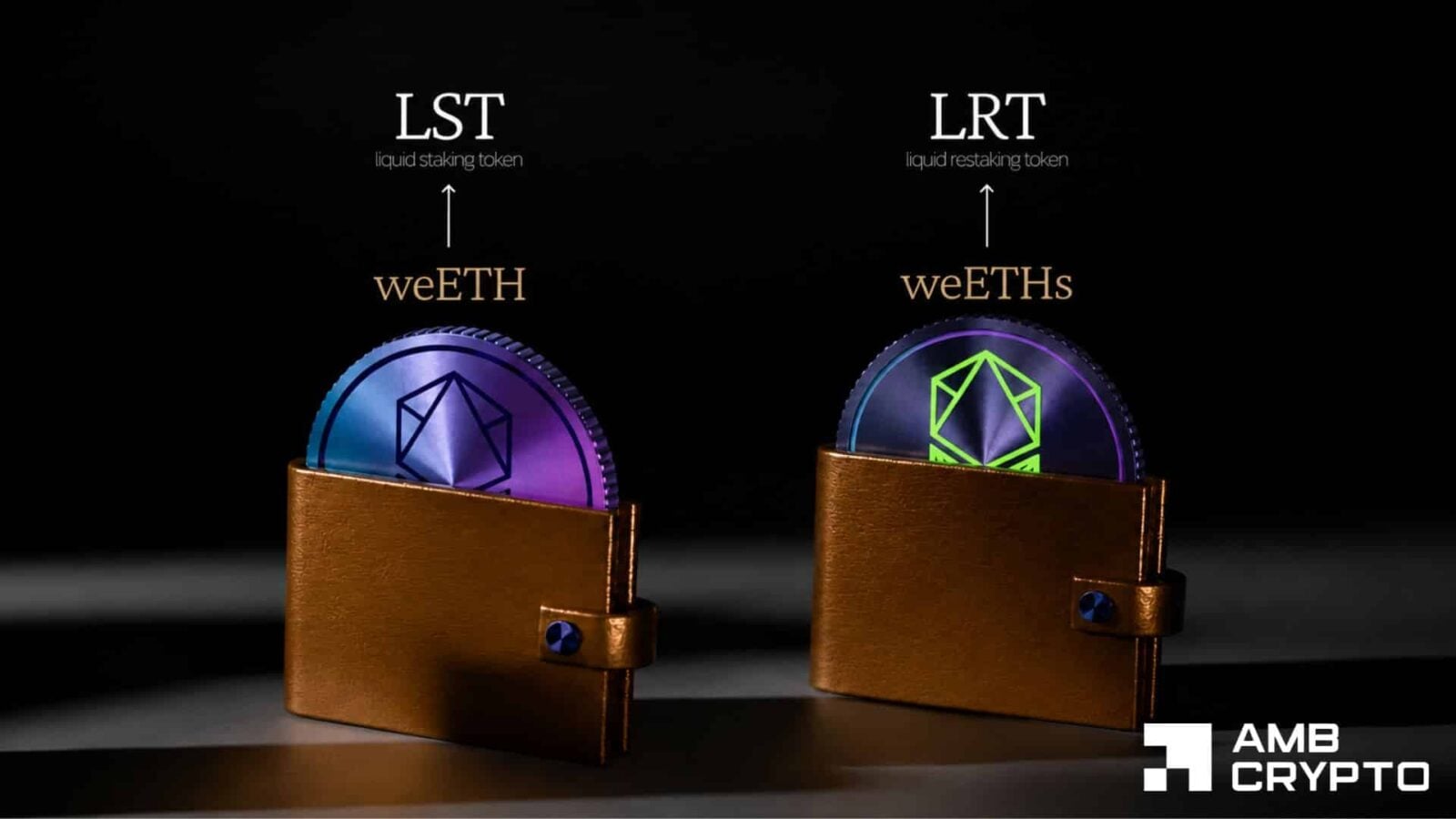
For the uninitiated, the distinction between Liquid Staking Tokens (LSTs) and Liquid Restaking Tokens (LRTs) is the pivot point of this entire transition. LSTs, such as stETH or standard ETH-backed tokens, allow users to earn base-layer Ethereum staking rewards while maintaining the liquidity of their capital in the form of a tradable token. LRTs, however, introduced a layer of complexity—and risk—by redeploying that staked ETH into secondary yield-generation strategies, often through protocols like EigenLayer.
Ether.fi’s decision to excise these restaking layers from weETH and shift its restaking activities exclusively to "weETHs" on the Symbiotic platform—while exiting EigenLayer—is a move intended to eliminate "bundled risk." By decoupling its primary token from the volatile, layered architecture of restaking, Ether.fi is prioritizing the safety and stability of its users’ underlying assets over the pursuit of the incremental yield that previously characterized the LRT market.
A Chronology of the Restaking Retreat
The trajectory of the restaking market has been nothing short of a rollercoaster.
- The Proliferation Phase (Late 2023 – Early 2024): This period saw the explosive rise of "looping" strategies. Pioneers like Ether.fi and EigenLayer successfully marketed the idea that ETH holders could earn a "base" reward plus an additional 50 to 100 basis points through sophisticated DeFi maneuvers.
- The Exploitation Threshold (Mid-2024): As total value locked (TVL) in these protocols surged, the complexity of these "loops" created new attack vectors. High-profile incidents, most notably the $292 million exploit involving KelpDAO, served as a stark wake-up call to the industry regarding the inherent dangers of over-leveraged staking protocols.
- The Regulatory and Risk-Mitigation Response (2025): Recognizing that the "deploy-everywhere" mentality was creating systemic vulnerabilities, major lending protocols like Aave began implementing rigorous risk frameworks. These frameworks systematically removed or deprecated assets deemed too volatile or insufficiently secure.
- The "Cleanup" Era (Early 2026): Aave’s aggressive move to purge nearly $98 million worth of risky, low-adoption assets signaled the end of the "wild west" of DeFi yield farming. This directly impacted the viability of the Pendle PT (Principal Token) trades, which were the engines of the restaking loop.
- The Strategic Pivot (August 2026): Ether.fi formalizes its retrenchment, moving away from EigenLayer and stripping weETH of its restaking exposure, effectively acknowledging that the market is entering a phase of consolidation and risk aversion.
Supporting Data: The Contraction of the Restaking Market
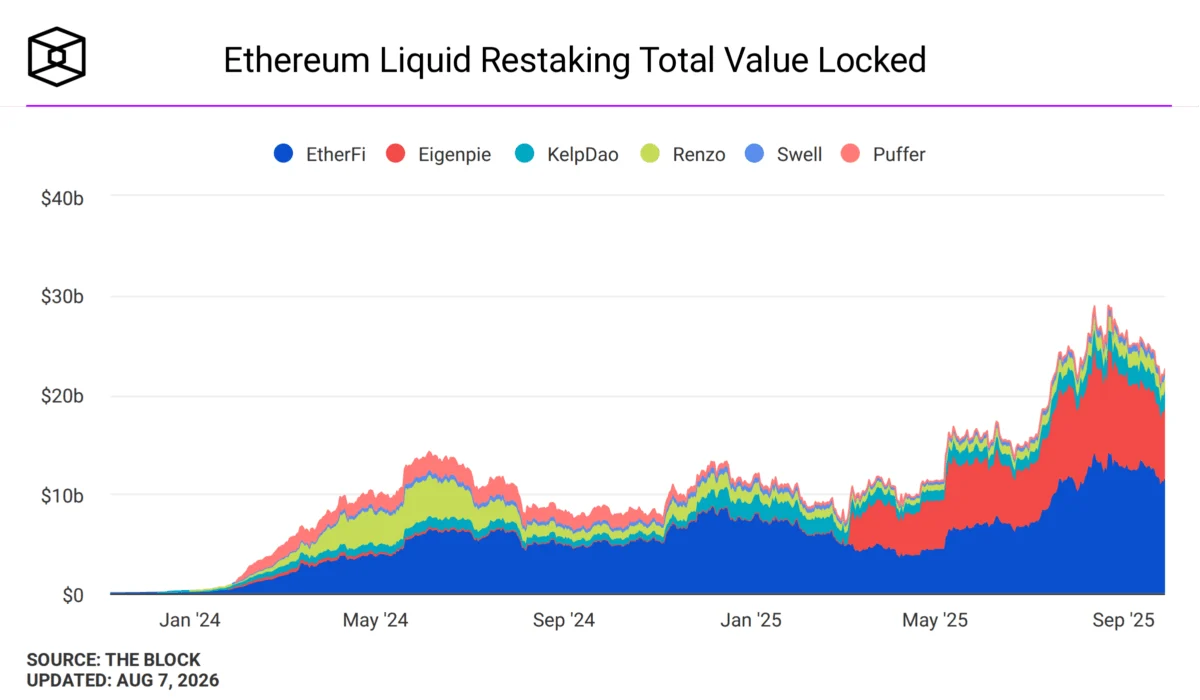
The data paints a clear picture of a market in transition. While Ethereum staking as a whole has seen record demand—with over 1.4 million ETH newly staked—the specialized liquid restaking sector has struggled to maintain its momentum.
According to market analysts, the total value locked (TVL) in the broader liquid restaking ecosystem has contracted significantly, easing from a peak of $29 billion in October 2025 to approximately $22 billion as of mid-2026. This contraction is not necessarily a sign of a dying ecosystem, but rather a reflection of a maturing user base that is increasingly favoring capital preservation over risky yield optimization.
Despite this broader market decline, Ether.fi remains a dominant force. With roughly $11.4 billion in TVL, the protocol controls approximately 50% of the market. Its move to scale back, therefore, is not a sign of desperation, but a calculated effort to lead the industry toward a more sustainable, less hazardous operational model.
Official Responses and Industry Sentiment
The sentiment from leadership at the highest levels of the DeFi space reflects a somber, if pragmatic, outlook. Ether.fi CEO Mike Silagadze captured the prevailing mood in a public statement following the announcement:
"End of an era. Sad. I still think restaking will come back in one form or another; I think it was just a bit too early."
This acknowledgment suggests that the fundamental premise of restaking—using staked ETH to secure secondary networks—is not flawed, but that the execution was premature. The rush to build on top of unproven, highly complex infrastructure created a house of cards that the industry is now choosing to dismantle before a larger collapse can occur.
Tom Wan, a notable analyst at Entropy Advisors, corroborated the necessity of this shift. He pointed out that the "looping" mania, which saw Ether.fi and EigenLayer at the forefront of the Aave integration, was always a high-stakes game. The deprecation of these loops by major lenders like Aave effectively forced the hand of platforms like Ether.fi. It was no longer a question of if they would withdraw from these strategies, but when.
Implications for the Future of DeFi
The ripple effects of Ether.fi’s decision are likely to be felt across the entire DeFi ecosystem.
1. The Death of "Yield-at-All-Costs"
The era of hyper-leveraged, multi-layered yield generation is facing a hard stop. Investors are now shifting their attention toward protocols that demonstrate high security, transparent risk management, and long-term sustainability. Protocols that rely on "bundled" risks to attract liquidity are likely to find themselves on the wrong side of this trend.
2. A Shift Toward Institutional-Grade Infrastructure
As lending giants like Aave continue to prune their supported assets, the industry is moving toward a bifurcated model. On one side, we will see "Blue Chip" DeFi—low-risk, highly secure, and institutional-friendly. On the other, we will see highly experimental, speculative playgrounds that will likely operate with lower liquidity and higher barrier-to-entry requirements.
3. The Re-evaluation of "Restaking"
Restaking will not disappear, but it will undergo a metamorphosis. Future iterations will likely prioritize modularity and individual risk selection, moving away from the "all-in-one" bundles that defined the last two years. By moving its restaking activity to Symbiotic, Ether.fi is signaling a preference for more controlled, isolated risk environments rather than the monolithic, bundled approach of the past.
4. Regulatory and Macro Pressure
The ongoing cleanup of DeFi protocols is not happening in a vacuum. As decentralized finance becomes more deeply integrated with broader financial markets, the pressure to conform to higher standards of risk management—often mirroring traditional finance (TradFi)—is mounting. The "Aave Effect"—where a single protocol’s risk framework changes the behavior of the entire market—is a precursor to a more standardized, regulated, and ultimately more stable future for decentralized finance.
Conclusion: A Mature Path Forward
Ether.fi’s decision to strip weETH of its restaking exposure is a defining moment for the current cycle. It serves as a stark reminder that in the world of decentralized finance, innovation often outpaces the infrastructure required to support it safely. By choosing to pivot, Ether.fi is protecting its users and its position as a market leader, proving that true longevity in crypto requires the wisdom to know when to retreat from the front lines of experimental yield generation. As the dust settles, the industry is likely to emerge more resilient, focused on the fundamental value of Ethereum staking rather than the volatile, high-risk loops of the past.
