


As the cryptocurrency market prepares to turn the page toward the final quarter of the year, a familiar macroeconomic narrative is reasserting itself: liquidity remains the ultimate catalyst for any sustained risk-on cycle. Following a brutal summer characterized by risk-off sentiment and a sharp market contraction, on-chain metrics are beginning to flash green. At the heart of this nascent recovery is a powerful resurgence in stablecoin supply, accompanied by an evolving convergence between traditional finance (TradFi) and decentralized finance (DeFi).
This structural shift is not merely lifting the broader market; it is actively reshaping the competitive landscape among major Layer-1 (L1) blockchains. A stark divergence in stablecoin momentum between networks like Ethereum and TRON highlights a high-stakes battle for liquidity dominance—one that could dictate market leadership as Q4 unfolds.
Main Facts: The Stablecoin Rebound and Market Divergence
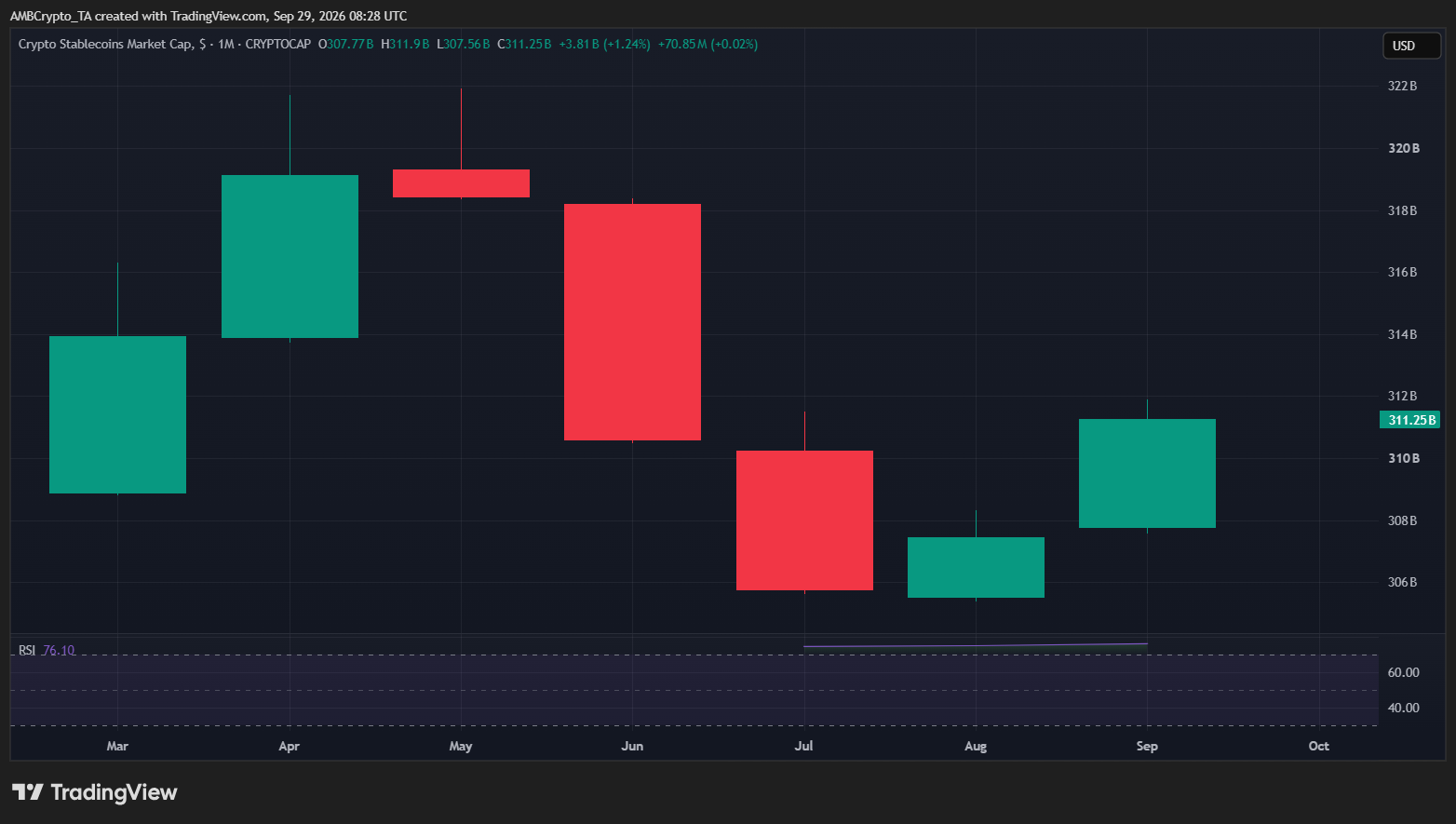
The macroeconomic backdrop for digital assets has been fraught with friction. Between late Q2 and early Q3, the broader crypto ecosystem suffered a punishing drawdown, with the total crypto market capitalization plunging by nearly 30%. This risk-off momentum triggered one of the largest capital flights of the year, wiping roughly $15 billion from the stablecoin market—the most severe liquidity drain observed since the first quarter.
However, the tide has officially turned. On-chain data indicates that the stablecoin market capitalization has surged by 1.24%, putting it on track for its strongest monthly expansion since April. More than $4 billion has poured back into the digital asset ecosystem this month alone.
This capital influx serves as a vital liquidity tailwind, arriving precisely as macroeconomic fear, uncertainty, and doubt (FUD) threaten to cloud the Q4 outlook. This liquidity injection is driven by two parallel forces:
- TradFi-DeFi Convergence: Major institutional banking giants are weaving stablecoins into legacy financial infrastructure.
- Layer-1 Redistribution: Capital is flowing unevenly across competing blockchains, with alternative L1s capturing a growing share of stablecoin supply at the expense of historical leaders.
Chronology: From Summer Liquidity Drains to Q4 Accumulation
To understand the current market inflection point, it is necessary to examine the chronological progression of liquidity flows over the past two quarters:

- Late Q2 to Early Q3 (The Liquidity Drain): As macroeconomic pressures mounted, investors aggressively de-risked. The total crypto market cap declined by nearly 30%, while approximately $15 billion in stablecoin liquidity exited the market. This exodus drained buying power across major exchanges and protocols, resulting in stagnant volume and prolonged consolidation.
- Mid-Q3 (The Institutional Pivot): Amid the market doldrums, institutional infrastructure developments accelerated quietly. Major legacy financial institutions began bridging the gap with blockchain rails, setting the stage for structural adoption rather than speculative hype.
- September (The Rebound and Inflection): Sentiment began to shift as net-positive stablecoin flows returned. Over $4 billion entered the market within a single month, pushing the stablecoin market cap up by over 1%. This recovery marked the most aggressive monthly expansion since April, proving that sidelined capital was beginning to re-enter the ecosystem despite ongoing macro headwinds.
- Heading into Q4 (The Positioning Phase): With stablecoin velocity picking up, market participants are repositioning themselves for an anticipated risk-on rally. Attention has sharply pivoted toward L1 blockchains capable of capturing and retaining this incoming liquidity.
Supporting Data: Analyzing the On-Chain Metrics
Data from analytics platforms like TradingView and Token Terminal provides empirical backing for the shifting liquidity dynamics.
The Macro Stablecoin Rebound
The 1.24% monthly expansion in total stablecoin capitalization signals a definitive end to the Q2/Q3 contraction phase. Historically, expansions of this magnitude—backed by billions in fresh capital inflows—precede periods of heightened volatility and upward price momentum. When sidelined stablecoins accumulate, dry powder increases, allowing whales and institutional desks to execute large-scale accumulation strategies without instantly destabilizing order books.
The L1 Battleground: Ethereum vs. TRON
Beneath the aggregate figures lies a compelling divergence between the top two blockchains by stablecoin dominance: Ethereum [ETH] and TRON [TRX].
- Ethereum’s Supply Contraction: Ethereum has long held the crown for the highest aggregate stablecoin supply, anchored heavily by Tether [USDT]. However, historical data reveals a notable contraction. Stablecoin supply on the Ethereum network has drifted downward to approximately $163 billion, retreating from a peak of roughly $182 billion recorded in Q4 2025. This contraction reflects both capital reallocation to Layer-2 (L2) scaling solutions and a broader shift in user behavior toward alternative, lower-fee environments.
- TRON’s Aggressive Expansion: Conversely, TRON has charted a diametrically opposed trajectory. Over the same timeline, TRON’s stablecoin supply climbed from roughly $78 billion to an impressive $92 billion. On-chain data underscores TRON’s sheer volume capacity: the network has processed a staggering $30 trillion in lifetime transfer volume, maintaining an average of $25 billion in monthly stablecoin transfers. Furthermore, TRON has processed over $6 trillion year-to-date (YTD), with more than $94 billion in USDT circulating actively across its network.
This divergence illustrates that while Ethereum remains the foundational layer for decentralized finance (DeFi) and complex smart contracts, TRON continues to entrench itself as a preferred high-velocity settlement layer for cross-border payments and peer-to-peer stablecoin transfers.
Official Responses and Institutional Catalysts
The revival of stablecoin liquidity is not happening in a vacuum; it is being actively catalyzed by sweeping institutional adoption and strategic banking partnerships.
The convergence of traditional finance (TradFi) and decentralized finance (DeFi) has reached a critical inflection point, serving as a primary adoption barometer for the upcoming Q4 cycle. Recent high-profile integrations highlight this momentum:
- Citi and Coinbase Partnership: As previously reported by AMBCrypto, financial titan Citi joined forces with Coinbase to open institutional stablecoin payment rails to a massive base of approximately 150 million holders. This move bridges institutional banking compliance with on-chain efficiency, allowing corporate clients to settle transactions via digital dollars seamlessly.
- Circle and Volante Integration: In a parallel development, stablecoin issuer Circle partnered with Volante Technologies to integrate USDC directly into existing, legacy enterprise payment rails. This collaboration removes technical friction for merchants and financial institutions looking to adopt blockchain settlement layers without overhauling their internal architecture.
These institutional developments validate the utility of stablecoins far beyond speculative trading. By embedding digital dollars into everyday financial plumbing, TradFi partnerships are laying the groundwork for sustainable, organic liquidity generation.
Implications: What This Means for the Q4 Crypto Cycle
As the market transitions into the final quarter of the year, the implications of these shifting liquidity trends are profound.
1. Liquidity as the Prerequisite for a Risk-On Rally
History dictates that crypto bull runs do not happen in the absence of liquidity. The $4 billion monthly injection into stablecoins acts as the fuel required to ignite a risk-on rally. As macro FUD persists—driven by central bank policies, geopolitical tensions, and regulatory posturing—investors often seek the safety of cash equivalents before deploying risk capital. The accumulation of stablecoins signals that sidelined capital is waiting in the wings, poised to rotate back into volatile assets at the first sign of a technical breakout.
2. The Redrawn L1 Competitive Landscape
The stark contrast between Ethereum’s cooling stablecoin supply and TRON’s robust expansion proves that liquidity is becoming increasingly specialized. Ethereum is evolving into a settlement and security layer for a sprawling network of L2 rollups, naturally decentralizing its liquidity footprint. Meanwhile, alternative L1s like TRON are capitalizing on high-frequency, cost-sensitive stablecoin utility, particularly in emerging markets where digital dollars serve as a hedge against local inflation.
3. Price Action and Tokenomics Impact
For native tokens such as TRON’s TRX and Ethereum’s ETH, these liquidity inflows carry direct implications. For TRON, an expanding stablecoin supply increases network utility, burning mechanisms through transaction fees, and overall economic activity, thereby establishing a strong demand backdrop for TRX heading into Q4. For Ethereum, the ongoing scaling via L2s shifts value capture, yet its massive institutional mindshare ensures it remains the primary beneficiary of high-value capital inflows.
Conclusion
The convergence of a $4+ billion monthly stablecoin recovery, aggressive TradFi integration, and shifting L1 liquidity dynamics points toward a highly dynamic Q4. While macroeconomic uncertainty remains a formidable hurdle, the underlying plumbing of the cryptocurrency market is stronger and more deeply integrated with traditional finance than ever before. If these liquidity trends persist, the stage is set for a robust risk-on cycle that could redefine market leadership for the months ahead.
