

After a protracted period of stagnation and investor skepticism, the Decentralized Finance (DeFi) sector is signaling a robust comeback. Throughout the first half of 2026, the industry faced significant headwinds, characterized by a steady erosion of liquidity and a cooling of market sentiment. However, the third quarter of 2026 has marked a definitive pivot. As the sector’s Total Value Locked (TVL) rebounds to $95 billion, observers are increasingly asking: Is this merely a market correction, or the beginning of a fundamental integration between legacy financial institutions and blockchain-native ecosystems?
Main Facts: A Sector in Rebound
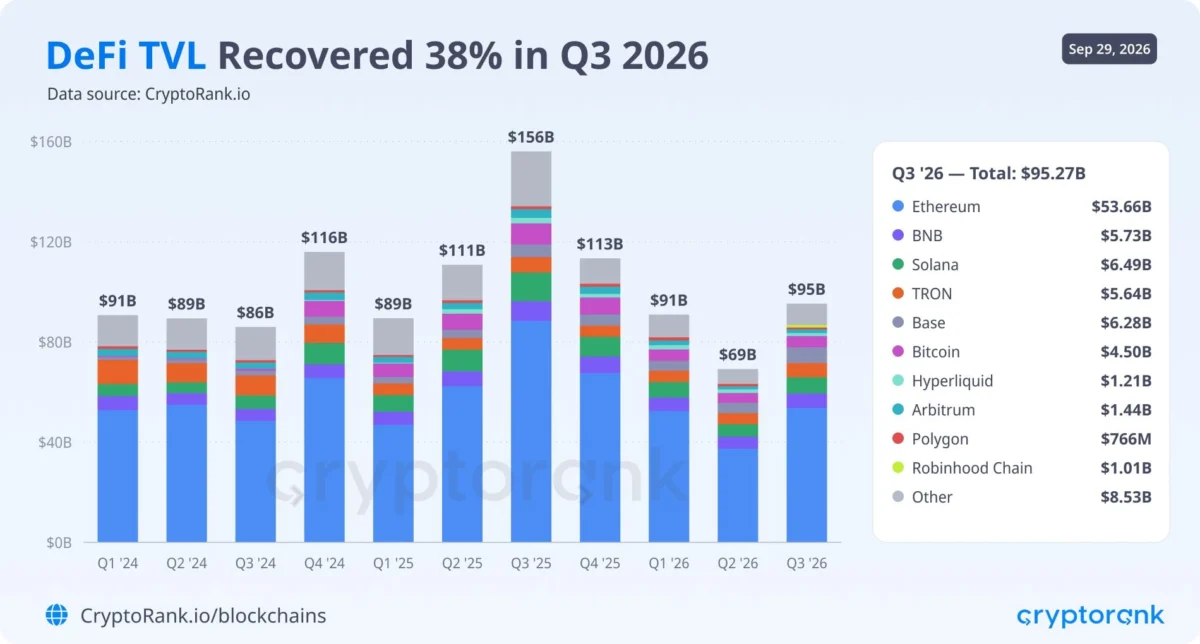
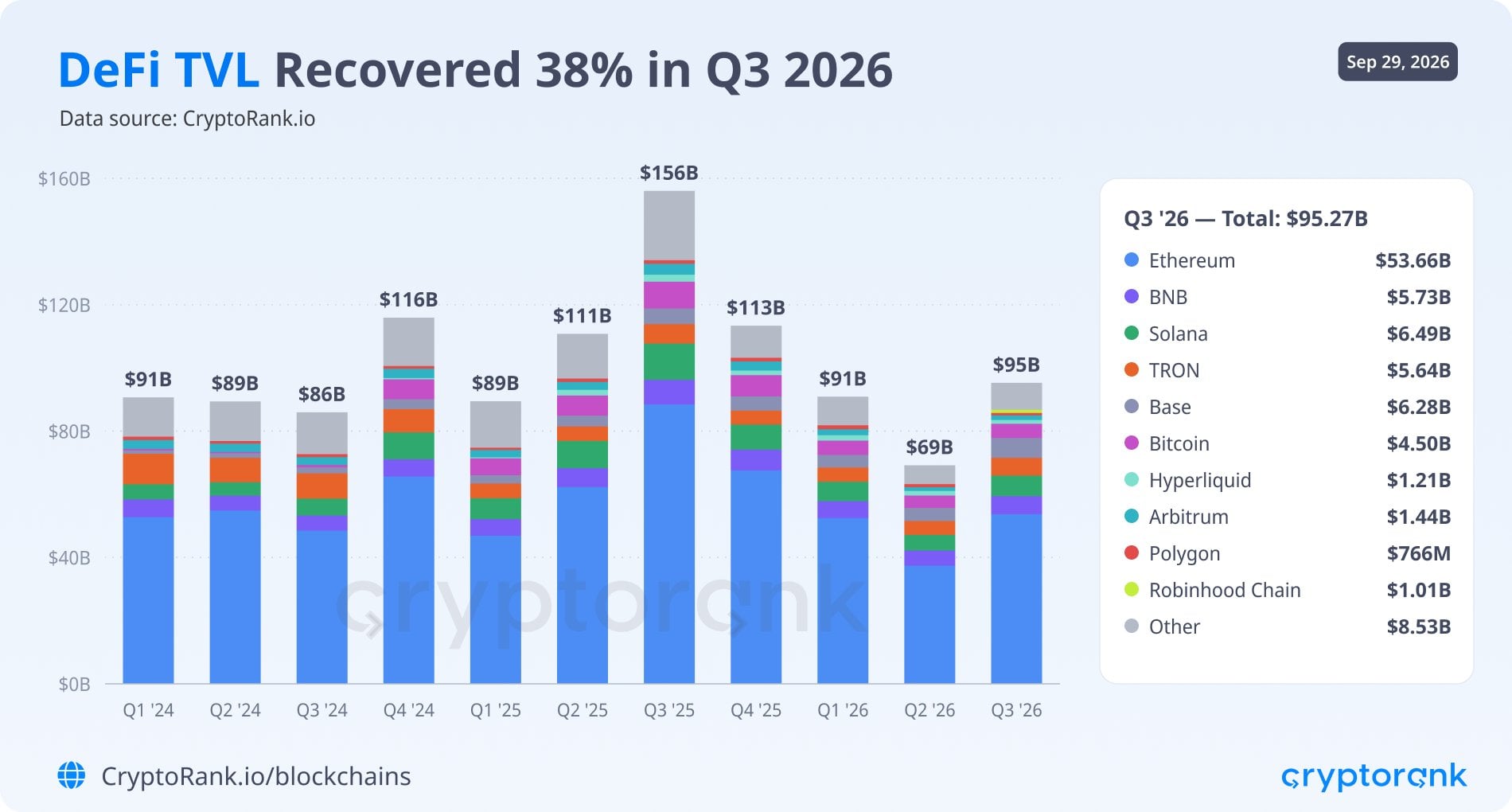
The narrative surrounding DeFi in 2026 has been one of resilience. According to data from CryptoRank, the industry recorded a 38% growth in TVL during Q3 2026, pushing the aggregate value to $95 billion. While this figure remains below the historic highs of 2025, the momentum behind this growth suggests that the "DeFi winter" may finally be thawing.
The recovery is not attributed to a single catalyst but rather a confluence of factors, including the launch of new, high-performance blockchain networks and the gradual migration of traditional assets—specifically tokenized stocks—onto decentralized protocols. This growth is broad-based, spanning established Ethereum-based platforms and emerging chains that are capturing fresh liquidity at an aggressive pace.
Chronology: From $156 Billion to $69 Billion and Back
To understand the significance of the current $95 billion valuation, one must analyze the tumultuous trajectory of the past eighteen months.

- Q3 2025: The Peak. At its zenith in the third quarter of 2025, DeFi TVL reached a staggering $156 billion. This period was characterized by high yield farming incentives and a surge in speculative interest.
- Late 2025 – Q2 2026: The Correction. Following the peak, the market entered a sustained downturn. For three consecutive quarters, liquidity bled out of protocols as market prices for native tokens fell and risk appetite dwindled.
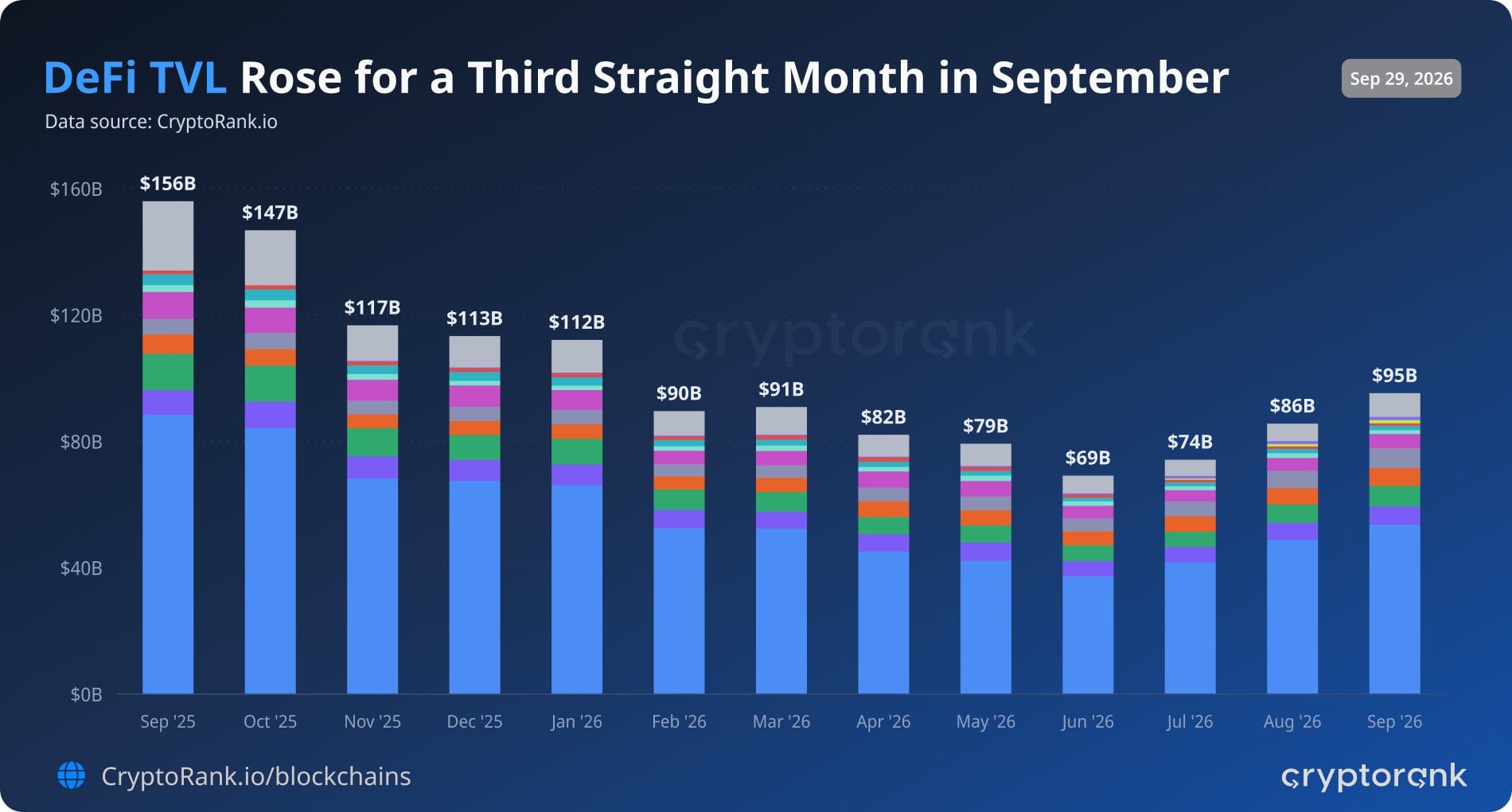
- June 2026: The Trough. By the end of June 2026, the sector reached its lowest point, with TVL contracting to $69 billion—a decline of more than 55% from its previous peak.
- Q3 2026: The Recovery. July served as the turning point, with a 7% increase in TVL. This momentum accelerated in August (+15%) and maintained a strong pace in September (+11%), confirming a trend of sustained capital inflow rather than a flash-in-the-pan rally.
Supporting Data: The Shift in Liquidity
While Ethereum remains the bedrock of the DeFi ecosystem—holding approximately $53.7 billion in TVL—the distribution of capital is becoming more dynamic.
Emerging Challengers
The most striking growth figures come from newer entrants. Monad [MON], for instance, saw an explosive 183% increase in TVL during the third quarter. Similarly, the Robinhood Chain, which only went live in July 2026, has already crossed the $1 billion threshold in record time. This suggests that users are not just loyal to legacy protocols; they are actively seeking out high-performance infrastructure that offers lower fees and faster execution.
The Rise of Tokenized Stocks
Perhaps the most transformative trend in the current recovery is the emergence of tokenized real-world assets (RWAs). As of late 2026, approximately $252 million in tokenized stocks are actively deposited within DeFi protocols. This represents a significant shift from early 2025, when such figures were virtually non-existent.
The allocation of these assets highlights a sophisticated user base:
- Uniswap [UNI]: Leads the pack with $82.1 million across its v3 and v4 pools.
- Kamino Lend [KMNO]: Secures $51.3 million, demonstrating a demand for lending and borrowing against traditional equities.
- Pendle [PENDLE]: Captures $33.8 million, indicating that investors are utilizing yield-derivative strategies to maximize returns on their tokenized holdings.
This data is crucial because it proves that tokenized stocks are not merely being "held" on-chain; they are being actively managed. Investors are leveraging the composability of DeFi to trade, lend, and stake traditional equities, effectively bridging the gap between Wall Street and the blockchain.
Institutional Involvement: The Morgan Stanley Pivot
The most significant development, however, is the growing interest from TradFi (Traditional Finance). The entry of institutional giants like Morgan Stanley is providing a "stamp of approval" that was previously lacking in the DeFi space.
Morgan Stanley has officially established a "Digital Asset Lab" dedicated to testing stablecoins, tokenization, and DeFi applications. While the lab’s mandate is broad—encompassing cybersecurity, machine learning, and electronic trading—the focus on tokenization signals a clear intent to modernize legacy infrastructure.
This institutional pivot is driven by client demand. As wealth management clients increasingly request exposure to Bitcoin and other digital assets, firms like Morgan Stanley are finding that they can no longer treat crypto as an "outsider" asset class. By integrating these services into established platforms—such as the recent rollout of crypto trading on E*Trade—these institutions are effectively onboarding a massive demographic of conservative investors into the broader digital asset ecosystem.
Implications: The Road Ahead
The current state of DeFi suggests that we are moving toward a hybrid financial system. Several key implications arise from this data:
- Professionalization of Yield: As tokenized stocks become more prevalent, the "DeFi yield" will likely converge with traditional equity returns, making the sector more palatable to institutional risk managers.
- Infrastructure Competition: The rapid growth of newer chains like Monad and the Robinhood Chain demonstrates that the market is prioritizing scalability. Legacy protocols will need to innovate or integrate with these high-performance chains to maintain their market share.
- Regulatory Harmonization: As banks like Morgan Stanley build out their DeFi capabilities, the pressure for clear regulatory frameworks will intensify. Institutional participation often serves as a precursor to government-backed compliance standards, which, while restrictive, provide the long-term stability needed for a trillion-dollar industry.
Final Summary
The DeFi sector has successfully navigated a brutal market contraction, proving its utility through a 38% growth in Q3 2026. With $95 billion in TVL, the market is no longer solely driven by crypto-native speculation; it is being propped up by the tangible integration of real-world assets and the quiet, methodical entry of Wall Street giants.
The transition from a "wild west" environment to one characterized by institutional-grade labs and tokenized equities indicates that DeFi is maturing. While volatility remains an inherent trait of the market, the foundation being laid in late 2026 suggests that the next cycle of growth will be fundamentally different from the last—more integrated, more institutional, and significantly more robust.
