

The cryptocurrency market is currently defined by a profound paradox. While the broader financial landscape remains gripped by the Federal Reserve’s hawkish monetary policy and a tightening regulatory net, digital assets have experienced a defiant surge in price. Bitcoin has rallied 20% in just three weeks, reclaimed the $30,000 threshold, and ignited a wave of "greed" among investors. However, beneath this veneer of bullish enthusiasm lies a complex reality characterized by crumbling liquidity, regulatory friction, and a macroeconomic environment that suggests the current rally may be built on shifting sands.
Main Facts: The Catalyst of Institutional Ambition
The recent market exuberance can be traced back to a single narrative: the institutionalization of Bitcoin through spot ETFs. The catalyst was a flurry of filings from global financial titans, most notably BlackRock—the world’s largest asset manager—and Fidelity Investments. These filings, coupled with the launch of EDX Markets—a new crypto exchange backed by heavyweight firms like Schwab, Citadel Securities, and Fidelity—have provided a much-needed morale boost to a sector reeling from the trauma of 2022.
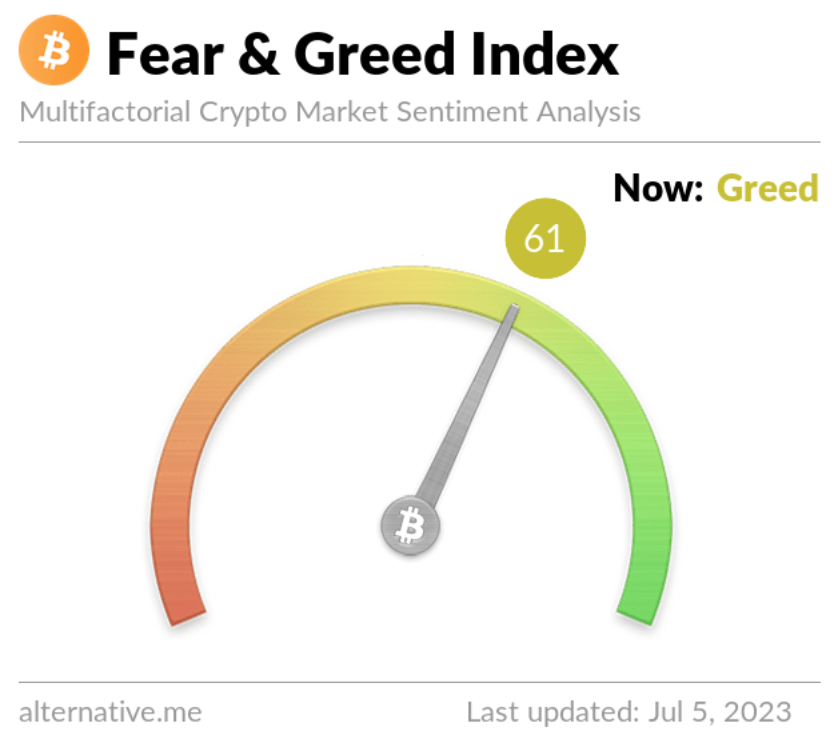
The result has been a shift in the "Fear and Greed Index," which has climbed into the "greed" territory with a score of 61. Bitcoin’s 83% year-to-date gain stands as a testament to the market’s resilience, yet this optimism is being challenged by the cold, hard facts of market mechanics. The primary driver of the recent rally, the spot ETF filing, has already hit its first significant regulatory hurdle. The U.S. Securities and Exchange Commission (SEC) reportedly informed Nasdaq and the CBOE—the exchanges acting on behalf of the applicants—that their filings were "inadequate." Specifically, the regulator noted a lack of detail regarding the "surveillance-sharing agreements" necessary to prevent market manipulation.
Chronology of a Volatile Month
To understand how the market reached this point, we must look at the timeline of the last thirty days:
- Early June: The SEC initiates high-profile legal actions against industry giants Binance and Coinbase. These twin lawsuits send shockwaves through the market, categorizing several major altcoins as unregistered securities.
- Mid-June: Despite the regulatory crackdown, the narrative shifts toward institutional adoption as BlackRock submits its application for a spot Bitcoin ETF.
- Late June: The market responds with a sharp rally. Bitcoin breaches $30,000, and Ethereum approaches the $2,000 mark.
- Early July: The SEC pushes back on the ETF applications, demanding more robust surveillance-sharing agreements. While the CBOE and Nasdaq have moved to refile, the delay serves as a reminder of the historical resistance the SEC has shown toward such products—including the rejection of Fidelity’s previous attempt in January 2022.
- Current Outlook: Investors are now weighing the persistent possibility of further Federal Reserve rate hikes against the potential for a breakthrough in institutional access to digital assets.
Supporting Data: The Liquidity Crisis
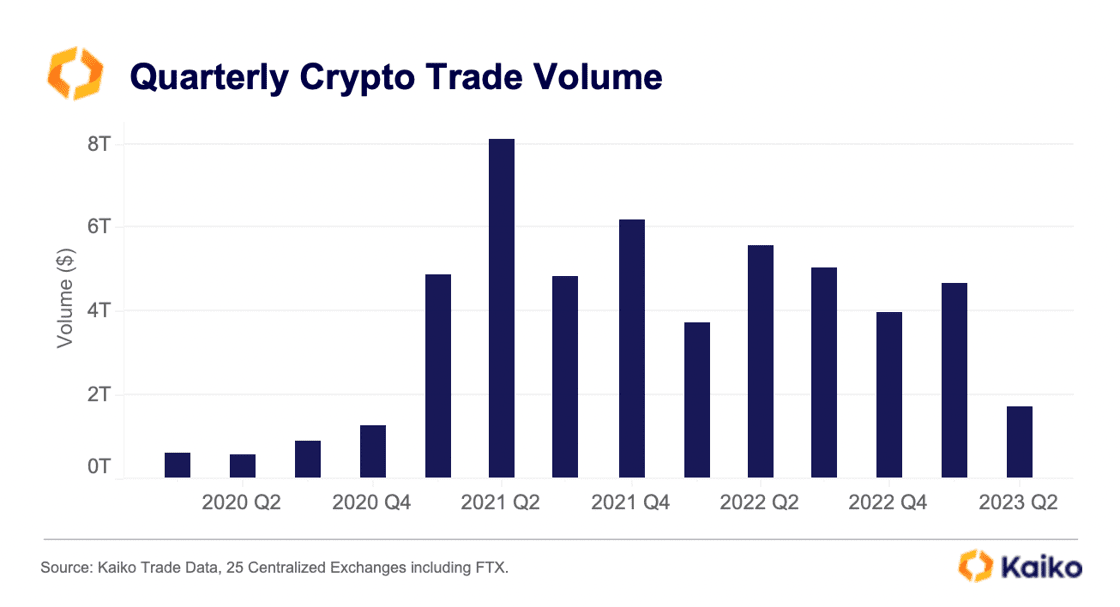
While prices have moved upward, a critical metric is trending in the opposite direction: liquidity. According to data from Kaiko, trading volumes on centralized exchanges have plummeted to their lowest levels since 2020. This decline is not merely a statistical curiosity; it is a structural concern.
Liquidity acts as a shock absorber for price volatility. When liquidity is thin, even small trades can result in outsized price swings—a phenomenon that has likely exacerbated the recent 20% surge in Bitcoin. Furthermore, the total balance of stablecoins held across major exchanges has declined by a staggering $26 billion over the last six months—a 60% contraction. This massive capital flight from exchange-held stablecoins suggests that the "dry powder" available for immediate purchasing has been significantly depleted.
However, the picture is not uniformly bleak. Derivatives markets have shown resilience, with trading volumes in the second quarter of 2023 significantly outperforming the latter half of 2022. This suggests that while spot market participation is waning due to regulatory uncertainty, institutional or professional interest in hedging and speculative trading remains robust.
Official Responses and Regulatory Friction
The regulatory landscape remains the single greatest variable in the crypto equation. The lawsuit against Binance, while expected due to the exchange’s history of jurisdictional maneuvering, covers a laundry list of grievances: trading against customers, volume manipulation, and circumventing geographic restrictions.
The suit against Coinbase, however, presents a more nuanced challenge. By targeting Coinbase—a publicly traded company whose IPO was approved by the SEC itself—the regulator is effectively putting the entire U.S. crypto-asset framework on trial. The SEC’s classification of various altcoins as securities contradicts the market’s recent behavior, where these same tokens have rallied in tandem with Bitcoin. This divergence suggests that the market is currently ignoring the legal implications of the SEC’s actions, choosing instead to focus on the promise of ETF approval.
Macroeconomic Implications: The Fed’s Shadow
The market’s recent enthusiasm is particularly curious when viewed through the lens of macroeconomic policy. While the Federal Reserve paused interest rate hikes during their recent meeting, Chairman Jerome Powell’s messaging was unambiguously hawkish. He signaled that the pause was a strategic maneuver rather than an end to the tightening cycle.
Fed futures markets now price in an 86% probability of a 25-basis-point hike at the next meeting. This is a stark contrast to the market sentiment from one month ago, yet Bitcoin prices have risen significantly despite the rising probability of tighter credit conditions.
The Lag Effect
It is vital to remember that monetary policy operates with a significant time lag. The world has moved from a zero-interest-rate environment to a regime where rates exceed 5% in one of the fastest cycles in modern history. The full impact of this tightening has yet to be fully realized in the broader economy. If liquidity continues to dry up and the cost of capital remains high, the current crypto rally may face a severe "gravity check."
Conclusion: Caution Amidst the Rally
The recent momentum in cryptocurrency markets is undeniably impressive, driven by the seductive narrative of institutional adoption and the potential for a regulated, accessible Bitcoin ETF. However, the disconnect between price action and underlying fundamentals—namely liquidity, regulatory hostility, and an uncompromising Federal Reserve—is widening.
Investors should remain wary of the "crypto-to-crypto" mentality that prioritizes momentum over economic reality. The market is currently operating in a vacuum, ignoring the regulatory fire and the tightening of monetary policy that have historically acted as anchors on high-risk assets. While the long-term inevitability of a Bitcoin spot ETF remains a valid thesis, the road to approval is fraught with hurdles. Until liquidity returns to centralized exchanges and the regulatory status of the broader digital asset market is clarified, the current rally should be viewed with a healthy degree of skepticism. We are in the midst of a significant shift in the financial landscape, but the road ahead is likely to be far more volatile than the recent price action suggests.
