

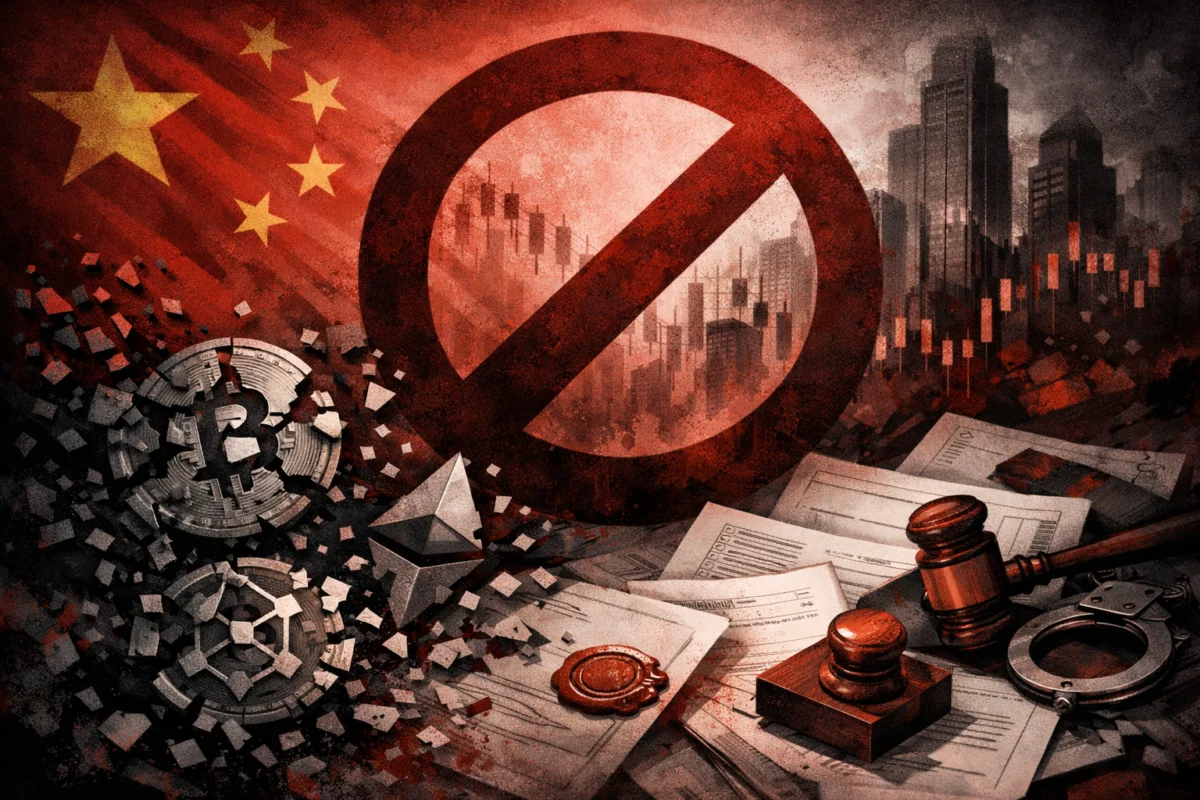
In a move that sends a definitive chill through the global Web3 ecosystem, China has formally classified the tokenization of Real-World Assets (RWA) as an illegal financial activity. This latest regulatory maneuver, executed through a coordinated declaration by seven of the nation’s most powerful financial industry associations, effectively closes the door on any speculation that RWA projects might find a legal foothold within the Chinese jurisdiction.
The directive, which places RWA tokenization alongside stablecoins, cryptocurrency trading, and mining as strictly prohibited, signals a deepening of Beijing’s commitment to state-controlled digital finance. By targeting the entire service chain—including offshore entities with mainland operations—regulators have signaled that geography is no longer a shield for those engaging in tokenization activities targeting Chinese citizens.
The Coordinated Front: A Unified Regulatory Warning
The severity of the crackdown is reflected in the breadth of the coalition behind it. The notice was issued jointly by the China Internet Finance Association, the China Banking Association, the China Securities Association, the China Asset Management Association, the China Futures Association, the China Association of Listed Companies, and the China Payment and Clearing Association.
This unprecedented cross-industry alignment underscores that the decision was not merely a peripheral policy update, but a high-level strategic containment effort aimed at systemic financial risk. The associations were unequivocal: RWA tokenization possesses no legal basis under existing Chinese law.
Regulators defined the practice as the financing and trading of rights or debt instruments through token issuance. According to the state, this structure inherently introduces "layered risks," including the potential for fictitious asset backing, operational failures, and rampant speculative trading. Most importantly, the authorities explicitly stated that no regulatory body in China has approved any form of RWA tokenization, effectively terminating any claims by projects that they are currently in "trial phases" or awaiting government registration.
Chronology of a Crackdown
To understand the current hostility toward tokenization, one must look at the trajectory of China’s digital asset policy:
- 2017: China initiates its primary crackdown on Initial Coin Offerings (ICOs) and domestic crypto exchanges, citing risks to financial stability.
- 2021: The People’s Bank of China and other regulators tighten the screws, declaring all cryptocurrency-related transactions illegal and banning mining activities nationwide.
- 2023-2024: As global markets pivot toward "Real-World Assets"—the tokenization of bonds, real estate, and commodities—various offshore projects attempt to attract Chinese capital, arguing that RWA represents a "regulated" form of blockchain participation.
- Early 2026: A surge in fraud cases involving RWA labels prompts a definitive response. The seven-association notice is published, legally codifying RWA tokenization as a form of illegal fundraising and unauthorized securities offering.
Legal Breaches and Criminal Exposure
The notice provides a granular roadmap for how authorities intend to prosecute these activities, mapping them directly to China’s Criminal Law and Securities Law. The implications for project operators are dire:
- Illegal Fundraising: Issuing tokens to the public for the purpose of raising capital is now classified as illegal public fund-raising, a charge that carries severe criminal penalties in China.
- Unauthorized Securities Offerings: Facilitating the distribution or trading of these tokens without regulatory approval constitutes an illegal securities offering.
- Illegal Futures Business: Any trading models incorporating leverage, hedging, or betting mechanisms are being categorized as unauthorized futures trading.
Crucially, the regulators have rejected the "technological veneer" often used by these projects. Even if a project claims to provide transparency or uses genuine collateral to anchor its tokens, the authorities maintain that the risk of "spillovers" remains uncontrollable. The government’s stance is that a digital claim to an asset cannot guarantee ownership or liquidation rights in a way that aligns with the Chinese legal system.
The Extraterritorial Reach: Targeting the Offshore Pipeline
Perhaps the most significant aspect of this directive is its aggressive stance on offshore structures. Many Web3 firms have attempted to navigate Chinese law by registering in jurisdictions like Hong Kong, Singapore, or the Cayman Islands while keeping their technical and operational staff in the mainland.
Beijing has effectively pierced this corporate veil. The directive warns that domestic brokerages and financial institutions must halt any involvement with RWA projects in Hong Kong, creating a clear demarcation line between Hong Kong’s evolving digital asset framework and the mainland’s absolute prohibition.
Furthermore, the "objective standard" of liability has been broadened. Any institution or individual who "knew or should have known" they were supporting RWA-related business can be held legally accountable. This is a direct strike at the "service chain" that sustains these projects.
The Web3 Service Chain: Who is at Risk?
The scope of this regulation extends far beyond the founders of a crypto project. The notice makes it clear that the entire ecosystem of support services is now under the microscope:
- Technology Outsourcers: Software developers writing smart contracts or maintaining platforms for RWA projects are now potential targets for enforcement.
- Marketing and Influencers: Agencies and social media figures promoting RWA schemes to Chinese users are explicitly cited as liable.
- Payment Processors: Any entity providing payment interfaces or on-ramps/off-ramps for these tokens risks being shuttered.
- Operations Personnel: Perhaps most drastically, the notice implies that even employing a single operational staff member in China can expose an entire offshore project to investigation.
This effectively forces a binary choice for many Web3 entities: either exit the Chinese market entirely, including the dismissal of all local staff, or face the prospect of criminal prosecution for participating in an "illegal financial activity."
Why Now? The Digital Yuan and State Control
Industry analysts suggest that the timing of this crackdown is inextricably linked to the state’s broader financial agenda. As China moves to internationalize the digital yuan (e-CNY), it is simultaneously establishing a new Shanghai-based hub for cross-border payments and blockchain infrastructure.
By restricting private stablecoins and RWA tokenization, Beijing is removing competing forms of "private money" that could challenge the hegemony of the digital yuan. The government views private tokenization as a threat to its ability to manage monetary policy and maintain strict capital controls.
Furthermore, the rise in "RWA-themed" scams—whereby perpetrators use the credibility of real-world assets to mask pyramid schemes or worthless digital collectibles—has provided the state with a justification to act. By painting the entire RWA sector as a fraudulent landscape, regulators are reinforcing the narrative that the only safe and legitimate financial system is the one overseen by the state.
Implications for Global Fintech
For global fintech startups, the message is clear: the Chinese market, which was once a tantalizing source of capital and technical talent for the blockchain industry, is now officially "off-limits."
The legal risk of operating in China, even for offshore-registered firms, has risen to a level that makes traditional compliance frameworks insufficient. As the regulatory climate in China continues to prioritize centralized, state-led digital innovation, the window for private, decentralized, or tokenized asset models has effectively slammed shut.
For the global industry, this signals a potential fragmentation of the Web3 landscape. Projects that have historically relied on Chinese talent or capital will need to undergo significant restructuring, potentially leading to an exodus of developers and firms to more permissive jurisdictions. Ultimately, this regulation represents one of the final hurdles in the decoupling of China’s digital economy from the global, decentralized Web3 ecosystem, marking a new, more isolationist era for the nation’s financial sector.
