


In the current landscape of decentralized finance (DeFi), a digital signature is often treated as the ultimate seal of authority. When a user signs a transaction on Ethereum, they are essentially providing a cryptographic "green light" for the network to execute a specific set of instructions. However, the Ethereum Foundation’s Trillion Dollar Security initiative has identified a critical vulnerability in this paradigm: the disconnect between what a user intends to happen and what the Ethereum Virtual Machine (EVM) actually executes.
As the ecosystem matures, the focus is shifting from simple transaction signing to "transaction outcome integrity." Through the exploration of native transaction assertions—specifically under the framework of EIP-7906—the Ethereum community is aiming to bridge the gap between user intent and on-chain reality, providing a safeguard against the risks of blind signing and transaction uncertainty.
The Core Problem: Intent vs. Execution
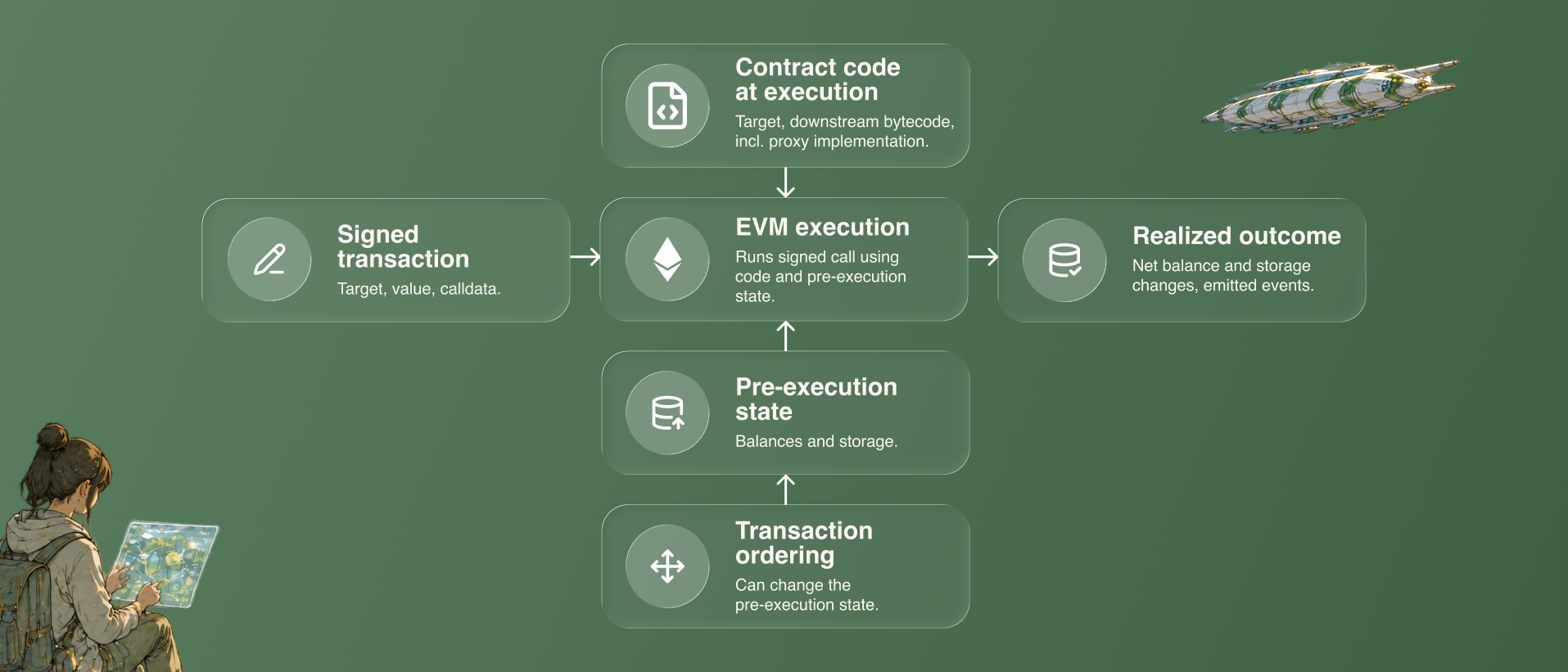
The fundamental challenge lies in the deterministic but context-dependent nature of the EVM. Ethereum executes code exactly as instructed, but that code operates within a dynamic environment. A signed transaction commits to a target, a value, and a specific payload (calldata). However, the ultimate result of that transaction—the net change in balances, storage, and events—is contingent upon the state of the blockchain at the exact moment of execution.
Because Ethereum lacks a native, protocol-level mechanism to verify the net state changes produced by a transaction, users are frequently exposed to two distinct types of failures:
- Intent Mismatch: The user is tricked into signing a request that differs from their actual goal. This often occurs when a frontend interface is compromised, leading the user to authorize a transaction that performs a malicious action, such as replacing a Safe’s implementation contract or granting unlimited token spending permissions.
- Outcome Mismatch: The user signs a legitimate request, but due to market volatility, poor liquidity, or malicious transaction ordering (like sandwich attacks), the final result is economically disastrous.
Chronology of Risk: From Bybit to Aave
The urgency of this initiative is underscored by a series of high-profile security incidents that have plagued the ecosystem over the past several years.
The Bybit and BadgerDAO Incidents (Intent Mismatches)
In the high-profile Bybit and BadgerDAO incidents, the root cause was not a flaw in the underlying protocol, but a manipulation of the user’s interface. In these cases, compromised frontends presented users with signing requests that appeared benign but contained hidden malicious instructions. Bybit signers were tricked into replacing the implementation contract of their Safe, effectively handing over control of their assets. Similarly, BadgerDAO users inadvertently granted attackers permission to drain their wallets. These events highlighted a glaring hole in existing defenses: the signature authorized the data provided by the UI, not the intended outcome.
The Aave and CoW Swap Collateral Incident (Outcome Mismatches)
The Aave/CoW Swap incident represents the second class of risk: the "bad trade." A user attempted to swap $50.4 million of aEthUSDT for aEthAAVE. Due to thin liquidity and the limitations of the CoW Swap gas ceiling, the transaction was forced into a highly disadvantageous path. Despite the interface displaying a 99.9% price impact warning, the transaction proceeded because the signature was technically valid. The user received tokens worth a fraction of their intended value. In this scenario, even a "correct" signing process failed to protect the user from an catastrophic economic outcome.

The Failure of Current Defenses
Current security measures, while valuable, operate within silos that fail to provide comprehensive, post-execution protection.
- Clear Signing: By translating hex-encoded calldata into human-readable text, Clear Signing helps users understand what they are signing. However, if the decoded message is misleading or if the user is conditioned to ignore warnings, this defense fails.
- Simulation: Many modern wallets simulate transactions before broadcasting them. Yet, simulations are only as accurate as the "state" used to run them. In the Radiant Capital exploit, for example, simulations showed the intended transaction, but malware on the user’s machine swapped the payload at the final moment of signing, bypassing the pre-flight check.
- Contract Guards (e.g., Safe’s
checkAfterExecution): Some smart contract wallets implement hooks to inspect state after a transaction. While powerful, these require specific integration and cannot easily inspect the entire net state of the blockchain. They often struggle to read internal proxy implementations or complex state changes that occur across multiple contracts.
Enter EIP-7906: Native Transaction Assertions
The Trillion Dollar Security initiative proposes a paradigm shift: Native Transaction Assertions. By integrating the ability to verify outcomes directly into the EVM, Ethereum can ensure that if a transaction’s final state violates a predefined rule, the entire operation reverts.
How it Works: The POST_TX Frame
EIP-7906 introduces the concept of a POST_TX frame—a read-only execution step that runs after the main transaction logic. This frame acts as a "validator" for the entire transaction. Using new opcodes—TXTRACE, TXDIFF, and EVENTDATACOPY—this frame can inspect the net changes to balances, storage, and even emitted events.
If a user signs a swap, they can now include an assertion that states: "If the final output of this swap is less than $X, or if any other storage slot besides my own is altered, revert the transaction." Because this assertion is cryptographically bound to the transaction, it cannot be bypassed by a malicious relayer or a sandwiching bot.
The Role of Design Choice
The design process is currently weighing three key factors:
- Scope of Information: What should the EVM expose? The current consensus leans toward exposing net state differences (the "before and after" of specific storage slots) rather than the entire execution trace, which would be computationally prohibitive.
- Access Mechanism: Should developers enumerate every change, or provide a targeted lookup? The current EIP-7906 proposal favors a combination of both for maximum flexibility.
- Execution Phases: Limiting these opcodes to the
POST_TXframe ensures they remain "static," meaning they cannot trigger further state changes, which keeps the protocol’s security model robust and predictable.
Implications for the Ecosystem
The implementation of native transaction assertions would be a watershed moment for Ethereum, moving the network from a "trust-the-code" environment to a "verify-the-outcome" environment.
Empowering Delegation and Smart Accounts
One of the most exciting implications is in the realm of account abstraction. When users delegate control of their assets to a sub-account or an automated agent, they can set rigid "guardrails" for that agent. Instead of giving an agent full access to their funds, a user could grant an agent the ability to interact with a specific DeFi protocol only if the outcome results in a profit or a neutral state.
Solving the "Solver" Dilemma
In the world of intent-based architectures—where third-party "solvers" execute trades on behalf of users—assertions provide a trustless guarantee. A user can specify their desired outcome (the "intent"), and the protocol can enforce that the solver’s execution path matches that intent. If the solver tries to siphon off extra value or route the trade through a malicious contract, the POST_TX assertion will fail, reverting the transaction and protecting the user’s capital.
A Call to Action
The journey toward EIP-7906 and native transaction assertions is far from over. The Ethereum Foundation’s research team emphasizes that this is a collaborative effort. As the community moves toward the "Hegot" upgrade (where EIP-8141, the foundation for frame transactions, is scheduled), the integration of assertions becomes the next logical step in securing the network.
For wallet developers, protocol architects, and security researchers, the time to contribute is now. The Trillion Dollar Security initiative is actively seeking input on:
- Edge cases in assertion logic: How can we ensure assertions are both flexible enough for complex DeFi and simple enough to be gas-efficient?
- User Experience (UX): How can wallets present these complex rules to users without overwhelming them?
- Protocol Integration: How can existing immutable contracts be updated or wrapped to support these assertions?
Interested parties are encouraged to reach out to the team at [email protected] or join the ongoing discussions on the Ethereum Magicians forum.
By moving beyond the signature and into the realm of outcome-based verification, Ethereum is taking a definitive step toward making decentralized finance safer for everyone—from the casual retail user to the sophisticated institutional investor. The goal is clear: to ensure that when a user interacts with the blockchain, their intent is not just an aspiration, but a mathematical certainty.
