


The digital asset market is currently navigating a high-stakes period of consolidation. After a turbulent stretch that saw Bitcoin test precarious lows near the $58,000 mark, the world’s largest cryptocurrency has staged a measured recovery, stabilizing near $66,347 as of Wednesday. For market participants, this price action offers a glimmer of hope, though it remains framed by a complex web of technical signals and macroeconomic headwinds.
While Bitcoin’s ability to defend its 200-period exponential moving average (EMA) provides a foundation for optimism, the broader financial landscape—characterized by nervous anticipation surrounding major tech earnings—suggests that the path forward is anything but guaranteed. As the market teeters between a potential "golden cross" and the lingering shadow of a "death cross," investors are weighing immediate political catalysts against a persistent lack of institutional conviction.
Main Facts: The Current Market State
Bitcoin’s recent price movement has been defined by a struggle to regain momentum. On July 22, the daily candle opened at $66,520, eventually hitting a session high of $66,698 before retreating slightly. Despite a minor daily dip of approximately 0.47%, the asset has successfully held the $65,000 support level, a zone that has proven critical in preventing a further slide.
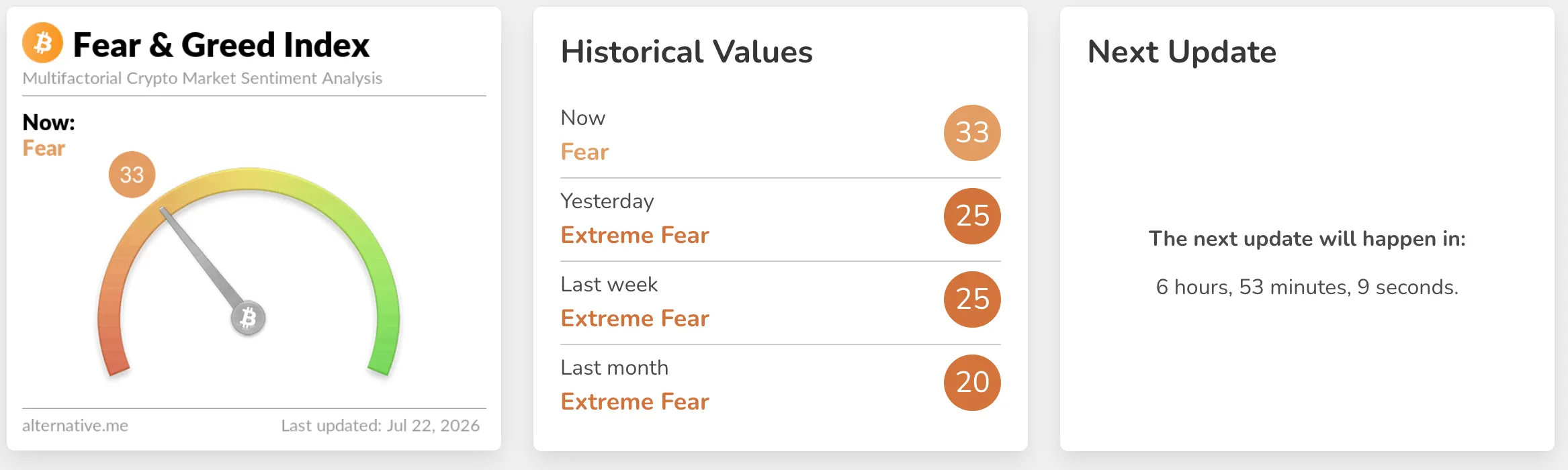
The Crypto Fear & Greed Index currently sits at 33, placing the market in a state of "fear." This reading is notable because it signifies a lack of panic, yet it also highlights an ongoing impasse. Investors are neither aggressively buying the dip nor capitulating in mass, resulting in a low-conviction environment where the market awaits a definitive signal from either Washington or the balance sheets of Big Tech.
Chronology of the Recent Correction
The last several weeks have been a gauntlet for Bitcoin holders. The journey from previous highs to the mid-$50,000 range was marked by high volatility and the emergence of a "death cross"—a technical formation where the 50-day EMA dips below the 200-day EMA. Historically, this pattern is viewed as a harbinger of long-term bearish sentiment, reflecting a period where long-term holders are significantly underwater compared to their shorter-term counterparts.

However, the recent bounce from the $58,000 test has allowed the "death cross" to begin thinning. Traders are now watching the charts with renewed interest, hoping that the convergence of these moving averages might pivot toward a "golden cross" in the coming months. This transition, if realized, would serve as a structural confirmation that the long-term trend has regained its bullish integrity.
Supporting Data: Technical Indicators and Institutional Flows
To understand the current impasse, one must look beyond the price tag and into the underlying data streams that dictate institutional behavior.
The EMA and ADX Analysis
The 200-period EMA acts as a primary barometer for "big-picture" health. When Bitcoin crashed toward this line, the immediate intervention of buyers served as a validation of demand at the $65,000 floor. While the structure remains technically bearish due to the ongoing death cross, the Average Directional Index (ADX) provides a nuanced perspective.
Currently, the ADX sits at 19.5. On a scale of 0 to 100, readings below 25 indicate a lack of trend. While this suggests that the current rally lacks the "conviction" needed for a breakout, it also confirms that the bearish momentum of the recent crash is rapidly exhausting itself. In a vacuum, a low-ADX environment following a correction is often a precursor to a period of range-bound stability rather than further freefall.
The RSI Signal
The Relative Strength Index (RSI), currently at 59.9, stands as the most bullish indicator on the dashboard. By hovering above the neutral 50-line without crossing into the overbought territory (typically above 70), Bitcoin exhibits healthy momentum. This positioning suggests there is sufficient "room to run" before the asset becomes overextended, providing a technical argument for a potential push higher.
The Coinbase Premium Index
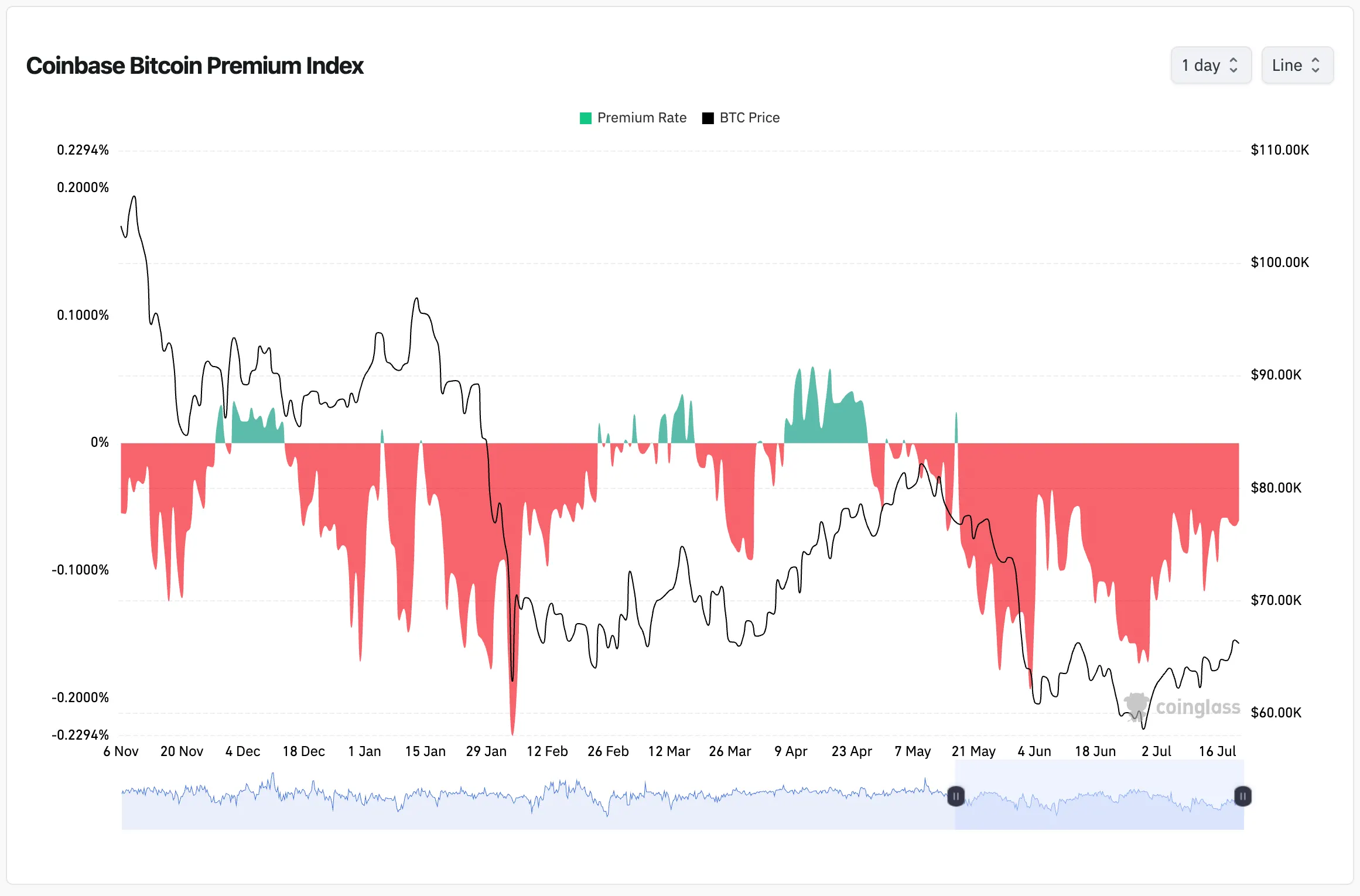
Perhaps the most telling bearish indicator is the Coinbase Premium Index, which has remained negative since May. This index measures the price difference between Bitcoin on Coinbase (largely U.S. institutional buyers) and global exchanges. A persistent negative premium indicates that institutional capital is not currently driving the market. Instead of accumulating, major players appear to be practicing risk aversion, likely influenced by the broader uncertainty in the S&P 500 and Nasdaq.
Official Responses and Policy Catalysts
The primary bullish narrative hinges on the "Clarity Act," a landmark piece of legislation aimed at resolving the long-standing jurisdictional dispute between the Securities and Exchange Commission (SEC) and the Commodity Futures Trading Commission (CFTC).
Treasury Secretary Scott Bessent recently signaled that the bill is at the "1-yard line," urging Congress to push the legislation through before the August 7 recess. For the crypto industry, this is not just a regulatory update; it is a potential structural transformation. Clarity on whether crypto assets are classified as securities or commodities would likely invite a wave of institutional capital that has been sidelined by legal ambiguity.
On the other side of the ledger, analysts like Daniela Hathorn of Capital.com emphasize that current market behavior is less about crypto-specific failures and more about macro-driven risk aversion. The tech sector’s earnings, particularly from giants like Alphabet and Tesla, are seen as the "litmus test" for the broader market’s risk appetite. If AI spending remains strong, the resulting market optimism could spill over into crypto. If those earnings disappoint, the subsequent equity-market volatility could pull Bitcoin back toward its recent support levels.
Implications: A Market at a Squeeze
The current environment is best described as a "statistical squeeze." Prediction markets, such as those on Myriad, reflect this uncertainty. Traders are currently pricing in only a 19% probability that Bitcoin will clear $68,000 by July 26, suggesting that the current range is expected to hold through the weekend.
The Bull Case
- Legislative Momentum: The passage of the Clarity Act could provide the necessary catalyst to break the current technical stagnation.
- Resilient Support: The defense of the 200-day EMA confirms that institutional demand remains present at lower price points.
- Long-Term Targets: Despite the correction, institutional researchers like those at Bernstein maintain a $150,000 year-end target, framing the current volatility as a temporary hurdle rather than a cycle-ending event.
The Bear Case
- Institutional Absence: The sustained negative Coinbase Premium confirms that "smart money" is not yet ready to lead a new leg up.
- Technical Headwinds: The death cross remains active, and the low ADX implies that even if the price moves, it lacks the volume and conviction to sustain a significant rally.
- Macro-Sensitivity: As long as crypto remains highly correlated with tech stocks, any disappointment in upcoming earnings reports could trigger a broader sell-off that forces Bitcoin back to test the $55,000 level.
Conclusion
Bitcoin is currently in a state of suspended animation. The technical indicators are flashing mixed signals: the RSI suggests underlying strength, while the ADX and the death cross warn of structural weakness. The market is waiting for a signal—either a breakthrough in Washington regarding regulatory clarity or a confirmation of economic health from the leaders of the AI revolution.
Until the negative Coinbase Premium flips positive and the ADX trends upward, the most likely outcome is continued consolidation. However, for long-term investors, the fact that Bitcoin has successfully defended its long-term support levels during a period of intense global uncertainty remains a testament to the asset’s evolving maturity. The coming weeks will likely determine whether the current squeeze resolves into a breakout toward $70,000 or a re-test of the $55,000 bear-case scenario.
Disclaimer: The views and opinions expressed in this article are for informational purposes only and do not constitute financial, investment, or other professional advice. Cryptocurrency investments involve significant risk.
