

Main Facts
The landscape of decentralized finance (DeFi) and digital currency has long been dominated by USD-denominated stablecoins, leaving major fiat currencies like the South Korean won (KRW) largely unrepresented in on-chain infrastructure. Enter KRW1, an innovative, bank-backed stablecoin designed to anchor the South Korean won directly onto high-speed blockchain architecture.
Operating on a strictly conservative, reserve-backed model, KRW1 ensures that every single token in circulation is mathematically and physically tethered to real-world capital: for every 1 KRW1 minted, Woori Bank—one of South Korea’s premier financial institutions—holds exactly 1 KRW in reserve.
This model relies on a carefully divided institutional ecosystem designed to segregate regulatory compliance from decentralized efficiency:
- Woori Bank: Serves as the bedrock custodian holding the fiat reserves, providing institutional-grade trust and safety.
- BDACS: Manages the technical issuance and digital custody of the stablecoin tokens.
- Avalanche [AVAX]: Acts as the high-throughput, scalable settlement layer, facilitating swift on-chain transfers.
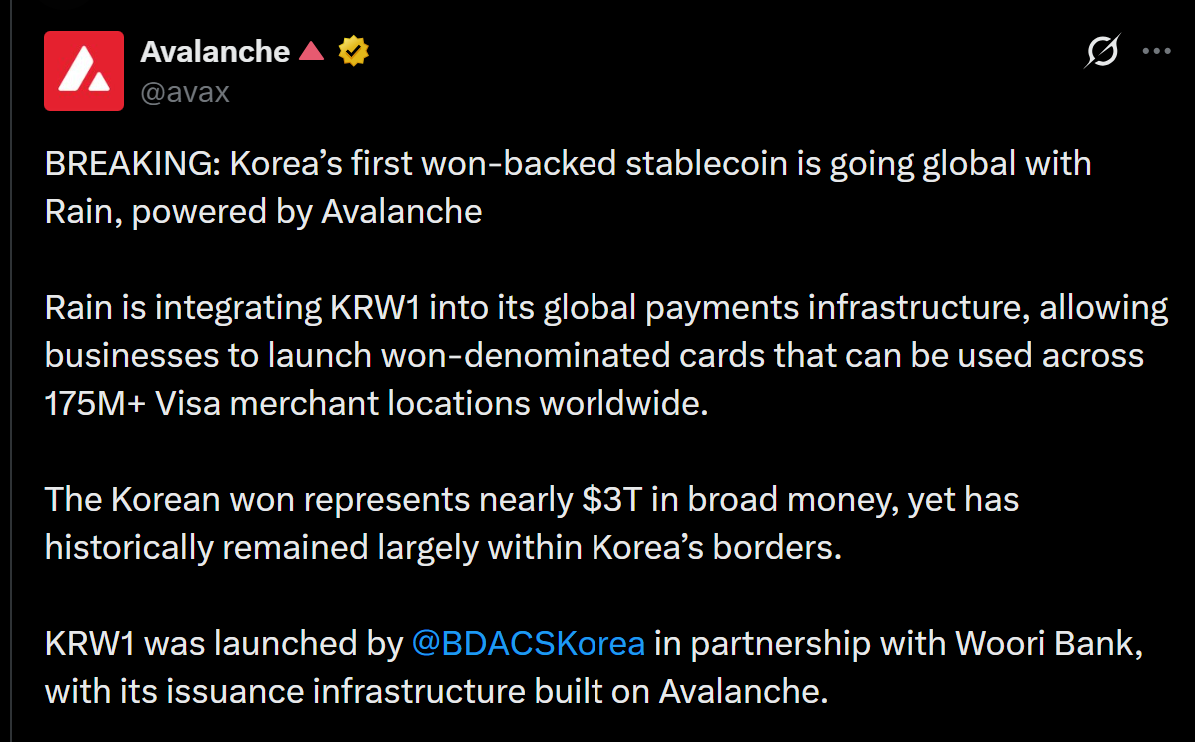
Despite this robust institutional backing, KRW1 remains in its foundational stages. Current on-chain metrics reveal a circulating supply of approximately 142 million KRW1 tokens, valued at roughly $105,195 according to recent Real-World Asset (RWA) tracking data. While active wallet counts and transaction volumes are modest, a pivotal integration with the Rain network—unlocking Visa acceptance at over 175 million merchants across 200 countries—aims to transform KRW1 from a niche regional experiment into a globally accessible payment rail.
However, scaling this infrastructure will require overcoming substantial liquidity bottlenecks, thin order books, and rigorous cross-border regulatory frameworks.
Chronology
To understand how KRW1 evolved from a theoretical concept into a live, blockchain-native asset integrated with global payment rails, it is essential to trace its development timeline:
- The Institutional Foundation (Pre-Launch): Recognizing the need for compliant, fiat-backed digital assets in South Korea, development began on a secure, multi-party model. Financial heavyweights and tech infrastructure providers, notably Woori Bank and BDACS, collaborated to establish a fully backed, transparent reserve mechanism that complies with strict domestic banking standards.
- Deployment on Avalanche: To ensure high-speed transactions and low latency compared to legacy networks, the developers selected the Avalanche network as the dedicated settlement layer. This separation of powers allowed regulated traditional banking (Woori Bank) to interface seamlessly with permissionless on-chain movement.
- Initial Circulation Phase: KRW1 went live with an initial rollout, minting approximately 142 million tokens. During this early phase, adoption was largely confined to experimental transfers, early-stage network testing, and controlled institutional environments, resulting in limited transaction volumes and active wallets.
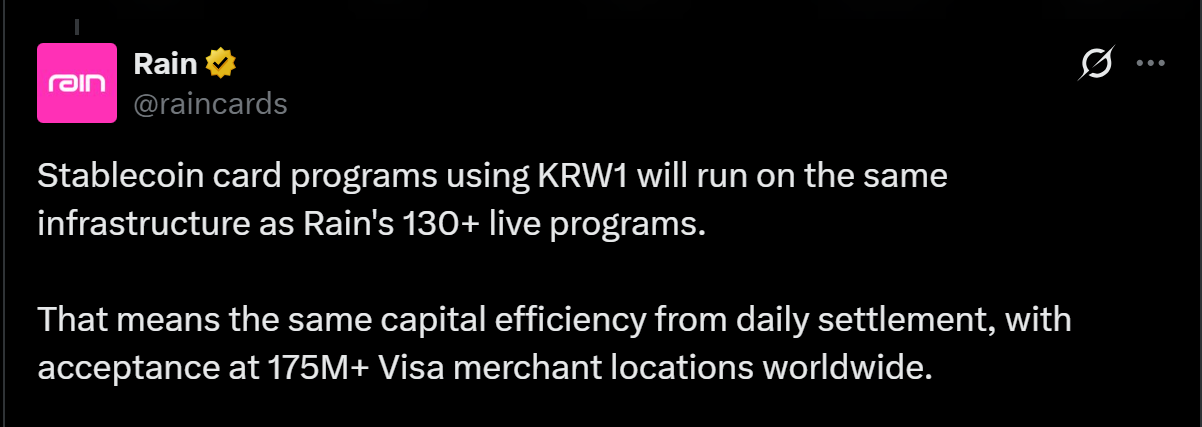
- The Rain and Visa Integration Milestone: In an effort to break out of domestic silos, KRW1 partnered with Rain. This integration bridged digital won balances directly to the global Visa merchant network. By tapping into Rain’s existing framework—which includes over 130 operational card programs—KRW1 positioned itself to bypass traditional foreign exchange rails, enabling cardholders to spend digital won directly at more than 175 million merchant locations worldwide.
- Current Status (Growth vs. Liquidity Phase): Today, KRW1 stands at a critical crossroads. While the technical and payment infrastructure is fully established via Visa connectivity, the token’s market capitalization and liquidity remain thin, prompting analysts to closely monitor upcoming transaction volume, settlement metrics, and active wallet expansion.
Supporting Data
A rigorous examination of KRW1 requires looking past marketing narratives and evaluating hard on-chain data and RWA metrics. The current health and scale of the KRW1 ecosystem can be broken down into several key quantitative indicators:
1. Token Supply and Valuation
- Circulating Supply: ~142 million KRW1 tokens.
- USD Market Valuation: ~$105,195 (based on current exchange rates and RWA tracking data).
- Reserve Ratio: 1:1 backing maintained by Woori Bank (1 KRW1 = 1 physical KRW held in reserve).
2. Network Activity and Adoption Metrics
- Transaction Velocity: Currently low, reflective of an early-stage network where issuance outpaces everyday retail or commercial velocity.
- Active Wallets: Modest counts indicate that usage remains concentrated among early adopters, testers, and institutional participants rather than mainstream consumers.
- Growth Catalysts: Analysts emphasize that true adoption will only be signaled when Circulating Supply, On-Chain Transfers, and Active Wallet Counts begin to rise concurrently over consecutive quarters.
3. Global Reach and Payment Infrastructure
- Merchant Acceptance: Access to over 175 million Visa merchants globally through the Rain integration.
- Geographic Reach: Operational support spanning more than 200 countries.
- Precedent Programs: Leverages a robust foundation built upon 130+ existing card programs deployed by Rain, minimizing deployment friction for new won-denominated card issuance.
Official Responses
As institutional interest in stablecoins grows globally, traditional financial institutions and tech partners involved in the KRW1 ecosystem have shared insights regarding their strategic motivations and operational philosophies.
Representatives from Woori Bank have consistently emphasized the necessity of bridging traditional banking security with emerging ledger technologies. By acting as the sole reserve custodian, Woori Bank aims to provide users with absolute peace of mind, ensuring that digital tokens do not drift into the speculative, unbacked territory that has historically plagued parts of the crypto market. Bank executives have highlighted that maintaining a strict 1:1 fiat-to-token reserve ratio is non-negotiable for preserving public trust and satisfying South Korean financial regulators.
Meanwhile, representatives from BDACS, which handles issuance and custody, have defended the architectural separation between regulated reserves and on-chain movement. By utilizing Avalanche as the settlement layer, BDACS engineers noted that the network benefits from enterprise-grade speed and finality without compromising the rigorous compliance protocols required by South Korean law.
Furthermore, fintech partners behind the Rain integration have noted that the primary friction point for international travelers, corporations, and digital nomads has always been foreign exchange (FX) fees and conversion delays. By connecting KRW1 directly to Visa’s vast international infrastructure, official spokespersons argue that users can finally bypass the costly step of converting regional fiat into US dollars or other intermediary currencies, streamlining cross-border payments for Korean won holders.
Implications
The launch and expansion of KRW1 carry profound implications for the South Korean financial sector, the broader Asian digital asset market, and the future of global cross-border payments.
1. The Regional vs. Global Paradox
The most pressing implication of KRW1’s current state is the tension between its global ambitions and its regional liquidity constraints. While the integration with Rain and Visa technically grants KRW1 holders access to 175 million merchants across 200 countries, a total market capitalization of roughly $105,195 (142 million tokens) is far too shallow to support heavy commercial or institutional throughput. If a corporate entity or high-net-worth traveler attempts to execute large-scale settlements using KRW1 today, the thin liquidity pools could lead to severe slippage and execution bottlenecks. Therefore, until organic demand scales up liquidity, KRW1 remains a visionary regional token with global tools, rather than a fully realized global payment rail.
2. The Future of Bank-Backed Stablecoins in Asia
South Korea has traditionally maintained a cautious, highly regulated stance toward cryptocurrencies and digital assets. KRW1’s reliance on a traditional commercial bank (Woori Bank) establishes a regulatory-friendly blueprint for other domestic financial institutions. If KRW1 succeeds in proving that bank-backed stablecoins can operate securely on public-permissionless chains like Avalanche, it could pave the way for other Asian economies to tokenize their local fiat currencies, challenging the hegemony of USD stablecoins like USDT and USDC in regional trade.
3. Redefining Corporate Expenses and Travel
For South Korean businesses and frequent travelers, the long-term implications are deeply practical. By removing the need to convert won balances into U.S. dollars or execute costly international wire transfers, KRW1-enabled cards could drastically reduce corporate overhead. Cross-border payouts, supply chain settlements, and travel expenses could settle instantly on-chain while being spent seamlessly through standard Visa point-of-sale terminals.
4. What to Watch Moving Forward
Ultimately, KRW1’s survival and long-term viability depend on a triad of factors: deepening liquidity, driving organic merchant and user adoption, and maintaining clear regulatory backing. Observers should monitor whether post-card-launch metrics—specifically Transaction Volume, Settlement Volume, and User Spending—begin to climb in tandem. Until those gaps are closed, KRW1 will remain a fascinating case study in how traditional banking infrastructure attempts to conquer the decentralized global economy.
