

Main Facts
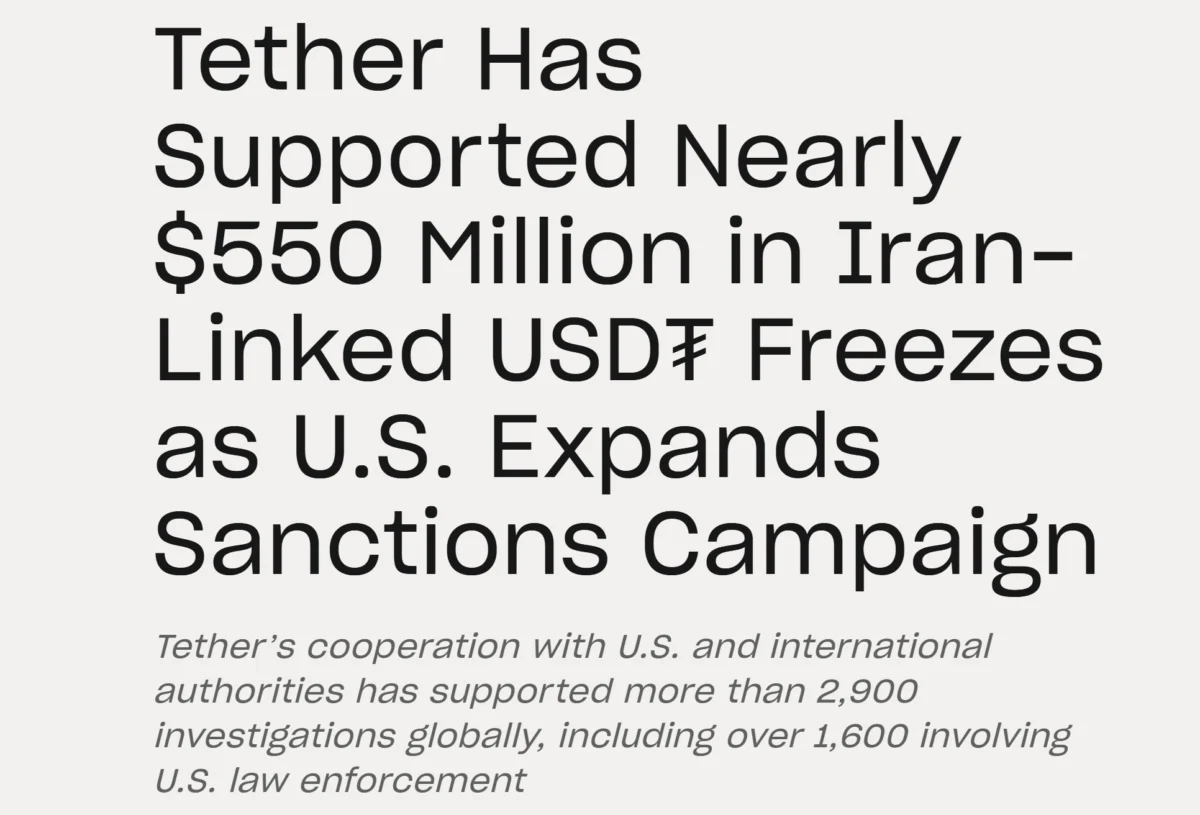
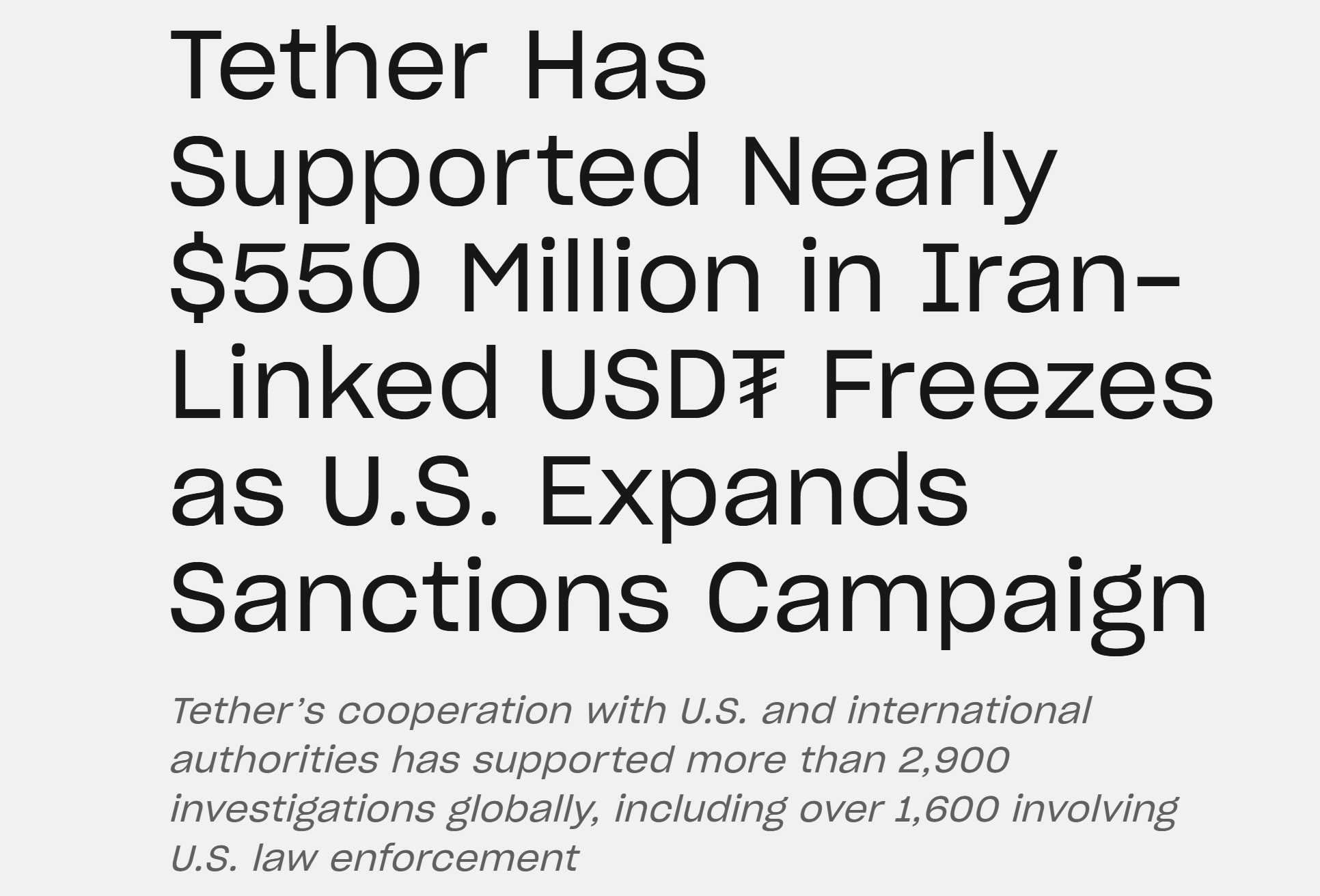
Stablecoin issuer Tether finds itself at the critical intersection of explosive financial growth and intense regulatory scrutiny. In a move highlighting its expanding cooperation with international law enforcement, Tether recently announced the freezing of approximately $550 million in Iranian-linked USDT assets at the direct request of a United States agency. This high-profile action underscores the company’s evolving role in global financial enforcement, leveraging the transparency of public blockchains to crack down on illicit actors who seek alternative banking rails.
However, this enforcement action arrives against a backdrop of staggering market expansion. Tether recorded a monumental $4.4 trillion in transaction volume during the fourth quarter of 2025 alone, cementing its status as the dominant stablecoin in the global digital asset ecosystem. This rapid scaling, while advantageous for liquidity and cross-border settlements, has placed a magnifying glass on the platform’s compliance mechanisms.
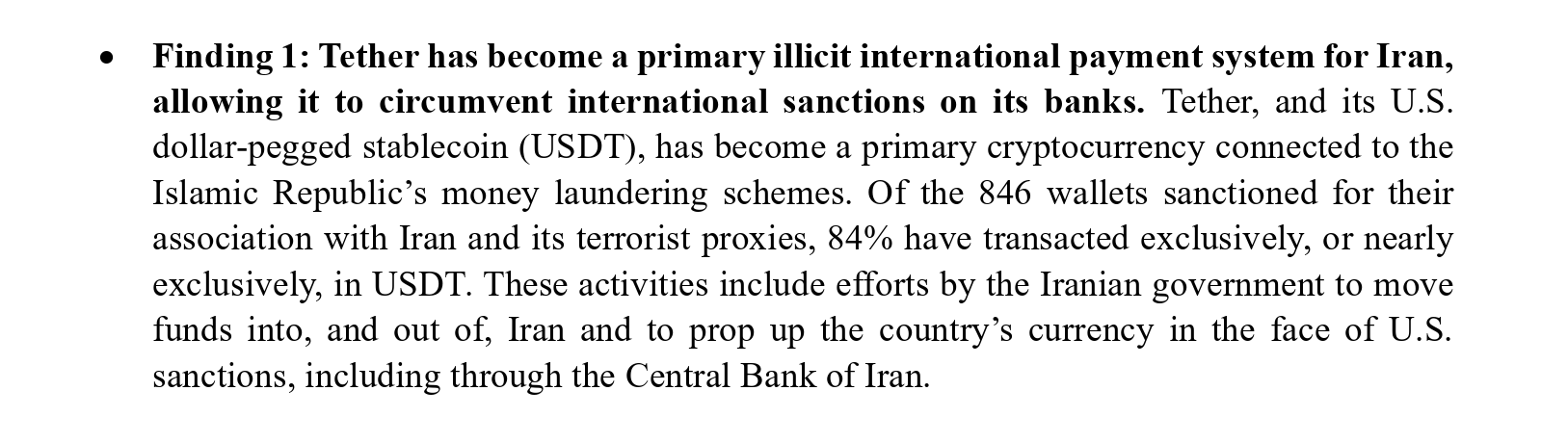
Parallel investigations, including a comprehensive U.S. Senate report, reveal that USDT has increasingly become the currency of choice within Iran’s shadow banking infrastructure—with roughly 84% of targeted sanctioned wallets utilizing the stablecoin. As technological upgrades like "StableChain" aim to push transaction speeds and scalability to unprecedented heights, Tether faces the ultimate test: maintaining its massive market dominance while proving it can outpace sophisticated illicit finance networks.
Chronology of Events: The Evolution of Tether’s Enforcement Strategy
To understand Tether’s current position in global financial policing, it is necessary to examine the timeline of how the stablecoin transitioned from a niche crypto-trading pair into a central pillar of geopolitical finance and regulatory focus.
- 2021 – 2025 (The Shadow Banking Era): Throughout these years, as traditional financial routes were aggressively squeezed by U.S. and international sanctions, Iran’s adoption of cryptocurrency surged to an estimated $10 billion. Investigators tracked more than $600 million in USDT moving through accounts tied to two sanctioned Iranian oil smugglers. These transactions effectively bridged traditional state-backed financial networks with regional militant organizations, such as Hizballah and the Houthis.
- Late 2025 (Volume Explosion): Tether achieved a record-breaking financial milestone, posting a staggering $4.4 trillion in transaction volume in Q4 2025. This historic high demonstrated the unmatched utility of USDT for global trade and remittances, but it simultaneously raised alarm bells among global regulators regarding systemic risk and illicit usage.
- August 2025 (The StableChain Update): Tether and its ecosystem partners introduced pivotal updates to StableChain, designed to enhance scalability. Promising a rapid 0.7-second transaction finality, guaranteed block space, and a long-term target capacity of 10,000 transactions per second (TPS), the infrastructure update aimed to revolutionize high-volume digital payments.
- Recent Enforcement Actions (The $550 Million Freeze): Responding directly to growing regulatory pressures and intelligence reports, Tether executed one of its largest asset freezes to date. At the behest of a U.S. agency, the firm locked approximately $550 million in Iranian-linked USDT wallets, marking a definitive escalation in Tether’s proactive compliance measures.
Supporting Data: Unpacking the Scale of USDT in Illicit Networks
The debate surrounding Tether’s regulatory burden is deeply rooted in empirical data regarding transaction volumes, wallet distributions, and network performance metrics.
1. The Senate Report and Wallet Concentration
According to findings from the U.S. Senate Homeland Security and Governmental Affairs Committee (HSGAC), USDT is deeply entrenched in sanctioned financial ecosystems. Out of 846 wallets specifically flagged for sanctions or asset seizure linked to Iranian networks, an overwhelming 84% relied on USDT as their primary currency. This high concentration demonstrates that the stablecoin has effectively replaced traditional fiat banking channels for sanctioned nation-states seeking to bypass Western financial blockades.
2. Multi-Year Oil Smuggling Flows
Blockchain analytics and legislative investigations revealed that between 2021 and 2025, over $600 million in USDT was successfully traced through the accounts of just two prominent Iranian oil smugglers. These funds did not merely circulate within isolated crypto-asset loops; rather, they directly financed broader cross-border settlements connecting Iranian financial institutions to regional proxy groups, proving that stablecoins are increasingly utilized for complex, geopolitical trade.
3. Macro-Volume and Technological Velocity
Tether’s operational scope reached unprecedented heights in the final quarter of 2025, processing $4.4 trillion in transactions. This colossal figure highlights the sheer liquidity moving through the network on a daily basis. Compounding this velocity is the rollout of StableChain, which achieves finality in a mere 0.7 seconds and targets a throughput of 10,000 transactions per second. While this speed is a boon for legitimate global commerce, it drastically compresses the window of time that automated compliance and monitoring tools have to flag and intercept suspicious movements before funds are laundered across decentralized protocols.
Official Responses and Executive Stance
As scrutiny mounts over how decentralized and semi-centralized assets are utilized by nation-states, Tether’s leadership has adopted an increasingly transparent and cooperative posture with global authorities.
Paolo Ardoino, Chief Executive Officer of Tether, has been vocal in defending the company’s proactive compliance framework. Addressing critics who point to the misuse of USDT by bad actors, Ardoino emphasized the inherent advantages that public blockchains offer to law enforcement agencies compared to legacy financial systems.
"Public blockchains provide visibility for investigators where cash does not," Ardoino stated, highlighting that every transaction on a public ledger leaves an immutable trail.
Furthermore, Ardoino clarified Tether’s operational policy regarding asset freezes. He reiterated that the company maintains an open line of communication with global regulators and law enforcement agencies, confirming that Tether will consistently assist authorities whenever they are provided with "credible information" regarding illicit wallets. By actively freezing hundreds of millions of dollars in compromised assets—such as the recent $550 million Iranian-linked seizure—Tether aims to reposition itself not as a sanctuary for evasion, but as a compliant partner in modern financial security.
Implications: The Future of Stablecoin Regulation and Compliance
The convergence of multi-trillion-dollar transaction volumes, rapid network upgrades, and high-profile sanctions enforcement carries profound implications for the future of the entire cryptocurrency industry.
The Intensification of Issuer-Level Controls
Because blockchain networks themselves are decentralized and permissionless, they cannot inherently screen transactions or execute court orders. Consequently, the burden of compliance falls heavily on centralized issuers like Tether. The ability to "blacklist" or freeze specific wallet addresses remains the primary intervention point for halting illicit capital flows. As malicious actors adopt more sophisticated methods to obfuscate their funds—such as utilizing privacy mixers or cross-chain bridges—Tether’s issuer-level controls will face relentless testing.
The Race Between Speed and Surveillance
The introduction of high-speed infrastructure like StableChain introduces a paradox for crypto compliance. While faster transaction finality and 10,000 TPS capacity are essential for mass adoption and competing with traditional payment rails like Visa or SWIFT, they simultaneously degrade the efficacy of legacy monitoring systems. Financial intelligence units and blockchain analytics firms must evolve in tandem, deploying real-time, AI-driven compliance solutions that can analyze high-velocity throughput without crippling user experience.
Regulatory Horizons
The vast scale of USDT—exemplified by its $4.4 trillion Q4 2025 volume—ensures that regulatory oversight will only intensify. Policymakers in Washington, Europe, and Asia are increasingly viewing stablecoins not just as crypto-native utilities, but as systemic components of global monetary policy. Tether’s willingness to cooperate with U.S. agencies may soften the regulatory blow, but it also establishes a precedent: stablecoin issuers are expected to act as the global gatekeepers of financial integrity.
Ultimately, Tether’s trajectory will depend on its ability to navigate this tightrope. By successfully freezing illicit funds and collaborating with international law enforcement, the company is attempting to prove that high-growth digital currencies and robust national security can coexist on the blockchain.
