

Executive Summary & Main Facts
The landscape of digital assets is undergoing a paradigm shift, moving rapidly from speculative retail trading instruments toward regulated, real-world utility rails. At the forefront of this evolution in East Asia is KRW1, an innovative South Korean won-backed stablecoin designed to anchor fiat currency directly into decentralized blockchain architecture. Utilizing a stringent reserve-based framework, KRW1 operates on a straightforward yet robust premise: for every single KRW1 token minted into circulation, Woori Bank—one of South Korea’s premier financial institutions—holds a corresponding 1 KRW in cash reserves.
This institutional-grade backing aims to bridge the gap between traditional banking security and the high-speed efficiencies of distributed ledger technology (DLT). Within its operational structure, responsibilities are cleanly divided to ensure regulatory compliance and operational safety. BDACS handles the intricate processes of issuance and secure digital asset custody, while the Avalanche [AVAX] network serves as the high-throughput settlement layer. This strategic division effectively separates heavily regulated financial reserves from rapid, borderless on-chain movement.
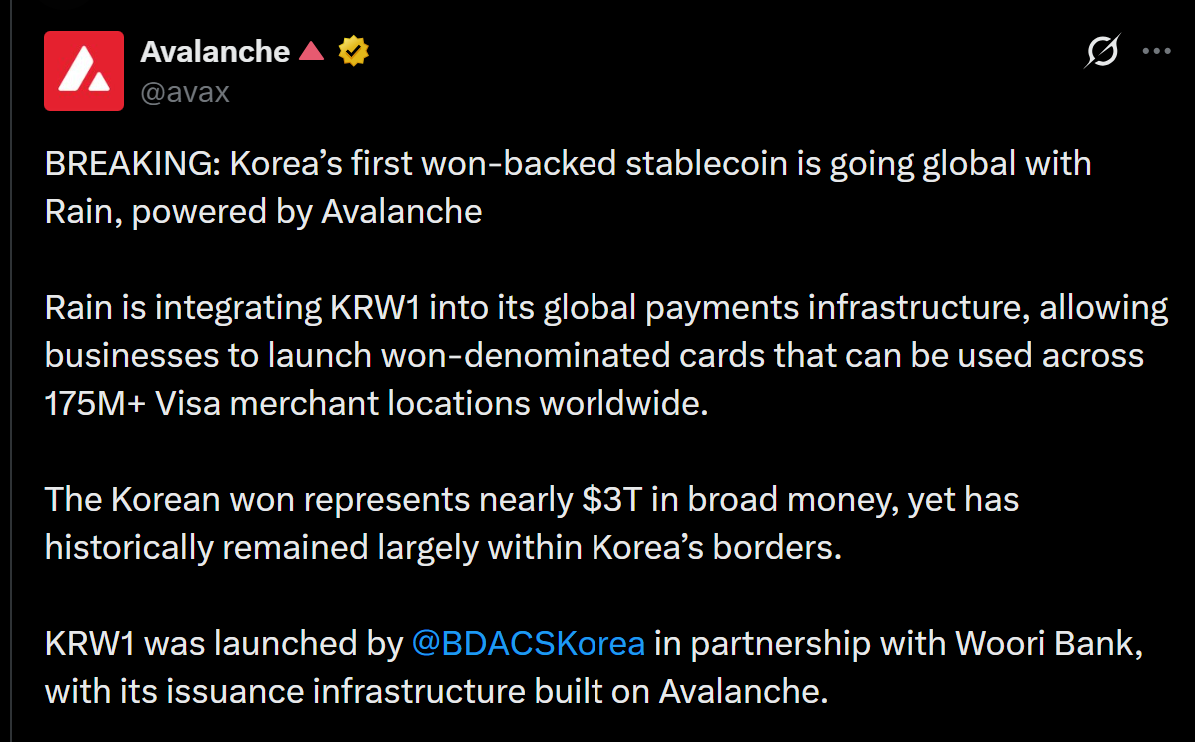
Despite its robust structural design, KRW1 currently exists in a delicate transitional phase. With a circulating supply hovering around 142 million tokens—translating to a modest valuation of approximately $105,195 based on real-world asset (RWA) data—its transaction volume and active wallet counts reflect an early-stage network rather than a ubiquitous payment medium. However, a monumental development threatens to alter this trajectory: a new integration via Rain that introduces Visa acceptance across more than 175 million global merchants in over 200 countries.
This comprehensive report breaks down the anatomy of the KRW1 stablecoin, its chronological development, the supporting on-chain and macroeconomic data, official and industry responses, and the profound implications this initiative holds for the future of cross-border commerce and Asian digital finance.
Chronology of Development: From Concept to Global Rails
The realization of a bank-backed South Korean won stablecoin did not happen overnight; it is the culmination of years of regulatory deliberation, technological experimentation, and strategic corporate partnerships.
- Laying the Foundation (Pre-2024): As global interest in stablecoins surged, dominated almost entirely by U.S. dollar-pegged assets like USDT and USDC, South Korean financial regulators maintained a notoriously cautious stance. Digital asset oversight focused heavily on investor protection, exchange transparency, and anti-money laundering (AML) protocols. However, forward-thinking fintech firms and institutional leaders recognized the immense inefficiency of routing local currency through legacy international wire systems.
- The Architecture of Trust (2024–2025): The conceptualization of KRW1 took shape through a collaborative model that prioritized institutional trust. Woori Bank stepped into the spotlight as the custodian of absolute fiat reserves, solving the counterparty risk that plagued early, unregulated algorithmic stablecoins. Concurrently, BDACS was established as the primary issuer and custodian interface, bridging traditional banking APIs with blockchain smart contracts.
- Selecting the Settlement Layer: Developers selected Avalanche [AVAX] as the foundational blockchain network. Avalanche’s sub-second finality, customizable subnet capabilities, and enterprise-grade scalability made it an ideal environment for issuing and transferring a regulated sovereign currency asset safely outside of volatile public DeFi arenas.
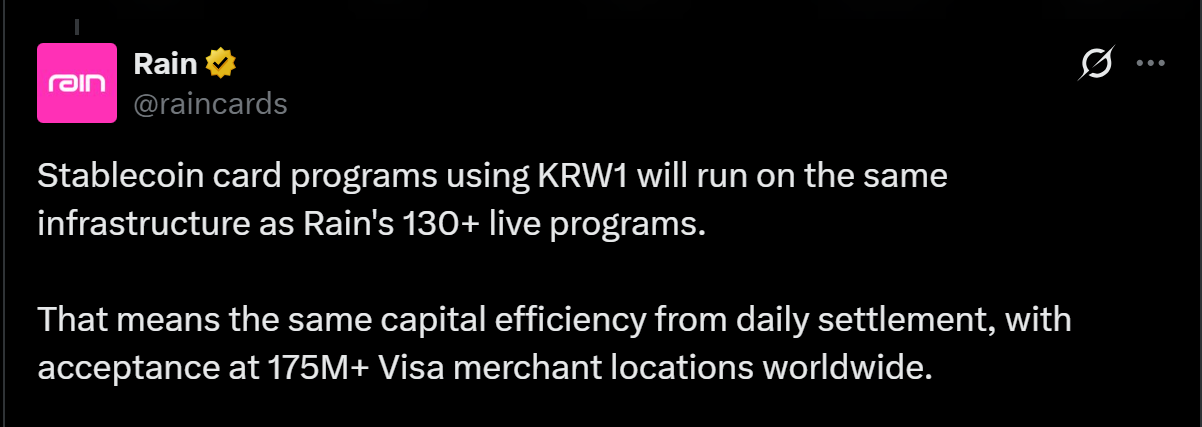
- The Rain and Visa Integration Milestone (2026): Moving past internal testing and localized transfers, the project reached a critical inflection point with the announcement of integration via Rain. By leveraging Rain’s card issuance infrastructure—which builds upon a proven track record of over 130 existing programs—KRW1 holders gained the unprecedented ability to link their digital won balances directly to Visa payment cards. This move effectively vaulted KRW1 from a localized blockchain experiment into an international spending mechanism capable of interacting with the global merchant ecosystem.
Supporting Data and On-Chain Metrics
To understand the current standing of KRW1, one must evaluate the intersection of its on-chain data, economic liquidity, and adoption metrics. While the narrative surrounding Visa integration is exceptionally bullish, current quantitative realities paint a nuanced picture of an asset with grand ambitions operating on a nascent scale.
1. Circulation and Valuation
According to real-world asset (RWA) analytics, KRW1’s circulating supply sits at approximately 142 million tokens. At current exchange rates, this aggregate circulating supply translates to a modest $105,195 USD. When compared against multi-billion-dollar dollar-pegged stablecoin giants, KRW1’s liquidity depth is microscopic.
| Metric | Current Status | Market Implication |
|---|---|---|
| Circulating Supply | ~142,000,000 KRW1 | Indicates controlled, localized issuance rather than organic mass adoption. |
| USD Equivalency | ~$105,195 | Highlights a low liquidity ceiling compared to USD-denominated peers. |
| Active Wallets | Modest / Early-stage | Reflects niche usage primarily among institutional testers and tech-forward crypto users. |
| Merchant Reach | 175M+ Merchants (via Rain/Visa) | Vast theoretical expansion, shifting the bottleneck from access to liquidity. |
2. Transaction Dynamics and Velocity
On-chain analysis reveals that active wallet counts and daily transfer volumes remain relatively low. For KRW1 to transition from a controlled issuance experiment into a vibrant economic tool, market analysts stress that three vital metrics must rise in tandem:
- Circulating Supply: Demonstrating a growing demand for minting digital won.
- Transfers: Indicating active peer-to-peer circulation and smart contract utilization.
- Active Wallet Counts: Proving a broadening user base rather than concentrated institutional wallets.
Without a synchronized surge in these three indicators, the network risks remaining an underutilized digital ledger entry.
3. The Liquidity Dilemma
The stark disparity in liquidity between KRW1 and established dollar-backed stablecoins poses a tangible engineering and economic hurdle. Low liquidity restricts the asset’s capacity to process large institutional transactions or smooth out major corporate treasury flows without causing severe slippage or execution bottlenecks. While the infrastructure to spend digital won anywhere in the world now exists via Visa rails, the underlying pool of liquid KRW1 tokens must expand exponentially to support global commerce at scale.
Official Responses and Stakeholder Perspectives
The launch and expansion of KRW1 have elicited significant commentary from traditional banking executives, blockchain developers, and regulatory watchers across the Asia-Pacific region.
Woori Bank’s Institutional Perspective
Representatives from Woori Bank have consistently emphasized prudence, compliance, and consumer safety. By anchoring every token to a physical won held within the bank’s vaults, Woori aims to insulate users from the contagion risks that have historically affected crypto-native stablecoins. Bank executives view KRW1 not as a speculative cryptocurrency, but as an exploratory step toward modernizing South Korea’s financial infrastructure and preparing for a future where central bank digital currencies (CBDCs) and commercial bank-issued stablecoins coexist.
BDACS and Avalanche Ecosystem Reactions
BDACS has highlighted the importance of a clean separation of concerns. By isolating the regulated banking reserves from the rapid movement of tokens on Avalanche, the issuing body satisfies regulatory demands while preserving the programmatic agility of Web3. Avalanche developers have similarly pointed to KRW1 as a prime example of real-world asset (RWA) tokenization, showcasing how enterprise subnets can host sovereign fiat currencies with absolute cryptographic verification and compliance parameters.
Fintech and Payment Observers
Fintech analysts monitoring the Rain and Visa integration have praised the strategic elimination of foreign exchange friction. By allowing users to spend digital won directly without intermediate conversions into U.S. dollars or legacy fiat rails, the partnership effectively solves a major pain point for travelers, expatriates, and corporate entities managing cross-border supply chains. However, independent market commentators remain cautious, reiterating that availability does not automatically equate to organic demand.
Strategic Implications: Regional Innovation vs. Global Ambitions
The evolution of KRW1 carries far-reaching implications for South Korea’s digital economy, international trade dynamics, and the broader global stablecoin market.
1. Eliminating Foreign Exchange and Intermediary Friction
One of the most profound implications of linking KRW1 to a global card network like Visa is the reduction of transaction friction. Traditionally, spending South Korean won abroad required multi-layered conversions—often moving from KRW to USD, and then to the local currency of the destination country—incurring steep FX fees and multi-day settlement delays. By utilizing a direct digital won balance accessed via a global card rail, users can bypass traditional banking intermediaries, drastically lowering costs for international travel, corporate travel expenses, and cross-border vendor payouts.
2. Regulatory Compliance as a Competitive Moat
Unlike decentralized stablecoins that operate in legal gray areas, KRW1’s bank-backed architecture places it firmly within the crosshairs of modern financial regulation. While this compliance-first approach limits its initial velocity and anonymity, it acts as a powerful institutional moat. As global regulatory bodies crack down on unverified stablecoins, bank-backed instruments like KRW1 are uniquely positioned to win enterprise contracts, government integrations, and institutional treasury allocations.
3. The Road Ahead: Overcoming the Regional Boundary
Despite its ambitious global reach enabled by Visa’s 175-million-merchant network, KRW1 currently remains fundamentally tethered to the economic gravity of the South Korean won. To evolve from a regional token with global ambitions into a globally recognized payment rail, the project must overcome two primary barriers:
- Scaling Liquidity: The current circulating valuation of ~$105,195 must multiply significantly to absorb the demands of international commercial activity.
- Driving Organic Spending: Post-launch metrics—specifically transaction volume, merchant settlement data, and recurring user spending—will dictate whether the market genuinely desires a won-denominated decentralized asset.
Conclusion
KRW1 stands as a fascinating bridge between the rigid, highly regulated world of South Korean traditional banking and the borderless, high-speed capabilities of Avalanche and Visa. While its current metrics indicate that the project is still in its infancy, the infrastructural groundwork is fully laid. Whether KRW1 can successfully scale its liquidity to match its global ambitions will serve as a crucial bellwether for sovereign stablecoin adoption in the modern digital economy.
