

In the high-stakes world of decentralized finance (DeFi), the margin for error is non-existent. As Ripple moves closer to integrating a native lending protocol into the XRP Ledger (XRPL), the company has adopted an uncompromising stance on security. By employing "formal verification"—a rigorous, mathematical approach to code validation—Ripple is aiming to preemptively neutralize vulnerabilities that traditional testing methods often overlook.
This initiative, spearheaded by Ripple software engineer Vito Tumas in collaboration with blockchain security experts at Common Prefix, marks a significant shift in how Layer-1 protocols approach systemic risk. As the XRPL prepares to enable borrowing and lending directly within its core architecture, this "Fortress XRP" strategy aims to instill institutional-grade confidence in a network increasingly defined by its native DeFi capabilities.
The Limits of Conventional Testing
For decades, the standard for software development has relied on "testing": writing scripts to simulate user behavior, edge cases, and error handling. While effective for standard web applications, this approach is fundamentally reactive. Developers can only test for the scenarios they can anticipate. If a developer fails to account for a specific sequence of complex, multi-layered operations, a vulnerability remains hidden in the code, waiting to be exploited.
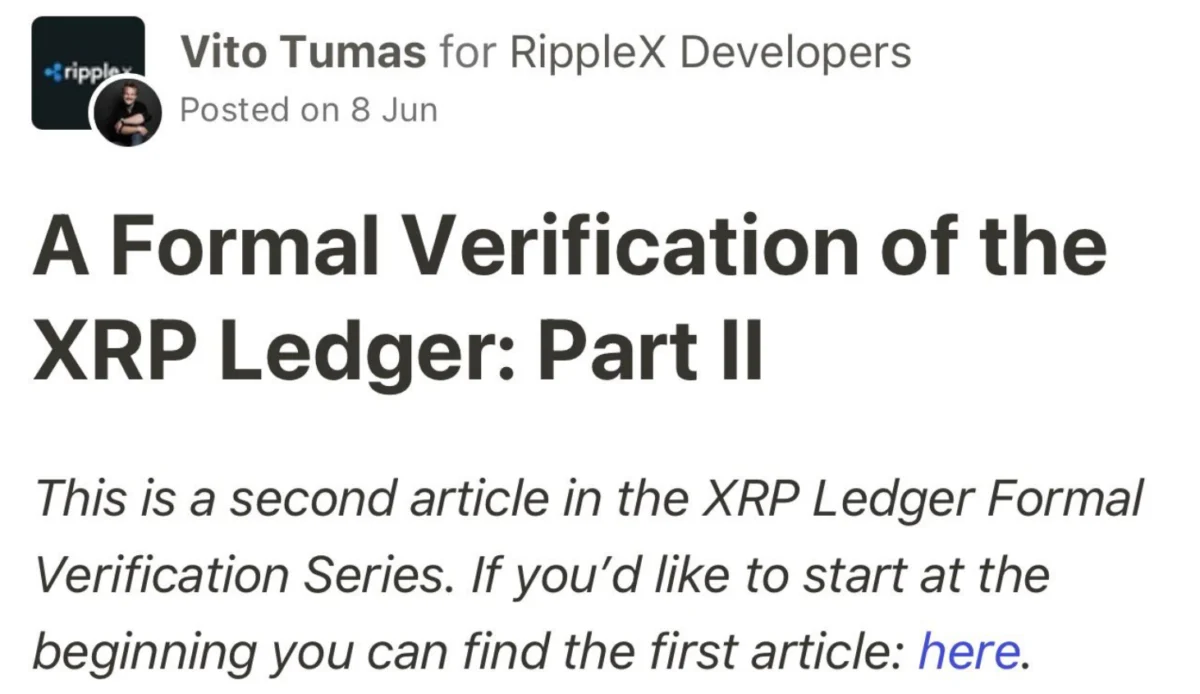
Vito Tumas recently disclosed that the formal verification process for the upcoming lending protocol has already identified complex edge cases that traditional testing methodologies completely missed. Unlike standard testing, formal verification utilizes mathematical proofs to verify that code behaves exactly as intended under all possible conditions. By constructing an abstract model of the protocol and continuously comparing it against the C++ implementation of xrpld—the server software powering the XRP Ledger—the team is essentially building a "digital twin" of the protocol that enforces logical correctness.
This methodology is not new to the world of high-reliability engineering. It is the same rigorous standard utilized to safeguard nuclear power plants, commercial aircraft flight control systems, and military-grade encryption software. By applying this to the XRP Ledger, Ripple is treating financial protocol security with the same gravity as life-critical infrastructure.
Chronology: The Path to XLS-66
The journey toward a native lending protocol on the XRPL has been a multi-year project of incremental development and community oversight.

- Initial Proposal: The lending protocol was introduced under the XLS-66 amendment, a proposal designed to integrate peer-to-peer lending capabilities directly into the Ledger.
- Version 3.1.0 Release: With the rollout of XRPL version 3.1.0 earlier this year, the lending protocol moved into the validator voting phase. This marked a critical transition from theoretical design to technical implementation.
- Security Integration: Recognizing the systemic risks of embedding DeFi at the protocol level, Ripple engaged Common Prefix to begin the formal verification audit.
- AI-Assisted Security Breakthroughs: In early 2026, the community witnessed the power of AI in security auditing when an automated tool successfully identified a critical flaw in the "Batch" amendment. This discovery served as a catalyst for integrating more advanced, AI-driven verification tools into the broader development lifecycle.
- Current State: As of June 2026, the lending protocol remains in the final testing and verification phase. Developers are currently ensuring that all security safeguards are robust before the protocol is officially activated for the public.
The Architecture of Native DeFi
A defining feature of the XRP Ledger’s approach to DeFi is the absence of smart contracts. While Ethereum and its derivatives rely on complex, external smart contract languages—which are notorious for being vectors of attack—the XRPL opts for native, protocol-level functionality.
The two pillars of this push are the Lending Protocol and Single Asset Vaults. Because these features are embedded directly into the Layer-1 architecture, they offer a unique value proposition:
- Efficiency: Without the overhead of virtual machine execution environments, transactions are faster and cheaper.
- Safety: Because the functionality is part of the core code, there is no "contract risk" in the traditional sense, provided the core code is verified.
- Network-Wide Impact: The downside of this design is that any flaw in the protocol would have systemic implications for the entire network. This is precisely why the decision to implement formal verification is not merely an optional security layer—it is an existential requirement for the network’s long-term viability.
The Role of AI in Scaling Security
The sheer complexity of the XRPL codebase makes manual verification an exhaustive, and sometimes impossible, task. This is where Artificial Intelligence enters the fold. XRPL dUNL validator "Vet," who brought widespread attention to this initiative via social media, has been a vocal proponent of using AI to assist in the verification process.
AI models are now being trained to parse massive volumes of code to identify potential logical inconsistencies that human reviewers might miss. By automating the generation of test cases based on the formal specification, AI allows the development team to cover an exponential number of scenarios in a fraction of the time.
"Combining AI with formal verification could strengthen institutional confidence in the XRP Ledger ecosystem," Vet noted in his recent commentary. This sentiment is echoed by institutional investors, who are historically wary of the "move fast and break things" culture of early-stage DeFi. By replacing that mantra with "verify everything and secure the core," the XRPL is positioning itself as a credible infrastructure for institutional credit markets.
Implications for the Future of XRPL
The implications of successfully deploying a formally verified lending protocol are profound.
1. Institutional Adoption
Institutional capital requires high-assurance systems. By proving that the lending protocol is mathematically incapable of certain failure modes, Ripple removes a significant barrier to entry for banks and financial institutions that want to utilize XRP and the upcoming stablecoin, RLUSD, for lending and liquidity provision.
2. A New Standard for DeFi
If the XRPL successfully deploys this feature without incident, it may set a new industry standard. Many DeFi projects currently suffer from "exploit fatigue," where users are constantly at risk from bridge hacks or flawed smart contracts. If the XRPL model proves that native DeFi is fundamentally more secure than application-layer DeFi, it could force a migration of developers toward networks that prioritize formal verification.
3. Economic Utility
Once live, the lending protocol will allow users to lock assets like XRP and RLUSD into vaults, providing liquidity to borrowers while earning interest. This will create a circular economy on the XRPL, where the asset is not just a medium of exchange, but a productive capital asset. The ability to access credit directly through the Ledger, without intermediaries, represents the maturation of the XRPL into a full-scale financial operating system.
Conclusion: The "Fortress" Approach
The integration of formal verification is more than just a technical upgrade; it is a signal of the maturity of the XRP Ledger ecosystem. By moving beyond the limitations of human-led testing and embracing the rigorous, mathematical precision of formal methods and AI-assisted analysis, the developers of the XRPL are building a foundation for the next decade of finance.
As the network prepares for the activation of the lending protocol, the message to the industry is clear: the era of "beta-testing" finance on the blockchain is coming to an end. In its place, the XRPL is establishing a new paradigm of verifiable security—a "Fortress" that is built to withstand the rigors of global finance. Whether this approach will be the catalyst for the next massive wave of institutional adoption remains to be seen, but the groundwork for a more stable, secure, and productive DeFi environment is clearly being laid.
