Global fintech powerhouse Revolut has officially stepped into the digital asset issuance arena with the launch of its euro-pegged stablecoin, EURR. Debuted on Wednesday, August 26, the product represents a strategic pivot for the digital banking giant as it seeks to capture market share in a rapidly evolving, regulatory-compliant European ecosystem.
However, the rollout has drawn sharp divisions among crypto analysts and traditional finance experts. While some view EURR as a natural extension of Revolut’s massive consumer base and a timely replacement for shifting market dynamics, others question the long-term global viability of euro-denominated digital assets in a market overwhelmingly dominated by the U.S. dollar.
This launch occurs against the backdrop of sweeping regulatory transformations across the European Union, most notably the implementation of the Markets in Crypto-Assets (MiCA) framework. As legacy tokens face structural roadblocks within the bloc, the race to establish compliant local alternatives is accelerating faster than many anticipated.
1. Main Facts: The Anatomy of Revolut’s EURR and the MiCA Effect
The introduction of EURR is not merely a localized product drop; it is a direct consequence of shifting regulatory realities in Europe.
The Asset: EURR is an on-chain, euro-backed stablecoin designed to maintain a 1:1 peg with the traditional fiat currency. While EURR is Revolut’s maiden voyage into stablecoin issuance, the fintech firm has signaled that it plans to expand its portfolio to include stablecoins pegged to other major fiat currencies in the near future.
The Regulatory Catalyst: The European Union’s landmark MiCA regulations have fundamentally reshaped which digital assets can legally operate within member states. Tether’s USD-pegged USDT—the undisputed heavyweight of the global stablecoin market—failed to secure the necessary MiCA compliance licenses, leading to widespread delistings across European exchanges and fintech platforms.
Revolut’s Alignment: Aligning fully with the new compliance mandates, Revolut confirmed it will completely drop support for USDT by the end of August. By shedding USDT concurrently with the launch of EURR, the fintech is effectively steering its massive European user base toward its own proprietary, regulatory-compliant alternative, alongside products from competitors like Circle.
2. Chronology of Events: From Regulatory Crackdowns to the Launch of EURR
Understanding how the European stablecoin market reached this crossroads requires examining the timeline of regulatory pressure and corporate adaptation:
Early 2024 (The MiCA Countdown): European regulators signal zero tolerance for non-compliant stablecoin issuers as the phased rollout of the MiCA framework approaches. Issuers rush to evaluate their reserve structures, transparency reports, and legal frameworks to meet EU standards.
Mid-2024 (The Stablecoin Squeeze): Major European platforms begin reassessing their listings. Compliance burdens force exchanges and fintech applications to draw up timelines for dropping assets that cannot or will not seek European regulatory clearance.
August 26, 2026 (The EURR Debut): Revolut officially launches its euro-based stablecoin, EURR, marking its transition from a pure financial aggregator and neobank to an active on-chain asset issuer.
Late August 2026 (The USDT Exit): In lockstep with its strategic product roadmap and regulatory obligations, Revolut prepares to finalize the complete removal of USDT from its platform before the month concludes, clearing the runway for native alternatives like EURR and Circle’s EURC.
3. Supporting Data: The Expanding Footprint of Non-USD Stablecoins
While the U.S. dollar continues to command the vast majority of the global stablecoin ecosystem, underlying metrics suggest a profound structural shift is underway, particularly in regional and non-USD transactions.
Market Dominance and Regional Rankings
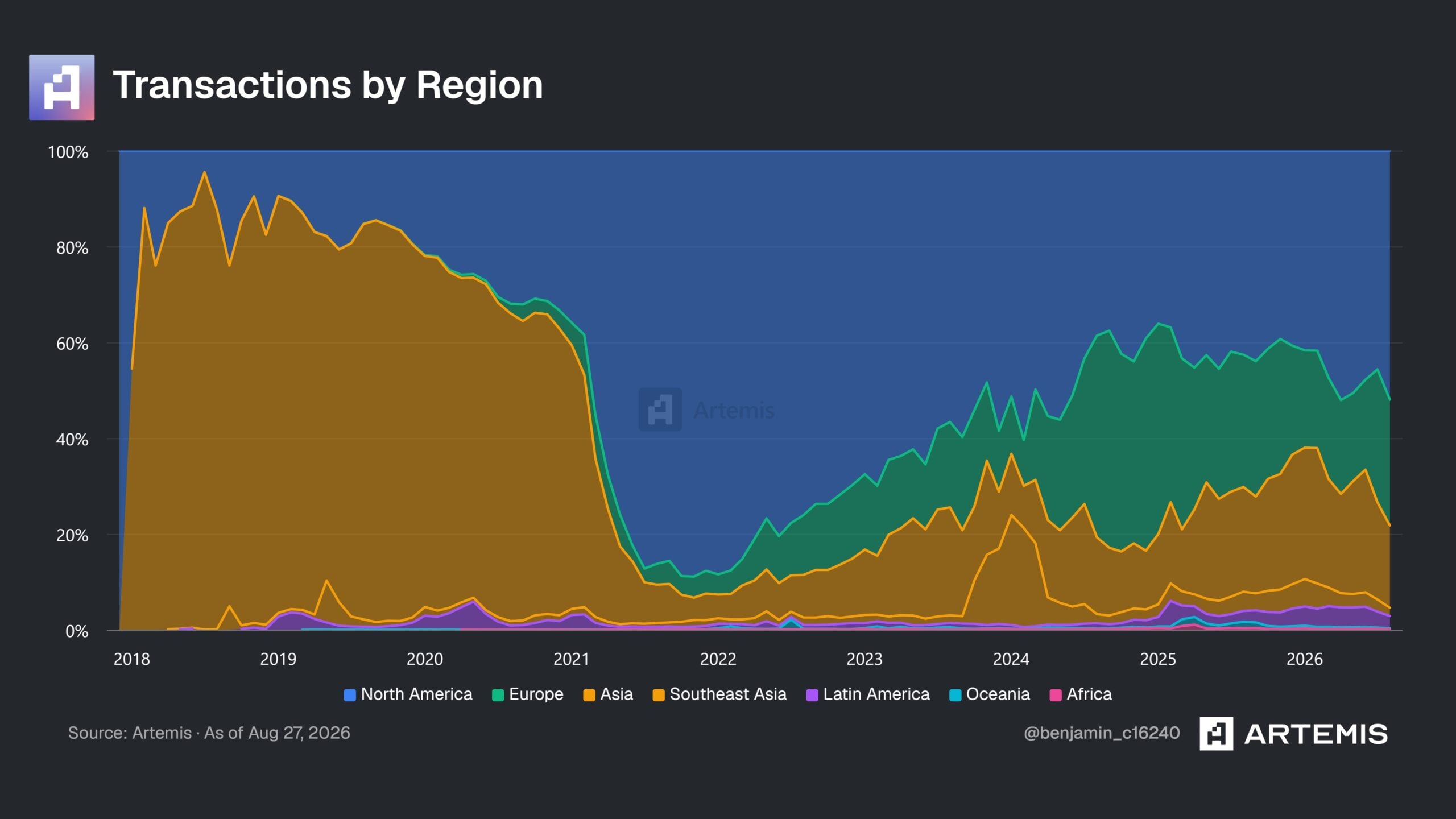
According to data compiled by blockchain analytics firm Artemis, USD-based stablecoins—led by Tether’s USDT and Circle’s USDC—still account for over 90% of the total global market share.
Geographically, North America retains the crown for the highest volume of stablecoin transactions. However, Europe has firmly secured the second position globally, capturing a 26% market share in stablecoin activity, comfortably outpacing Asia in third place.
The Growth Divergence: USD vs. Non-USD Volumes
Perhaps the most surprising trend highlighted by Artemis data is the explosive percentage growth of non-USD alternatives compared to their legacy American counterparts:
USD Stablecoins: Recorded nearly $7 trillion in 30-day trading volume, representing a solid, mature 22% increase over the period.
Non-USD Stablecoins: While posting a smaller absolute volume of $15 billion over the same timeframe, this figure translates into an astounding triple-digit growth rate of 137%.
Within this non-USD category, euro-denominated variants have experienced exceptional momentum throughout the year. However, the market remains concentrated among private issuers. Circle’s EURC currently reigns as the largest euro stablecoin, boasting a supply of approximately $455 million—representing more than 50% of the total EUR-pegged stablecoin market, which currently sits at $772 million.
4. Official Responses and Industry Analyst Perspectives
The launch of EURR and the broader ascent of euro stablecoins have triggered intense debate across the cryptocurrency and fintech sectors.
Skepticism Over Global Utility
Prominent crypto analyst and commentator Scott Melker pulled no punches when evaluating Revolut’s new product and the broader thesis of euro-backed digital assets. Melker argued that Revolut is merely capitalizing on the vacuum left by the forced exit of USDT in Europe, but expressed deep skepticism regarding the global competitiveness of the euro on-chain.
"Nobody wants euros anywhere outside of Europe, and they don’t really want them there either; they’re just forced to use them," Melker remarked bluntly. "So, it’s not like this is going to compete with dollar-backed stablecoins."
Institutional Optimism for Tokenization
Conversely, institutional advocates view non-USD stablecoins through a broader macroeconomic and technological lens. Zach Abrams, former CEO of institutional stablecoin transfer network Bridge, offered a much more bullish outlook on the structural evolution of global finance.
Writing on social media, Abrams stated:
"Our financial system will be increasingly tokenized over the next 5 years. First currencies, then treasuries, next stocks, and so on. Non-USD stablecoins will play a critical role in local settlement, collateral, FX, and more."
From this perspective, stablecoins are not merely speculative tools for crypto traders, but the foundational settlement layers for future foreign exchange (FX) markets, cross-border trade, and tokenized traditional assets.
5. Implications: Navigating the Future of European Digital Finance
Revolut’s entrance into the stablecoin market and the broader expansion of EUR-pegged tokens carry profound implications for users, traditional banking institutions, and policymakers alike.
The Battle for Compliance and Convenience
For everyday European consumers and businesses, the mandatory phase-out of USDT means adjusting to a new landscape of regulated assets. Revolut’s immense retail footprint gives EURR an immediate distribution channel that few other private European stablecoin issuers can match. By embedding EURR directly into its app interface, Revolut bridges the gap between traditional fiat checking accounts and decentralized finance (DeFi) rails.
The Looming Shadow of the Digital Euro
Even as private fintechs rush to fill the void left by international stablecoins, a massive regulatory counterweight is looming on the horizon. The European Union has formally advanced plans to roll out its own central bank digital currency (CBDC)—the digital euro—targeted for release by 2029.
The primary motivation behind the European Central Bank’s (ECB) push for a digital euro is defensive: policymakers want to protect traditional commercial banks from deposit flight and prevent private stablecoins from encroaching upon the monetary sovereignty of the eurozone.
Whether the impending arrival of a state-backed digital euro will stifle the traction currently enjoyed by private euro stablecoins like Revolut’s EURR and Circle’s EURC remains one of the most critical open questions in modern fintech. For now, however, private innovators are seizing the moment, laying down the blockchain infrastructure for a tokenized Europe while traditional institutions watch closely from the sidelines.