


The Ethereum ecosystem is currently undergoing a paradigm shift in how it addresses user-level security. As part of its broader "Trillion Dollar Security" initiative, the Ethereum Foundation is aggressively tackling the persistent, systemic risks posed by blind signing and transaction uncertainty. The primary focus of this new research frontier is the development of "native transaction assertions"—a mechanism designed to provide an enforceable, on-chain guarantee of a transaction’s final outcome.
While Ethereum’s current architecture allows for the precise authorization of a specific request, it does not inherently guarantee that the resulting state change aligns with the user’s economic intent. This gap between authorization and result has been the catalyst for some of the most devastating exploits in DeFi history. By exploring solutions like EIP-7906, the Foundation aims to move beyond superficial interface warnings toward a protocol-level safety layer.
The Anatomy of the Problem: Two Ways Transactions Fail
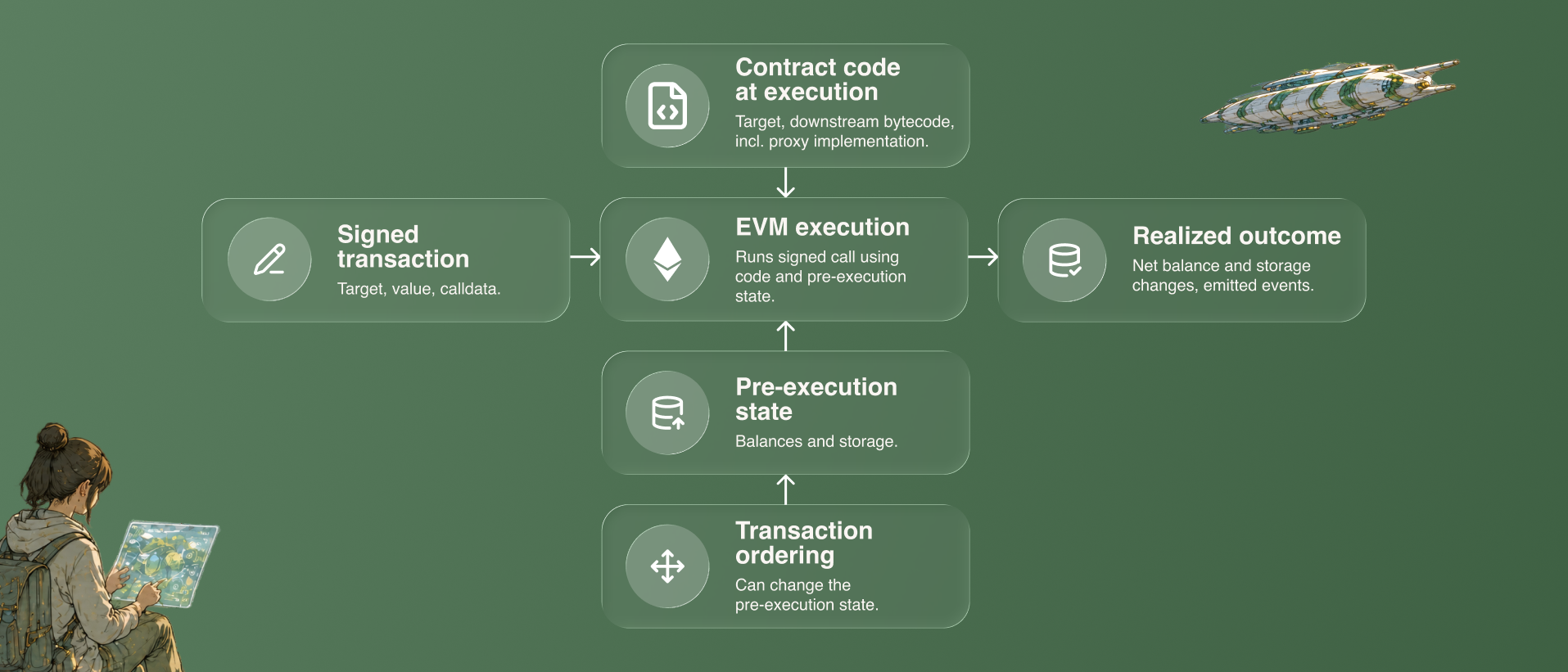
To understand why native transaction assertions are necessary, one must first recognize the fundamental nature of the Ethereum Virtual Machine (EVM). The EVM is a deterministic state machine that executes instructions exactly as instructed. It lacks an "intent layer." When a user signs a transaction, they are cryptographically committing to a specific set of inputs, but they are essentially "blind" to the final state of the blockchain after the code runs.
1. Intent Mismatch (The "Malicious Payload" Scenario)
The most common and catastrophic failures occur when the transaction requested by the user is not the transaction that is actually executed. This is often the result of a compromised frontend.
- The Bybit Incident: Attackers manipulated a frontend to trick users into authorizing a change to the implementation contract of their Safe wallets, effectively handing control to the attackers.
- The BadgerDAO Attack: Users were prompted to grant token approvals that, while appearing legitimate, allowed an attacker to drain the users’ assets.
In these cases, the signature was valid, but the user’s intent was hijacked by an intermediary. Current systems often fail to catch this because the wallet interface is effectively "trusting" the frontend provider to display the correct data.
2. Outcome Mismatch (The "Unintended Consequence" Scenario)
Even when a transaction is not malicious, it can lead to financial ruin due to volatility or poor execution.

- The Aave/CoW Swap Case: A user attempted a $50.4 million swap of
aEthUSDTforaEthAAVE. Due to thin liquidity and price impact, the user received only a fraction of the expected value—roughly $36,000 worth of tokens. While the interface provided a warning, the system lacked a hard, on-chain constraint that would have automatically aborted the transaction if the output fell below a specific threshold that the user deemed acceptable.
Chronology of Security Evolution
The path to native assertions has been a long journey of iterative security improvements:
- Pre-2024: Reliance on basic wallet-level warnings and manual user verification.
- 2024-2025: Emergence of "Clear Signing" initiatives. These efforts focus on decoding calldata so that users can read, in plain English, exactly what they are approving.
- May 2025: The Ethereum Foundation formally launches the "Trillion Dollar Security" initiative, identifying that while Clear Signing is helpful, it is insufficient to prevent sophisticated state-dependent attacks.
- Late 2025 – Early 2026: Research into "Frame Transactions" (EIP-8141) begins to gain momentum, providing the necessary modular structure for future security opcodes.
- October 2026: EIP-7906 gains traction as a potential standard for implementing native assertions via a
POST_TXframe, marking the current state of industry discourse.
Supporting Data: Why Current Defenses Fall Short
Current security models rely heavily on three pillars, all of which have inherent weaknesses:
- Simulation: Wallets simulate the outcome of a transaction before broadcasting it. However, simulations are only as good as the state they use. If the state changes between the simulation and the actual inclusion of the transaction in a block (a common occurrence in MEV-heavy environments), the simulation becomes obsolete.
- Clear Signing: This relies on the wallet correctly parsing the data. If the malicious actor finds a way to obfuscate the call or if the wallet software contains a bug in its decoding logic, the user is left unprotected.
- Hooks and Guards: Tools like Safe’s
checkAfterExecutionare powerful but limited. They are not universal and often depend on the target contract exposing specific functions to read state. They cannot, for instance, easily inspect the entire net state change of a complex transaction.
The Mechanism: How Native Transaction Assertions Work
Native transaction assertions introduce a new, read-only phase at the end of a transaction’s execution lifecycle. By using new EVM opcodes, the protocol can inspect the net state changes—such as balances, storage slots, and event logs—before the transaction is finalized.
If the "result" of the transaction does not match the "rule" defined in the assertion, the entire transaction reverts. This is the crucial differentiator: it is an atomic check performed by the consensus layer, not an external application.
Key Opcodes Proposed under EIP-7906
TXTRACE: Allows the protocol to enumerate all net state changes and emitted events.TXDIFF: Provides a mechanism to compare the starting and ending values of specific storage slots or ETH balances.EVENTDATACOPY: Facilitates the extraction of event data into memory for validation.
These opcodes are restricted to the POST_TX frame, a static call that ensures no further side effects can be created. If the assertion fails, the transaction is rejected, but the gas payer is still charged. This economic penalty is vital, as it prevents "denial of service" attacks where bad actors flood the network with failing transactions.
Official Responses and Industry Implications
The Ethereum Foundation has signaled that this is a collaborative effort, not a top-down mandate. By engaging with wallet providers, indexers, and protocol developers, they hope to create a standard that is both secure and performant.
The Role of Wallets
Wallets will play the most critical role. To be effective, the wallet must construct these assertion-based transactions on behalf of the user. This means the wallet must be intelligent enough to calculate the "expected outcome" based on the user’s intent and embed the corresponding assertion into the transaction object.
The Role of Protocols
For decentralized protocols, this opens the door to "Assertion-Required" functions. A lending protocol, for instance, could require that any transaction interacting with its core vault must include an assertion proving that the user’s collateral ratio remains above a certain level. This would effectively move safety from the user interface into the protocol code itself.
Strategic Implications for the Future of Ethereum
The implementation of native transaction assertions would have far-reaching implications for the ecosystem:
- Strengthened Delegation: Users can delegate control to smart agents or AI bots with specific, hard-coded constraints. An agent could be authorized to trade on a user’s behalf, provided it never allows the total balance of the user’s main asset to drop below a certain value.
- Solver-Based Execution: In the world of intents and solvers (like CoW Swap), native assertions provide a framework for trustless execution. The protocol can specify the required outcome, and the solver is then forced to adhere to that rule, regardless of the path it takes to get there.
- Revocation of Approvals: Assertions could theoretically include logic to ensure that any "approve" calls are immediately followed by a corresponding "revoke" or "limit" call, effectively automating the hygiene of token permissions.
Conclusion: A Call to Action
The move toward native transaction assertions represents a maturation of Ethereum’s security philosophy. It acknowledges that in a world of complex, composable DeFi, user warnings are not enough. By bringing state verification into the core protocol, the Ethereum Foundation is aiming to provide a robust, immutable safety net for the next billion users.
The research is ongoing, and the Foundation is actively soliciting feedback. Stakeholders—from wallet developers to security researchers—are encouraged to join the discussion on the Ethereum Magicians forum regarding EIP-7906 or reach out to the Trillion Dollar Security initiative directly. The goal is clear: to ensure that when a user clicks "sign," the result is not a gamble, but a guaranteed outcome.
