

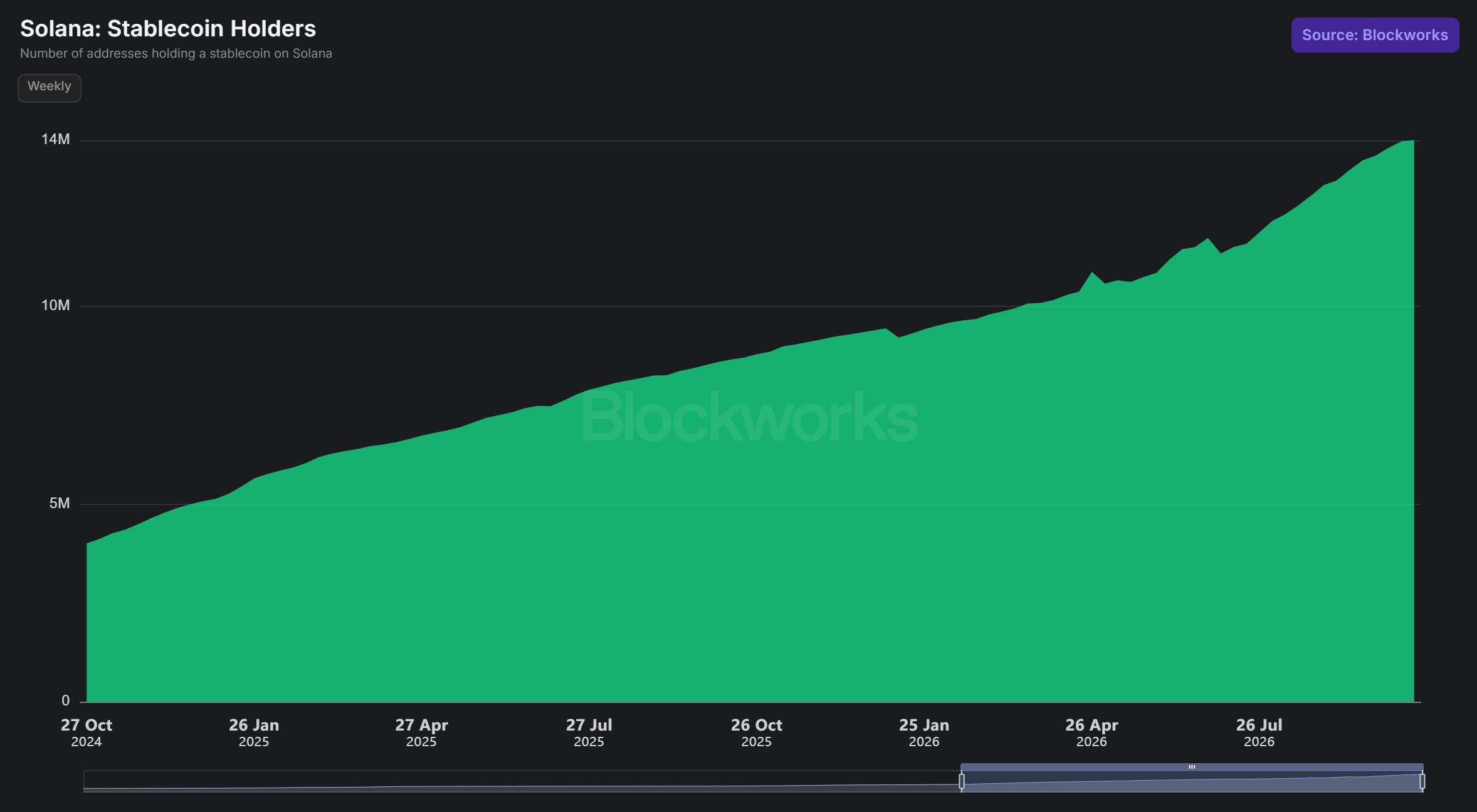
Abstract: While Solana’s stablecoin ecosystem is experiencing unprecedented growth—surging from fewer than 4 million holder addresses in late 2024 to a staggering 14 million—the native token, SOL, remains trapped in a consolidation range. This comprehensive deep-dive examines the widening gap between surging on-chain dollar liquidity and lagging network activity, analyzing exchange netflows, decentralized exchange (DEX) volumes, total value locked (TVL), and the broader macroeconomic implications for the Solana network.
Main Facts
The Solana network is currently witnessing a historic structural shift in how users interact with dollar-pegged digital assets. According to on-chain data compiled through late 2026, the ecosystem’s stablecoin adoption metrics have broken previous ceilings:
- Explosive Address Growth: Active stablecoin holder address accounts on Solana have skyrocketed from under 4 million in October 2024 to over 14 million. The momentum accelerated aggressively through 2025 and 2026, pushing counts well past the 10 million milestone.
- Massive Capital Pool: The total native on-chain stablecoin supply on Solana firmly remains in excess of $15 billion, hovering around $15.65 billion. This provides a deep underlying liquidity foundation for payments, decentralized finance (DeFi), and speculative trading.
- Decoupled Price Action: Despite record-breaking stablecoin liquidity and an expanded holder base, SOL has struggled to maintain upward momentum. The token has traded sideways in the $101–$102 range, down nearly 13% over a recent 30-day window.
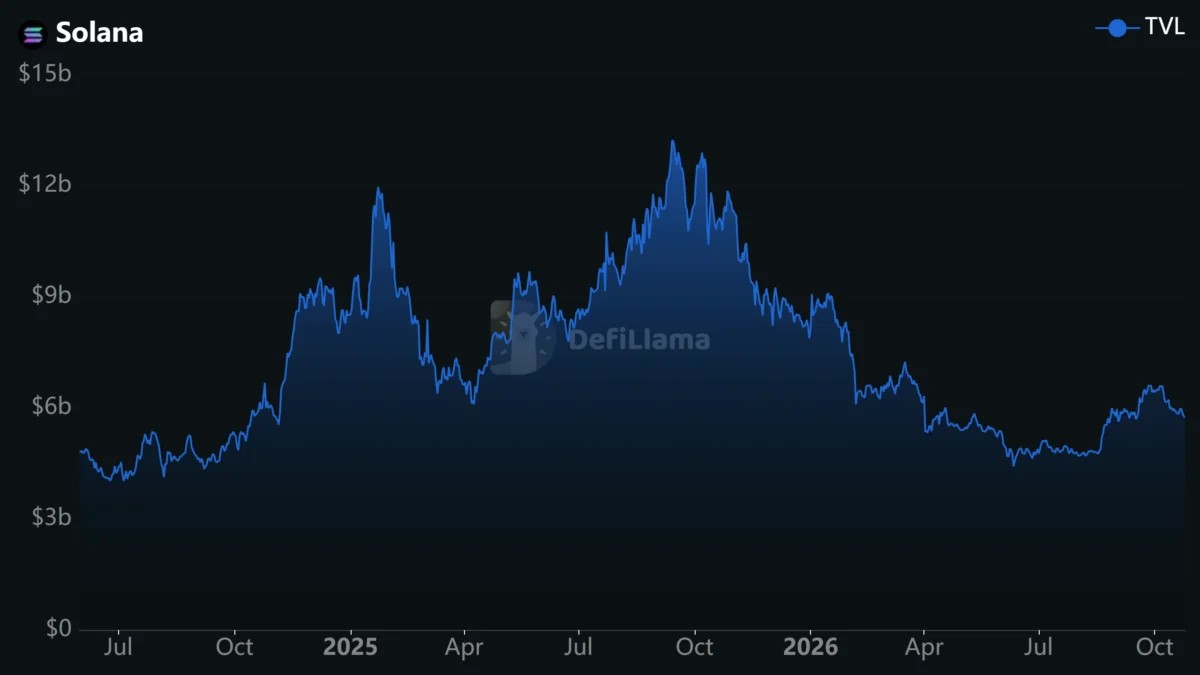
- Muted Activity Metrics: Weekly DEX volume has contracted by roughly 9%, while Total Value Locked (TVL) sits at $5.77 billion and daily network fee generation plateaus near $477,000. This highlights a fundamental disconnect between capital availability and active economic participation.
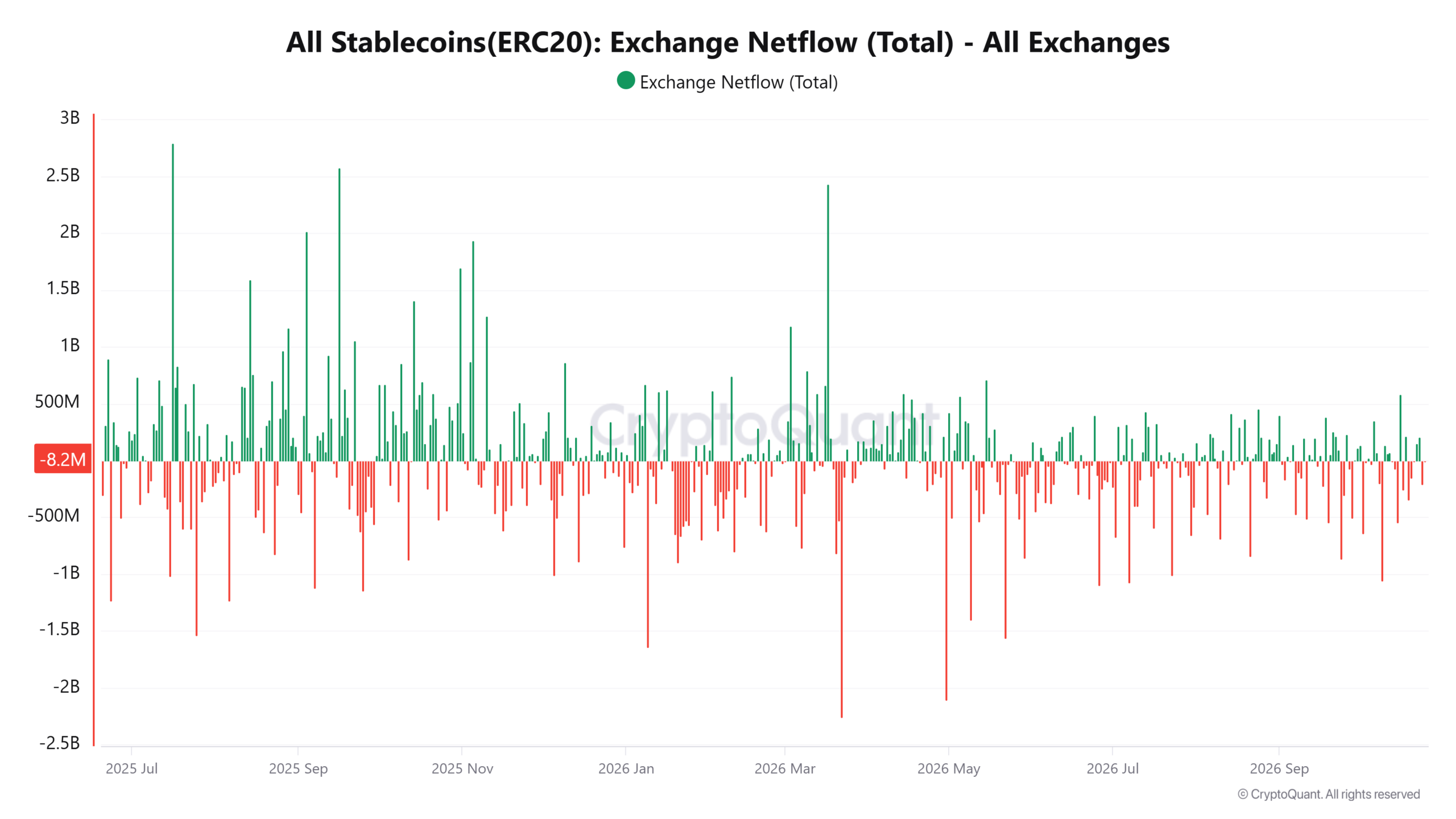
- Volatile Exchange Flows: CryptoQuant data reveals mixed exchange netflows, marked by intermittent capital surges (peak inflows near $2.8 billion) quickly counterbalanced by heavy withdrawals (such as $2.3 billion in April), leaving recent netflows hovering near a neutral -$8.2 million.
Chronology: The Evolution of Solana’s Stablecoin Landscape
To understand the current state of Solana’s digital asset economy, it is essential to trace the timeline of adoption, liquidity surges, and market corrections that have shaped the network from late 2024 through 2026.
Late 2024: The Foundation of Expansion
In October 2024, Solana’s stablecoin footprint was relatively modest compared to its ambitions, housing fewer than 4 million unique holder addresses. However, high throughput, sub-penny transaction fees, and institutional interest in fast settlement rails began attracting retail and institutional liquidity alike. The total stablecoin supply began building momentum, establishing the infrastructure needed to support mainstream consumer applications and high-frequency trading.
2025: Acceleration and Macro Volatility
Throughout 2025, the onboarding of new users into dollar-pegged assets accelerated exponentially. By mid-2025, specifically starting in June, on-chain metrics captured large, cyclical swings in exchange deposits and withdrawals. Institutional players and retail traders alike utilized Solana’s rails to shuttle capital rapidly in and out of trading venues, with peak exchange inflows reaching approximately $2.8 billion.

Despite these capital injections, broader crypto market conditions lacked consistent, sticky inflows. Subsequent phases of profit-taking and risk-off sentiment led to massive capital flights—epitomized by roughly $2.3 billion in stablecoin withdrawals. These competing tides prevented the influx of stablecoins from cementing a permanent, upward trajectory for token valuations.
2026: Milestone Holder Counts and Divergent Reality
By 2026, the number of distinct wallets holding stablecoins on Solana shattered previous estimates, comfortably clearing the 10 million threshold before scaling all the way to 14 million by October. Yet, this expanding user base exposed a critical market reality: a larger number of address accounts holding dollar-pegged assets does not automatically equate to higher transaction counts, sustained retail spending, or immediate upward pressure on the SOL token.
Supporting Data & On-Chain Metrics
A rigorous examination of blockchain analytics reveals the mechanics behind the "Solana Paradox"—a network dripping in stablecoin liquidity yet starved of proportional transactional velocity.
Table 1: Key Solana Ecosystem Metrics (October 2026 Snapshot)
| Metric Category | Data Point / Value | Trend / Context |
|---|---|---|
| Stablecoin Holder Addresses | ~14 Million | Up from <4M in Oct 2024; massive retail/institutional expansion. |
| Total Stablecoin Supply | ~$15.65 Billion | Sustained high baseline providing ecosystem liquidity. |
| SOL Token Price | $101 – $102 | Down ~13% over the trailing 30-day period. |
| Weekly DEX Volume | Down ~9% | Reflects a temporary cooling in speculative spot trading. |
| DeFi Total Value Locked (TVL) | $5.77 Billion | Indicates stable yet stagnant capital deployment in lending/yield protocols. |
| Daily Network Fees | ~$477,000 | Highlights consistent baseline utility without explosive transactional spikes. |
| Exchange Netflows | -$8.2 Million | Neutral territory, signaling a current lack of aggressive buying pressure. |
Analyzing the Exchange Flow Dynamics
Data from CryptoQuant emphasizes that stablecoin behavior across centralized exchanges has been erratic rather than directional. While multi-billion-dollar inflows periodically provide dry powder for prospective buyers, subsequent outflows quickly nullify potential bullish momentum.
For instance, the April wave of $2.3 billion in exchange withdrawals demonstrated that investors were moving capital off-loading platforms—either into cold storage, decentralized protocols, or out of the ecosystem entirely—rather than deploying it immediately into risk-on assets. With recent netflows settling near -$8.2 million, exchange liquidity remains range-bound, suggesting that sidelined capital is waiting for clearer macroeconomic or technical catalysts.
Official Responses & Ecosystem Perspectives
Industry leaders, developers, and market analysts have offered varied interpretations of Solana’s explosive stablecoin growth juxtaposed against flat market performance.
- The Developer Perspective: Core contributors to the Solana Foundation and various decentralized applications (dApps) view the surge in 14 million holder addresses as a monumental win for UI/UX accessibility. Proponents argue that stablecoins serve as the ultimate gateway for global payments, onboarding users who prefer the stability of fiat over the volatility of native cryptocurrencies. From this viewpoint, building the foundational layer of users is a necessary precursor to long-term utility.
- The Quantitative Analyst View: Financial researchers and on-chain analysts caution against vanity metrics. Market makers point out that airdrop farming, Sybil activity, and fragmented micro-wallets can artificially inflate unique address counts. Without a corresponding surge in daily active users (DAUs), contract interactions, and velocity of money, holding dormant stablecoin balances yields little direct economic value to the base layer security or token economics.
- Institutional Observers: Traditional fintech integrations—such as global payment processors and cross-border settlement pilots utilizing Solana-based USDC—validate the network’s technical capabilities. However, institutional desks note that broader macroeconomic headwinds, regulatory uncertainty, and shifting liquidity cycles across global markets continue to suppress aggressive capital deployment into high-beta altcoins like SOL.
Implications for the Future of Solana
The divergence between soaring stablecoin adoption and sluggish price action carries profound implications for the future trajectory of the Solana ecosystem.
1. The Real Test: Transitioning Access to Utility
The central challenge for Solana moving forward is bridging the gap between access and activity. Having 14 million wallets exposed to dollar-pegged assets is a powerful foundation, but true network demand is forged when those assets are actively deployed. Whether through high-frequency decentralized finance (DeFi) trading, institutional settlement, or everyday merchant payments, users must transition from passive holders to active economic participants. If developers fail to build sticky consumer-facing applications that capture this liquidity, the network risks housing dormant capital that contributes little to long-term value accrual.
2. Liquidity Availability vs. Spot Market Demand
The presence of $15.65 billion in stablecoin supply ensures that liquidity is readily available the moment market sentiment shifts. However, as demonstrated by the recent neutral exchange netflows and a compressed SOL price hovering near $101–$102, liquidity alone does not dictate price direction. Investor sentiment, broader crypto market cycles, and institutional risk appetite remain primary drivers of spot market demand.
3. Long-Term Viability and Fee Generation
For Solana’s validator ecosystem and tokenomics to thrive, daily network fee generation—currently holding steady around $477,000—must scale alongside user adoption. While low fees are a core value proposition that attracts users in the first place, sustained network security and economic health ultimately rely on robust transactional volume and fee-burning mechanisms.
Conclusion
Solana’s journey from 4 million to 14 million stablecoin holder addresses in a span of two years is a testament to the network’s scalability, speed, and growing dominance as a settlement layer for digital dollars. Yet, the current disconnect between immense capital supply and stagnant token performance reminds market participants that crypto adoption is a multi-layered equation.
As the ecosystem matures past simple address acquisition, the ultimate measure of Solana’s success will depend on its ability to convert passive stablecoin holders into a vibrant, highly active economy of traders, developers, and global consumers. Until that velocity picks up, the Solana paradox—a liquidity giant tethered to range-bound price action—will remain a fascinating case study in modern blockchain economics.
