

In the rapidly evolving landscape of Decentralized Finance (DeFi), "capital efficiency" has long been the gold standard. When protocols like Uniswap introduced concentrated liquidity, the promise was revolutionary: by allowing Liquidity Providers (LPs) to allocate their capital within specific price ranges, these platforms aimed to maximize returns while reducing slippage for traders. However, a comprehensive new report from the data analytics firm Dune has cast a long shadow over these claims, revealing that a staggering portion of assets contributed to decentralized exchanges (DEXs) is effectively sitting idle, generating no yield and providing no utility to the ecosystem.
Main Facts: The Anatomy of Underutilized Liquidity
The findings from the Dune report are as sobering as they are significant. For the first half of 2026, the study examined four major pillars of the decentralized exchange world: Uniswap v3, Uniswap v4, PancakeSwap v3, and Aerodrome Slipstream.
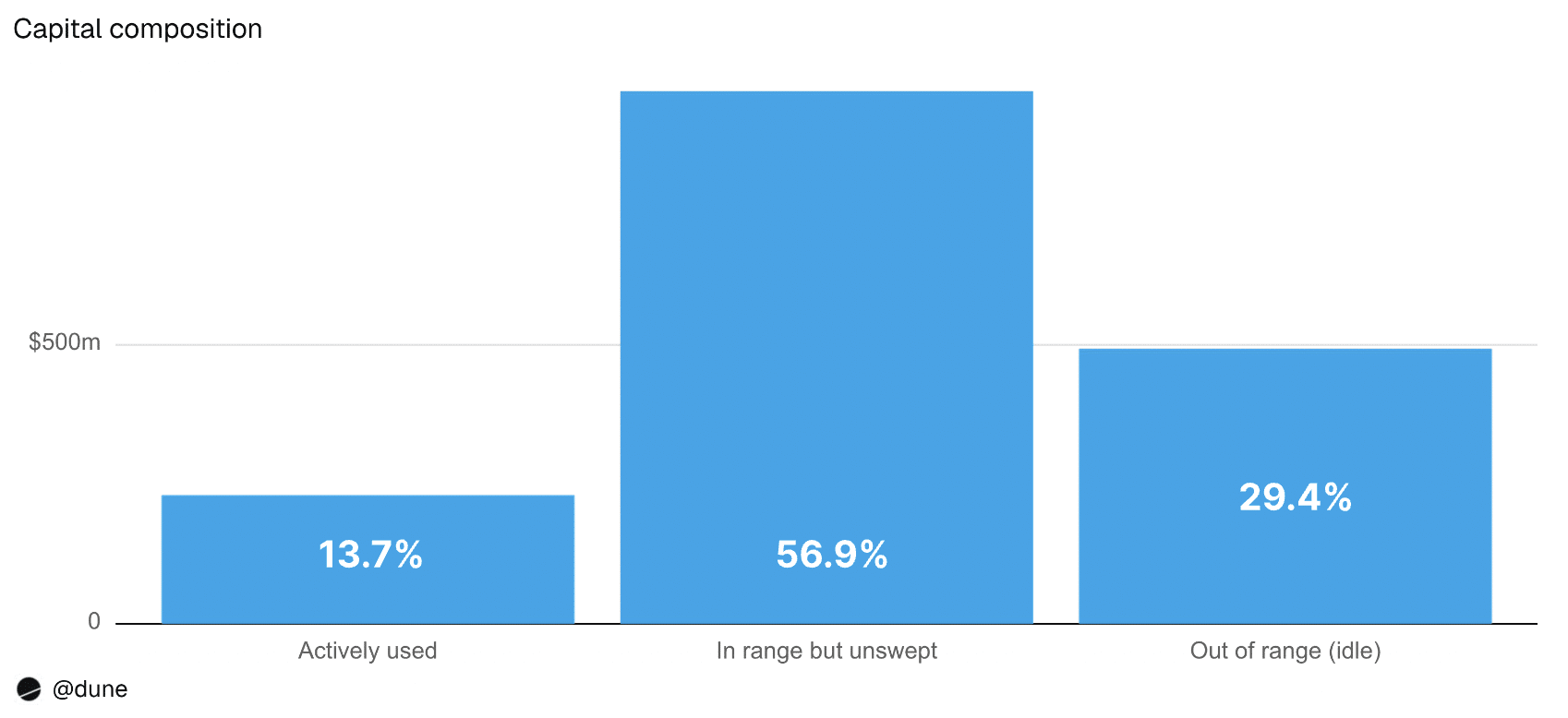
The core takeaway is that the promise of optimized capital is failing to manifest in reality. On average, 29.4% of all liquidity provided to these platforms remained outside the active trading range. In practical terms, this means that nearly one-third of the capital intended to facilitate trades was "out of the money," effectively acting as dead weight within the protocol. Because these funds were positioned outside the current market price, they were ineligible to capture trading fees, leading to a profound erosion of potential income for providers.
The financial toll of this inefficiency is immense. The report estimates that this configuration resulted in approximately $542 million in idle capital per week. Extrapolated over the course of a year, this represents a staggering $150 million in lost fee income—wealth that liquidity providers essentially left on the table due to static, unmanaged, or poorly positioned capital.

A Chronological Look at the Evolution of Inefficiency
To understand how we reached this point, one must look at the progression of automated market maker (AMM) technology.
- The Early Era: In the beginning, AMMs relied on "lazy liquidity," where assets were spread across the entire price curve from zero to infinity. While inefficient, it was simple for the user.
- The V3 Revolution: The introduction of concentrated liquidity (popularized by Uniswap v3) allowed LPs to define a "range" for their capital. If the price stayed within that range, they earned fees. If it moved out, their liquidity became idle.
- The 2026 Reality Check: As of the first half of 2026, the data shows that the complexity introduced by concentrated liquidity has become a double-edged sword. While it can provide higher returns, it demands constant manual intervention. The evidence suggests that the average retail investor is ill-equipped to handle this level of active portfolio management, leading to the current state of chronic underutilization.
Supporting Data: Dissecting the "Idle" Landscape
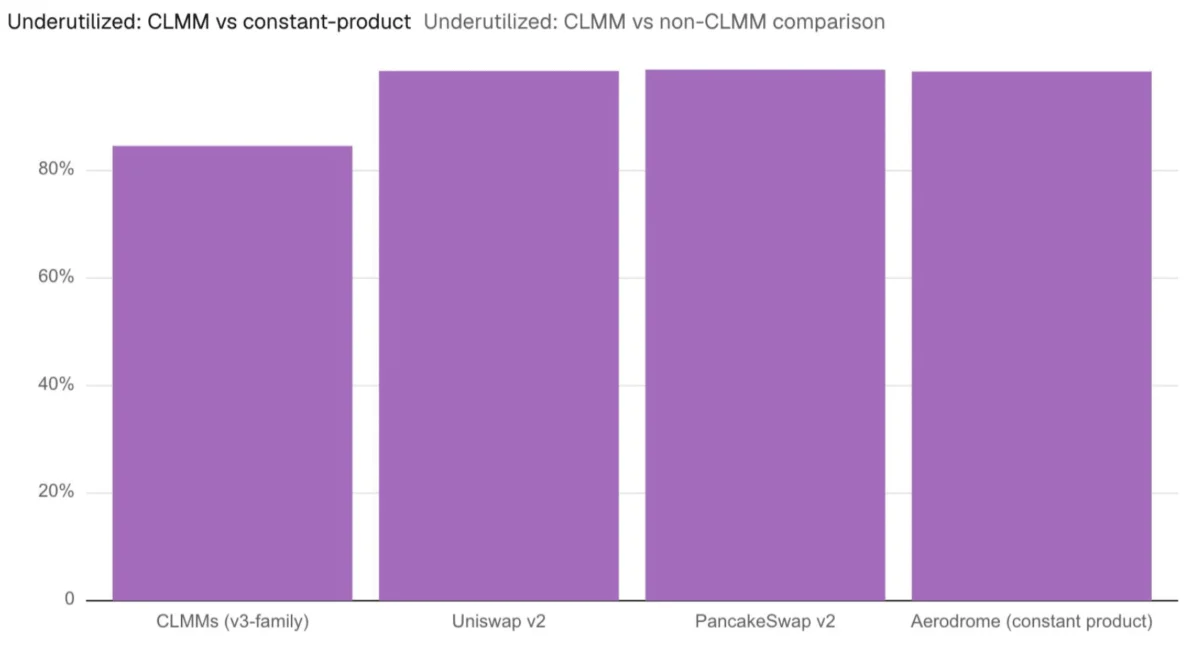
The data provided by Dune highlights a stark divide between sophisticated, automated strategies and the manual efforts of individual investors. When considering "technically available" liquidity—meaning liquidity that is technically on-chain but not actively facilitating trades—a massive 85% of total capital is underutilized.
Perhaps the most damning metric is the duration of inactivity. The report identified that more than $200 million in idle liquidity has remained stagnant for over 90 days without being repositioned. This suggests that a significant cohort of LPs are "set it and forget it" investors, failing to realize that concentrated liquidity models are not passive investment vehicles.
The Retail Investor’s Burden
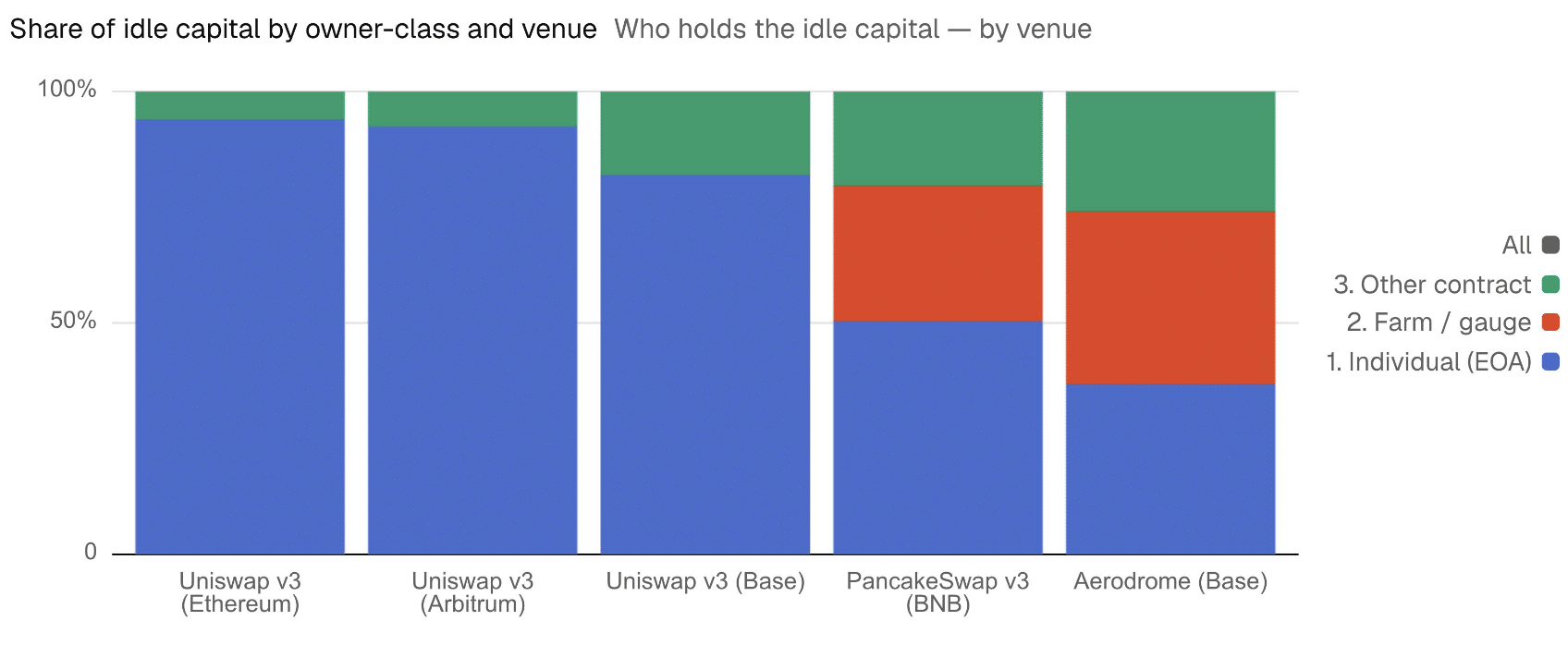
The burden of this inefficiency falls disproportionately on individual users rather than institutional or smart-contract-managed vaults. The breakdown across major networks is telling:
- Ethereum: Individual wallets held 94% of idle capital and 91% of total liquidity on Uniswap v3.
- Arbitrum: 92% of idle liquidity was controlled by individual users.
- Base: Individual users oversaw 82% of the idle capital, even though smart contracts managed roughly half of the total liquidity on the network.
In stark contrast, automated management protocols—which use algorithms to rebalance liquidity ranges as the market moves—showed much higher efficiency. These managers saw only about 6.5% of their positions fall out of range, compared to the 30% failure rate observed in manual, individual-managed wallets.
Implications: The Failure of Technological Panaceas
The most critical implication of this data is that technological innovation alone—such as the transition from v3 to v4—has not solved the fundamental problem of human behavior and market complexity.
The industry had high hopes for Uniswap v4, specifically the introduction of "hooks"—customizable code snippets that allow developers to create specialized liquidity strategies. In theory, these hooks could allow idle liquidity to be automatically swept into external yield strategies (like lending protocols) while waiting for the price to return to the active range.
However, the reality remains disappointing. Despite the potential of v4, the Dune report notes that approximately 30.5% of its liquidity remains out of range. Furthermore, only 10% of Uniswap v4’s total value locked (TVL) actually utilizes hooks, and currently, none of these implementations are successfully generating yield from idle liquidity.
Why This Matters for DeFi
The implications for the broader DeFi ecosystem are threefold:
- Market Stagnation: If a quarter of the liquidity meant to support trades is "dead," the overall depth of the market is far thinner than the TVL numbers suggest. This leads to higher slippage for large traders, discouraging institutional adoption.
- The "Complexity Trap": DeFi has reached a level of technical sophistication that is outpacing the capabilities of the average retail participant. When the cost of managing a position exceeds the time or expertise an individual can provide, the result is lost capital.
- The Rise of Automated Managers: The data provides a strong argument for the consolidation of liquidity management. We are likely to see a shift where individual LPs move away from direct liquidity provision and toward "Liquidity-as-a-Service" protocols that handle the rebalancing on their behalf.
Official Responses and Industry Outlook
While no single protocol has issued a formal "defense" against these findings, the industry consensus is shifting toward the necessity of better UX and more robust automated tools. Developers and protocol governors are now faced with the realization that "concentrated liquidity" is not a turnkey solution.
Proponents of the current models argue that the "idle" capital is not necessarily a failure of the protocol, but rather a reflection of the volatility of the crypto market. If an asset experiences a sudden, extreme price move, liquidity providers are naturally caught off-guard. However, the 90-day inactivity threshold suggests that the issue is not just volatility—it is a lack of active management.
Conclusion: Bridging the Gap
The path forward for decentralized exchanges likely involves a move toward "liquidity abstraction." If the protocol itself can automatically manage the range of a user’s capital—or if decentralized asset managers become the default interface for liquidity provision—the $150 million annual loss could be clawed back into the ecosystem.
For now, the Dune report serves as a wake-up call. The DeFi sector has built the most powerful financial infrastructure in history, but as long as a significant portion of its capital remains dormant, it is operating at a fraction of its potential. The challenge for the next iteration of DEXs will not be creating more complex features, but simplifying the existing ones to ensure that liquidity, once contributed, is put to work effectively.
As the industry matures, the divide between the "idle" and the "active" will likely dictate which protocols survive. Investors, for their part, must realize that in the age of concentrated liquidity, "passive" investing is no longer a viable strategy. The future of DeFi will be built by those who can bridge the gap between complex, high-efficiency tools and the reality of human behavior.
