

After enduring a prolonged winter, the Decentralized Finance (DeFi) sector is signaling a robust recovery, marked by renewed investor confidence and a significant influx of capital. As the Total Value Locked (TVL) across the ecosystem climbs back toward psychological milestones, the narrative surrounding DeFi is shifting. No longer merely a playground for crypto-native enthusiasts, the sector is increasingly becoming a testing ground for traditional finance (TradFi) giants, suggesting that the future of decentralized protocols may be inextricably linked to institutional integration.
The State of the Ecosystem: A $95 Billion Recovery
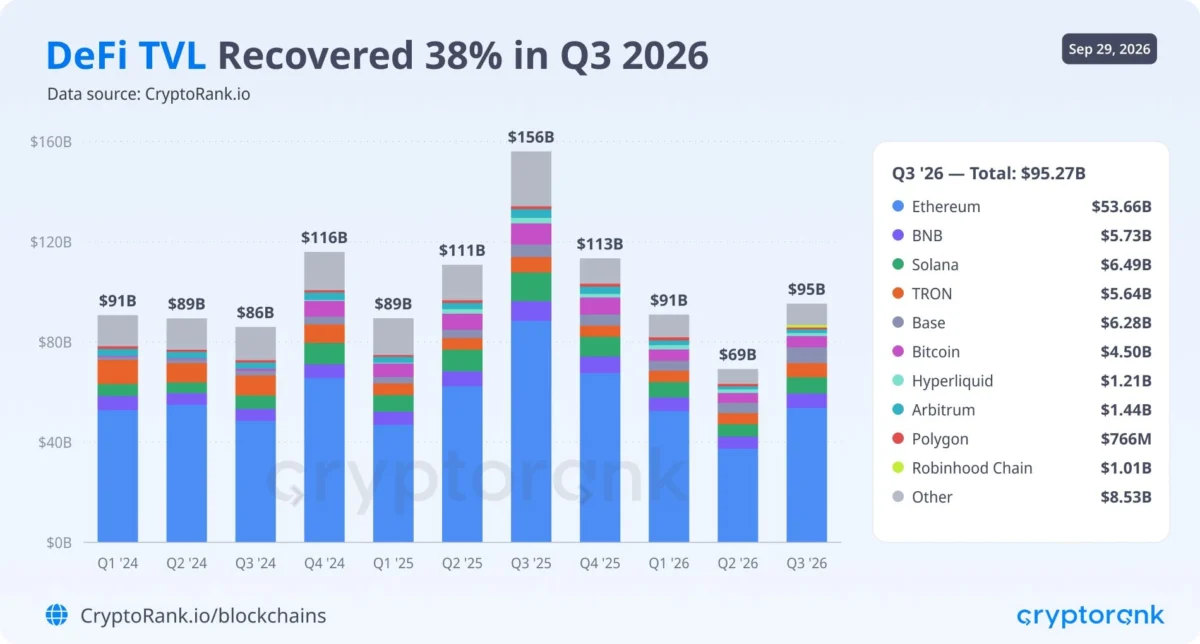
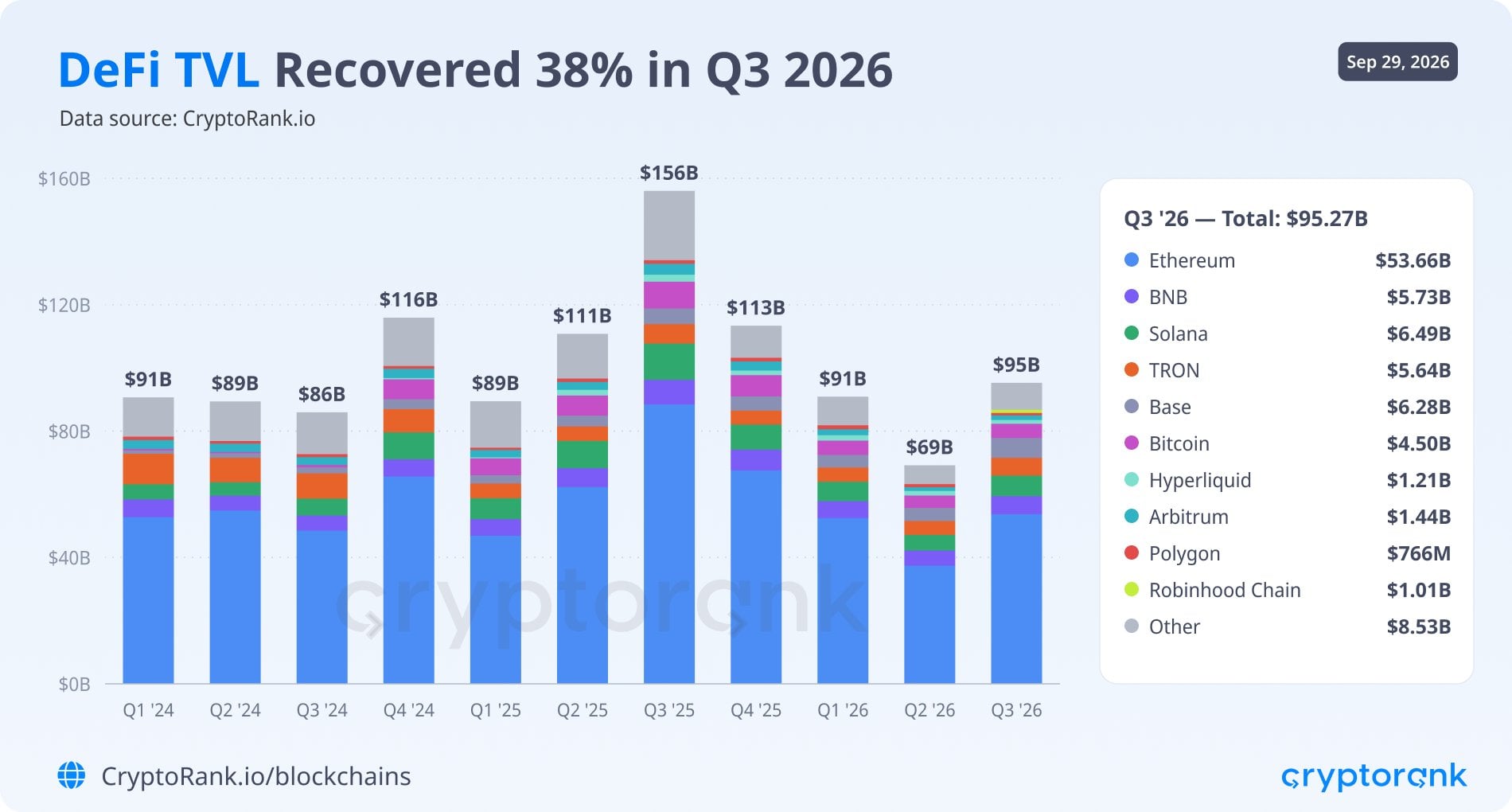
The third quarter of 2026 has provided a much-needed morale boost for the DeFi industry. Data from CryptoRank confirms that DeFi’s Total Value Locked surged by 38% throughout Q3, reaching a substantial $95 billion. While this figure represents a significant achievement, it is best understood through the lens of recent volatility.
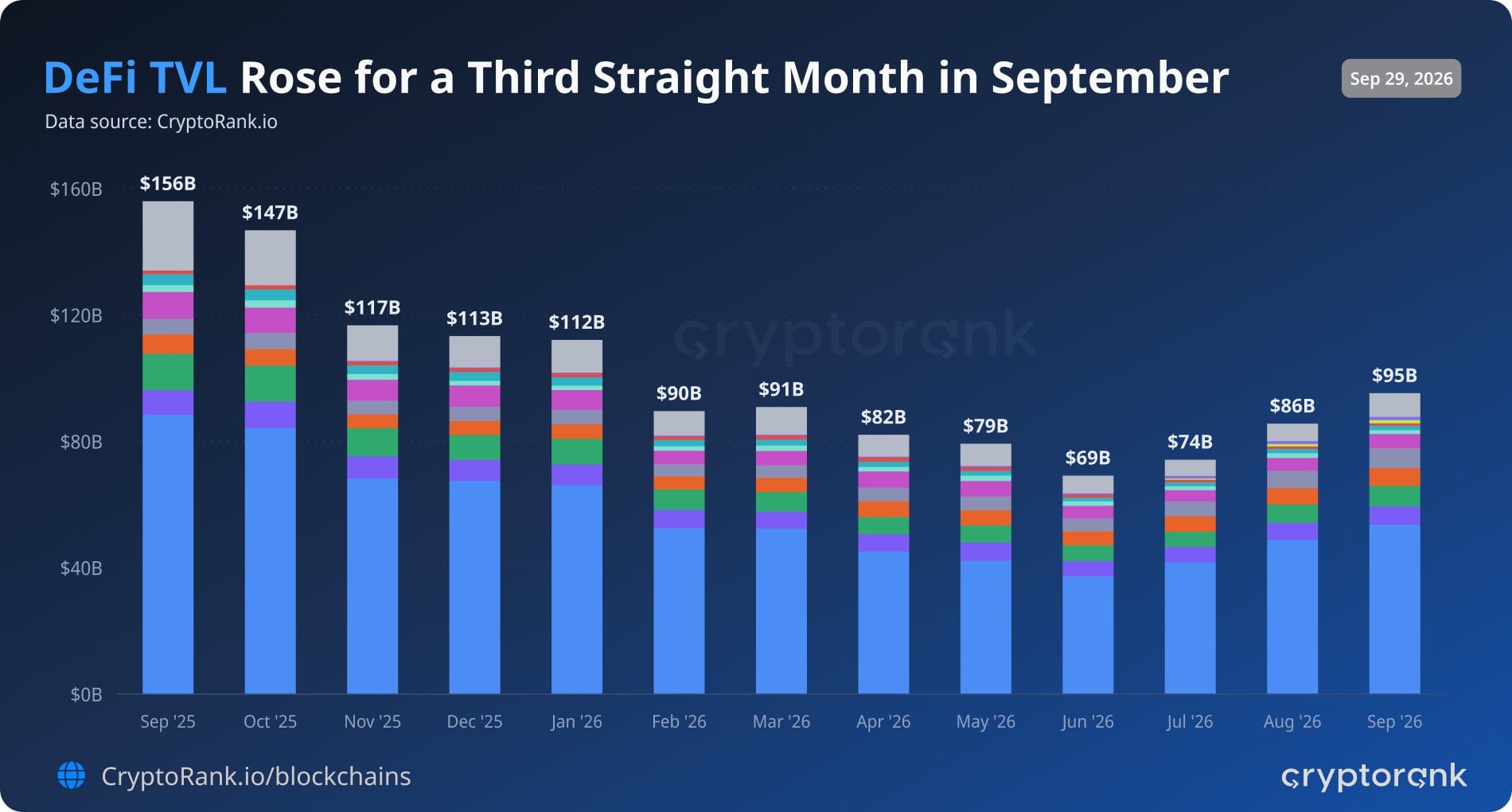
To appreciate the scale of this turnaround, one must look at the recent historical context. In Q3 2025, the industry reached a high-water mark of $156 billion. Following that peak, the sector faced a grueling three-quarter downturn, characterized by cooling interest and capital flight. By the time the industry hit its nadir in June 2026, TVL had plummeted to $69 billion.
The recovery, however, has not been a flash in the pan. The growth seen in Q3 was consistent and sustained, with monthly gains of 7%, 15%, and 11% in July, August, and September, respectively. This steady climb suggests that the capital returning to the ecosystem is not speculative "hot money" but rather a more calculated re-entry into yield-bearing protocols.
Sector Leaders and Emerging Infrastructure
While Ethereum (ETH) continues to serve as the bedrock of the decentralized economy, commanding a dominant share of the market with approximately $53.7 billion in locked assets, the landscape is becoming increasingly multi-chain.

The rapid rise of newer protocols highlights a demand for higher throughput and lower transaction costs. Most notably, the Monad (MON) ecosystem saw its TVL skyrocket by 183% over the quarter, signaling that users are eager to explore high-performance alternatives to traditional L1 networks. Furthermore, the launch of the Robinhood Chain in July has already proven successful; the infrastructure has attracted over $1 billion in capital in a matter of months, demonstrating the powerful synergy between established fintech brands and blockchain utility.
Tokenized Stocks: The Bridge Between TradFi and DeFi
One of the most compelling trends driving this recovery is the integration of real-world assets (RWA) into decentralized protocols. Specifically, the rise of tokenized stocks on-chain has evolved from a niche experiment into a $252 million industry.
According to insights from Token Terminal, the deposit of tokenized equities into DeFi protocols has seen an exponential trajectory. At the start of 2025, this figure was virtually negligible. As the year progressed, adoption began to tick upward, but the last few months have seen a parabolic surge in activity.
Where the Capital Flows
This capital is not merely sitting idle in static wallets; it is being actively deployed. Leading decentralized exchanges and lending platforms are currently the primary beneficiaries of this trend:
- Uniswap (UNI): With $82.1 million locked across its v3 and v4 pools, Uniswap remains the primary destination for traders looking to utilize tokenized assets.
- Kamino Lend (KMNO): Attracting $51.3 million, this platform demonstrates the growing appetite for decentralized credit markets utilizing real-world collateral.
- Pendle (PENDLE): Capturing $33.8 million, Pendle highlights the sophisticated nature of these investors, who are using yield-trading protocols to maximize the returns on their tokenized portfolios.
This shift is monumental. It represents a fundamental change in user behavior: market participants are no longer just buying tokens and holding them; they are treating them as active capital to be lent, traded, and leveraged within the DeFi stack.
Institutional Interest: The Morgan Stanley Paradigm
The most significant shift in the narrative is the encroachment of major financial institutions into the DeFi space. The barrier between "TradFi" and "DeFi" is thinning, and the establishment of a Digital Asset Lab by Morgan Stanley serves as a prime case study for this transition.
Morgan Stanley’s initiative is not a mere marketing gesture; it is a systematic testing of core DeFi infrastructure, including stablecoins, tokenization, and decentralized application (dApp) frameworks. By focusing on tokenization, electronic trading, cybersecurity, and machine learning, the bank is preparing its infrastructure for a future where digital assets are a standard component of wealth management.
Strategic Drivers for Institutional Adoption
The motivation for these institutions is clear: client demand. As one of the largest wealth managers in the United States, Morgan Stanley is under pressure to provide exposure to the asset classes that its high-net-worth clients are increasingly demanding. By integrating Bitcoin and other digital assets—exemplified by their recent move to offer crypto trading via E*Trade—the bank is positioning itself to be a full-service provider for the modern investor.
Implications: A New Era of Hybrid Finance
The convergence of rising TVL, the proliferation of tokenized stocks, and the direct participation of global investment banks suggests that we are entering a new phase of the DeFi lifecycle.
1. Increased Liquidity and Market Maturity
The inclusion of tokenized stocks and the entry of institutional capital provide a layer of stability to the market. Unlike purely native crypto assets, tokenized real-world assets are often tied to traditional market performance, which can introduce a different risk profile and potentially reduce the extreme volatility historically associated with DeFi.
2. Regulatory Compliance as a Competitive Advantage
As banks like Morgan Stanley enter the space, they bring with them stringent compliance standards. This forces DeFi protocols to evolve, moving away from "move fast and break things" toward a model that prioritizes security, auditability, and regulatory alignment. Protocols that successfully bridge this gap will likely become the dominant players in the coming years.
3. The Future of Yield
We are witnessing the democratization of institutional-grade yield. By allowing users to trade and lend tokenized stocks within a permissionless environment, DeFi is effectively opening up investment strategies that were previously reserved for hedge funds and private banking clients.
Conclusion
The rebound of DeFi to a $95 billion TVL is more than just a recovery of numbers; it is a validation of the underlying technology. The industry has weathered the storm of a prolonged downturn and emerged with a clearer focus on real-world utility. With institutional giants like Morgan Stanley acknowledging the potential of decentralized infrastructure and the rapid adoption of tokenized stocks, the sector is moving toward a hybrid model of finance.
The challenge for the next stage of development will be maintaining the ethos of decentralization while providing the safety, scalability, and user experience required for mass-market adoption. However, if the trends of Q3 2026 are any indication, the industry is not only ready for this challenge—it is already building the infrastructure to meet it head-on. The "DeFi Winter" is firmly in the rearview mirror, and the spring of institutional-grade decentralized finance has officially arrived.
