


The digital asset landscape is currently undergoing a structural metamorphosis. While the initial wave of crypto innovation was defined by volatile speculative assets and decentralized exchanges, a more sophisticated, institutional-grade architecture is emerging: the on-chain vault. According to industry experts, including Grayscale’s Head of Research, Zach Pandl, these automated yield-generating strategies are poised to transition from niche DeFi experiments to the bedrock of modern global finance.
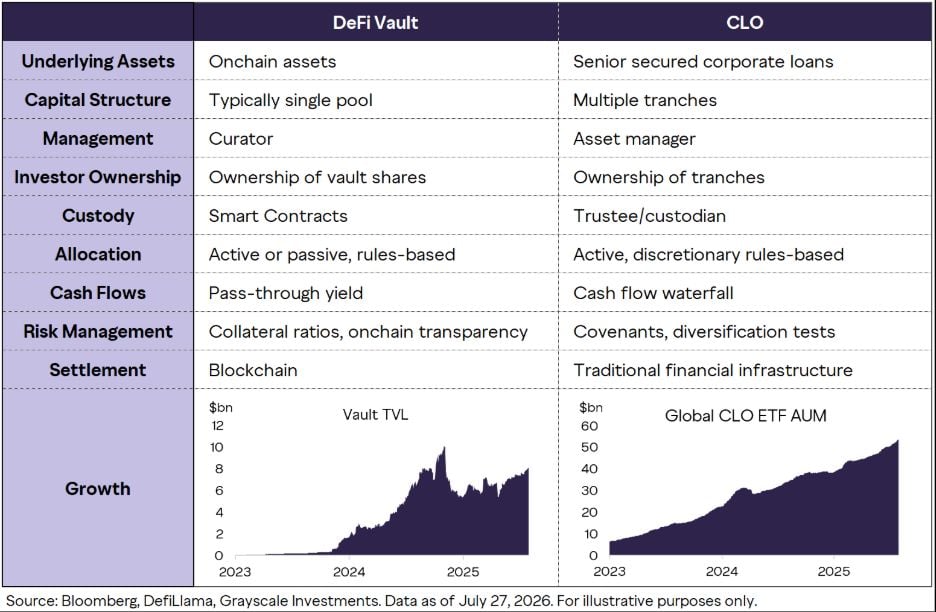
By leveraging smart contracts to replace traditional intermediaries, on-chain vaults are effectively digitizing the management of credit and liquidity. As these protocols begin to mirror the efficiency and structure of Collateralized Loan Obligations (CLOs), they are attracting the attention of both decentralized autonomous organizations (DAOs) and legacy financial institutions, signaling a pivotal moment for public adoption.
The Mechanics of Modern Yield: What Are On-Chain Vaults?
At their core, on-chain vaults are automated, programmable investment vehicles designed to manage assets and generate yield. In traditional finance, an investor looking for diversified credit exposure would typically rely on a hedge fund manager or a private equity firm. These human-led institutions carry high management fees, complex custodial requirements, and significant administrative overhead.
On-chain vaults remove these friction points. By utilizing smart contracts, these vaults execute pre-defined strategies—such as lending, liquidity provision, or arbitrage—without the need for a central clearinghouse. The "curators" of these vaults, such as Steakhouse, Gauntlet, and Sentora, act as the architects of the strategy, while the blockchain itself serves as the immutable ledger and custodian.
Parallels to the $1.5 Trillion CLO Market
The comparison to Collateralized Loan Obligations (CLOs) is not accidental. CLOs have long been the gold standard for institutional credit exposure, representing a massive, highly liquid market that has historically shown resilience during financial downturns. By pooling corporate loans and allowing investors to participate in the interest generated, CLOs provide a steady, risk-adjusted return.
On-chain vaults are essentially "CLOs 2.0." By tokenizing the interest in these pools, vault protocols allow for greater transparency, 24/7 liquidity, and the ability for investors to enter or exit positions with minimal friction. This shift from manual, opaque, and slow-moving traditional credit structures to transparent, code-based execution represents a fundamental evolution in how capital is managed globally.
Chronology: From Experimental DeFi to Institutional Interest
To understand the current trajectory of vaults, one must look at the progression of decentralized finance (DeFi) over the last half-decade.

- 2020–2021 (The DeFi Summer Era): Vaults began as experimental yield aggregators. Protocols like Yearn Finance pioneered the concept of "yield farming," where code automatically moved liquidity to wherever interest rates were highest. While effective, these early versions were often prone to smart contract risks and lacked institutional safeguards.
- 2022–2023 (The Search for Real Yield): As the crypto market entered a bear cycle, the industry shifted its focus from unsustainable token incentives to "real yield"—returns generated by underlying economic activity rather than inflationary token printing. This period saw the rise of Real World Assets (RWAs), as protocols sought to bridge the gap between stable fiat-denominated credit and digital asset rails.
- 2024–2025 (The Institutional Pivot): With the integration of stablecoins and the maturation of perpetual futures, major players like Ethena began incorporating CLOs and other RWA instruments into their reserves. This marked the transition from "crypto-native" yields to "macro-backed" yields.
- 2026 (The Current Frontier): The market for vaults has reached a critical mass of approximately $7.3 billion. With over 3,000 active vaults managed by 57 distinct curators, the infrastructure is now robust enough to support significant institutional allocation.
Supporting Data: The Market Landscape
The current vault ecosystem is characterized by high concentration but rapid innovation. The top three curators—Steakhouse, Sentora, and Gauntlet—collectively manage over 70% of the market share. This centralization of expertise provides a layer of professional trust for institutional allocators who are wary of unaudited or unmanaged smart contracts.
| Metric | Status |
|---|---|
| Total Value Locked (TVL) | ~$7.3 Billion |
| Active Curators | 57 |
| Managed Vaults | 3,000+ |
| Top 3 Market Share | >70% |
The dominance of these firms highlights a trend toward "Curated Finance," where professional risk managers utilize blockchain technology to offer superior transparency compared to the "black box" nature of traditional hedge funds. For investors, this offers a unique value proposition: the reliability of an institutional asset manager combined with the verifiable, real-time auditing capabilities of a public blockchain.
Official Responses and Regulatory Challenges
The potential for vaults to disrupt the $1.5 trillion CLO market has not gone unnoticed by global regulators. S&P Global, in a recent analysis, identified RWA tokenization as the primary catalyst for long-term growth, but also highlighted the regulatory hurdles that keep traditional institutions on the sidelines.
The Regulatory Uncertainty
The primary challenge is the classification of vault tokens. In many jurisdictions, it remains unclear whether a token representing a share in a managed, automated credit pool should be classified as a security. S&P Global noted:
"Many institutional investors are avoiding direct investment in vault tokens as they can’t be certain which regulatory regime they fall under."
The SEC’s Evolving Stance
In July, the U.S. Securities and Exchange Commission (SEC) provided a measure of clarity, suggesting that most vaults would indeed fall under federal securities laws. However, the Commission explicitly rejected a "one-size-fits-all" approach. Instead, the agency indicated that it will adopt a case-by-case review, focusing on the specific design, management structure, and distribution methods of each vault.
This "case-by-case" framework, while currently creating a period of cautious navigation, is viewed by many as a net positive. It suggests that regulators are willing to create a pathway for compliant, on-chain credit products, provided that curators implement appropriate disclosures and investor protection mechanisms.
Implications for the Future of Finance
The transition toward on-chain vaults suggests a future where the distinction between "DeFi" and "TradFi" becomes increasingly blurred.
1. The Democratization of Credit
Historically, access to high-yield credit products like CLOs was restricted to accredited investors, pension funds, and major banking institutions. On-chain vaults have the potential to democratize this access, allowing a broader range of global participants to interact with institutional-grade yield strategies through simple digital wallets.
2. Operational Efficiency
By removing the need for manual custodians and intermediaries, vaults drastically reduce transaction costs. The automation of administrative tasks—such as interest distribution, collateral monitoring, and margin calls—creates a more efficient market where a higher percentage of the underlying yield flows directly to the end investor rather than being absorbed by middlemen.
3. The "Institutionalization" of DeFi
As Grayscale’s Zach Pandl pointed out, the growth of stablecoins and perpetual futures followed a specific path: they began as fringe experiments before becoming essential components of the financial system. Vaults are now on that exact trajectory. When major traditional financial entities begin to utilize on-chain vaults for their own treasury management, it will serve as the ultimate validation of the technology.
Final Conclusion
The on-chain vault market stands at a critical juncture. It has moved beyond the speculative excesses of the early crypto era and into a phase of disciplined, product-led growth. While regulatory clarity remains a work in progress, the technical advantages—transparency, automation, and efficiency—are simply too significant for the market to ignore.
As the industry continues to align with global regulatory standards, the integration of on-chain vaults into the broader financial system seems inevitable. Whether they will fully capture the $1.5 trillion CLO market or create entirely new asset classes remains to be seen, but one thing is clear: the infrastructure for the next generation of managed credit has arrived, and it is built on the blockchain.
