

Cardano, one of the blockchain industry’s most scrutinized and ambitious projects, successfully executed a major network hard fork over the weekend. The "Van Rossem" upgrade, which transitions the network to protocol version 11, represents far more than a simple code update. It marks a historic shift in the project’s lifecycle: for the first time in its history, a Cardano hard fork has been ratified and implemented entirely through on-chain, community-driven governance, effectively severing the reliance on the network’s founding entity, Input Output Global (IOG), for administrative control.
This transition signifies that the "Voltaire" era of Cardano—the final phase of its roadmap dedicated to self-sustainability—is no longer a theoretical goal but a functioning reality. By moving away from centralized oversight, Cardano is attempting to prove that a decentralized network can manage its own evolution, security, and future trajectory without the "hand-holding" of its original architects.
The Chronology of Autonomy
The path to the Van Rossem upgrade was paved by a deliberate, multi-year strategy aimed at gradually transferring power from developers to the community.
The process began in earnest with the 2024 Chang hard fork, which served as the "Big Bang" for Cardano’s on-chain governance. Chang introduced the fundamental infrastructure required for voting, allowing ADA holders and delegated representatives to weigh in on protocol changes. This was followed by the Plomin hard fork in early 2025, which deepened the integration of governance, granting token holders meaningful decision-making authority over the network’s future.
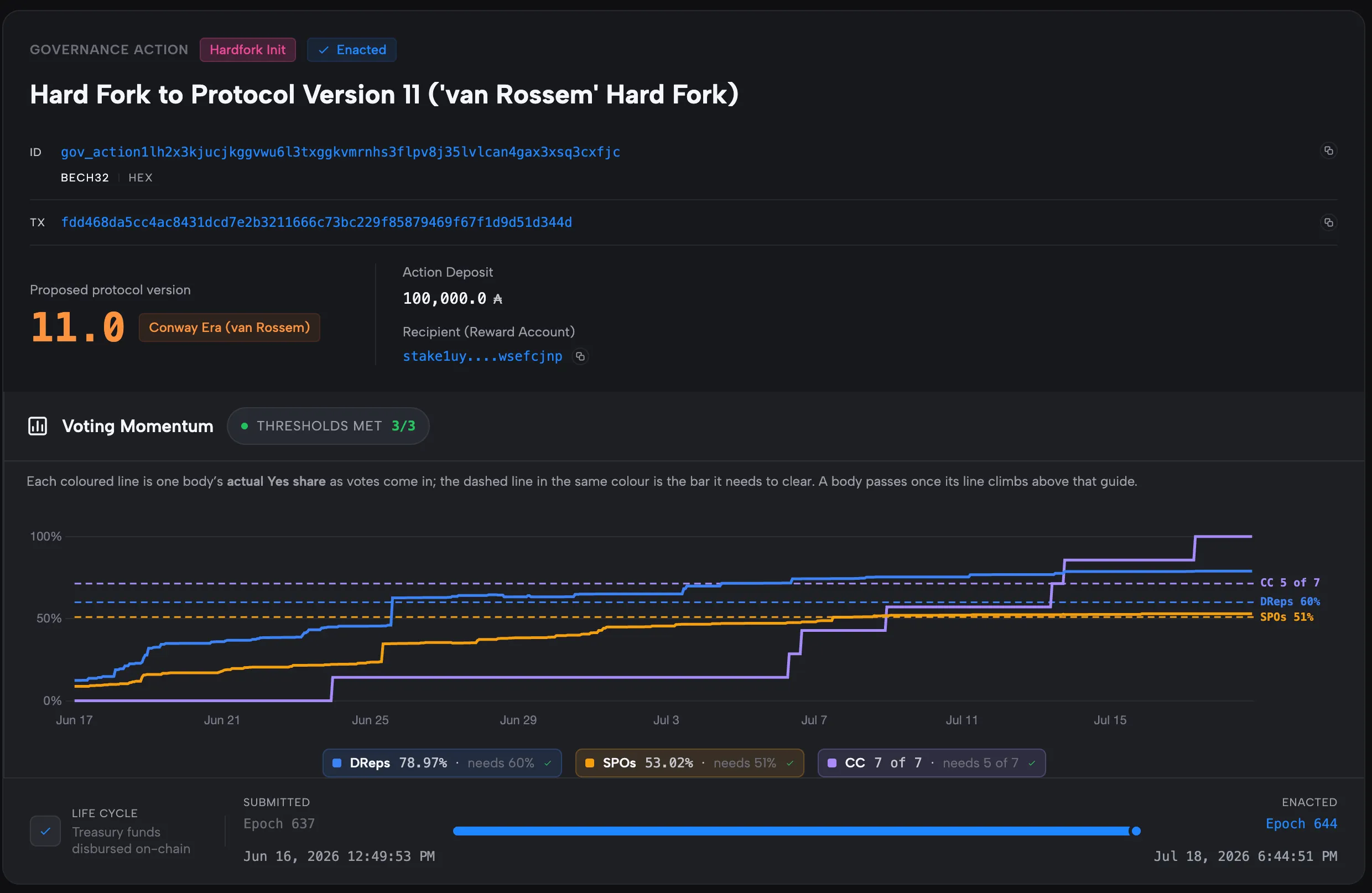
The Van Rossem upgrade serves as the logical conclusion to this series of experiments. The proposal faced a rigorous, multi-stage approval process, mirroring the checks and balances found in traditional democratic systems:
- Delegate Ratification (DReps): The community-elected representatives, serving as the voice of individual ADA holders, approved the measure with a 77.63% majority, comfortably surpassing the required 60% threshold.
- Stake Pool Operator (SPO) Consensus: The backbone of the network—the SPOs responsible for maintaining nodes and securing the ledger—voted at a 52.7% margin, narrowly clearing the 51% requirement to ensure the upgrade was technically supported by the infrastructure providers.
- Constitutional Committee Review: A specialized seven-member board, tasked with ensuring all upgrades align with the foundational "Cardano Constitution," provided the final sign-off.
The fork is named in memory of Max van Rossem, a dedicated Dutch contributor who passed away in October 2025. Van Rossem was a polymath of the Cardano ecosystem, serving as a developer, a node operator, and a constitutional delegate. His work was instrumental in architecting the very governance system that facilitated this successful, community-led transition.
Technical Scope: What Van Rossem Changes
While the governance implications are political and structural, the technical content of the Van Rossem upgrade is focused on operational efficiency. It is categorized as an "intra-era" upgrade, meaning it refines existing features rather than executing a fundamental overhaul of the blockchain’s core architecture.
The primary objective is the optimization of Plutus, Cardano’s native smart contract programming language. By reducing the execution costs associated with Plutus, the upgrade enables developers to build and deploy increasingly complex decentralized applications (dApps), NFT marketplaces, and DeFi protocols with significantly lower overhead.
Key technical additions include:
- Constant-Time Array Indexing: A performance improvement that ensures predictable processing speeds regardless of data size.
- Native Value Handling: Streamlining how the network manages and transfers different types of assets.
- Faster List Traversal: Reducing the computational burden on nodes when navigating complex data structures.
- Enhanced Cryptographic Primitives: The integration of new tools to accelerate digital signature verification, a critical component for transaction throughput.
- Security Hardening: A mandatory requirement for all stake pools to utilize unique cryptographic keys, effectively closing a known attack vector that could have potentially compromised network integrity.
Input Output Group (IOG) emphasized that these changes are designed to provide a more robust "developer experience," ensuring that the network remains competitive in a landscape dominated by high-speed, low-cost chains.
Implications: The End of IOG’s Monopoly
The most profound implication of the Van Rossem upgrade is the end of an era for Input Output. For years, IOG was the primary driver of development, security audits, and protocol upgrades. However, as of August, IOG is set to hand over the majority of its development responsibilities to independent, specialized engineering teams.
Van Rossem is the first test of this new, decentralized model. By successfully navigating the upgrade without IOG’s direct intervention, the Cardano community has effectively "passed the baton." This shift is vital for regulatory compliance and long-term viability, as it demonstrates that no single entity holds the "kill switch" or the "upgrade key" for the network.
Looking forward, the roadmap is dominated by the Ouroboros Leios project. Leios is the next major leap in the network’s evolution, designed to solve the "trilemma" of security, decentralization, and scalability. With a target of 1,000+ transactions per second—a 30x to 65x increase over current capabilities—Leios represents the final hurdle before Cardano can truly compete with traditional finance (TradFi) throughput. The Van Rossem upgrade provided the essential cryptographic foundation necessary for Leios to be implemented later in 2026.
Market Analysis and Investor Sentiment
Despite the technical significance of the hard fork, the market response has been notably muted. Cardano’s native token, ADA, has remained largely stagnant, hovering around the $0.1662 price level with a market capitalization of approximately $6 billion.
The technical indicators present a complex picture:
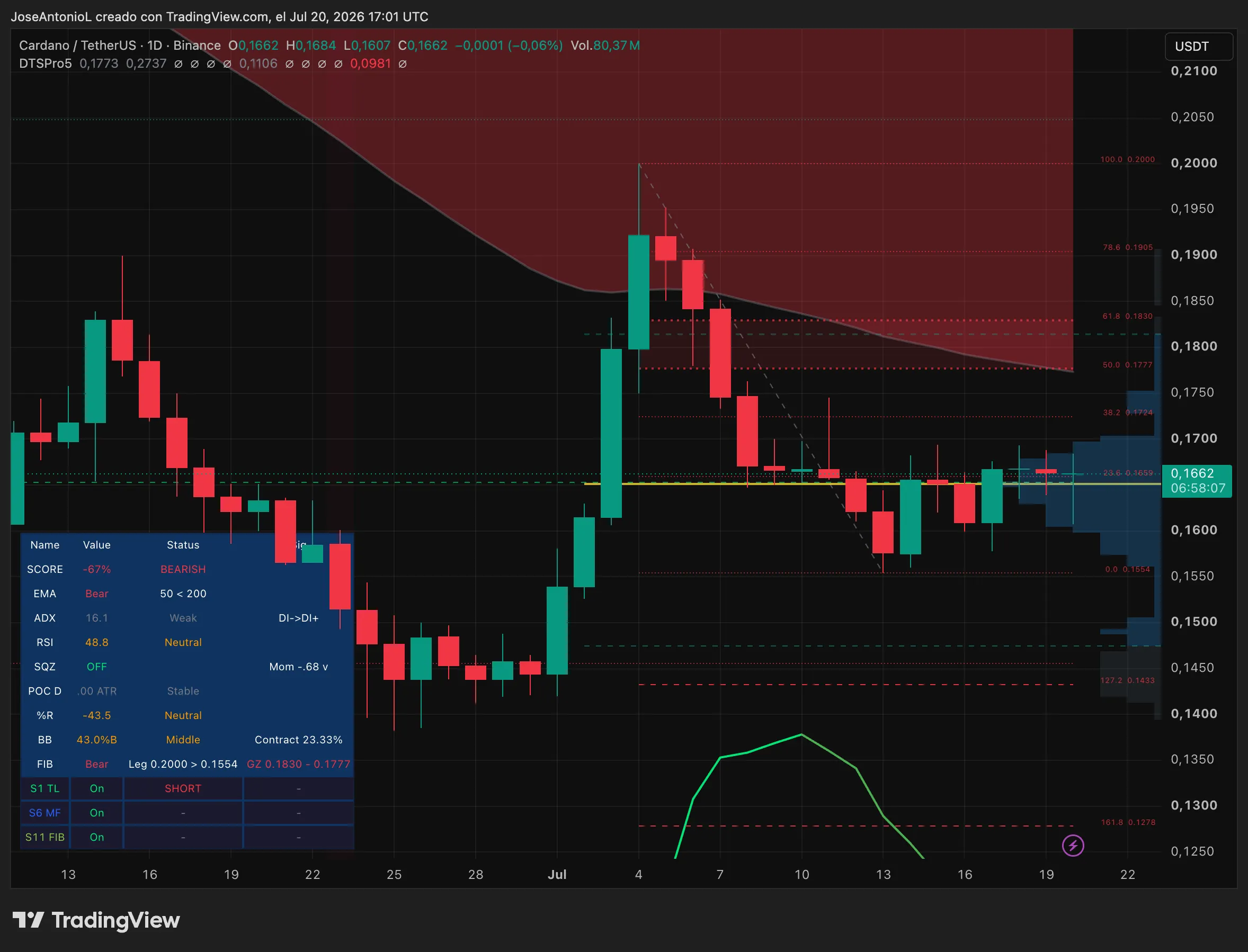
- Moving Averages: The 50-day exponential moving average remains below the 200-day average, a classic "death cross" pattern that traditionally signals long-term bearish sentiment.
- Momentum: The Relative Strength Index (RSI) sits at 48.8, indicating a neutral market where neither buyers nor sellers have established a dominant trend.
- Trend Strength: The Average Directional Index (ADX) is low at 16.1, suggesting a lack of strong momentum in either direction. However, some traders have noted a subtle shift in the directional component, which has moved from bearish to bullish—an early warning sign often monitored by professional market participants.
Data from on-chain analytics firm Santiment reveals a fascinating dichotomy among investors. "Whales"—holders of 100,000 to 100 million ADA—have been aggressively accumulating, pushing their combined balances to the highest levels since 2023. Conversely, smaller retail holders have been reducing their exposure, perhaps seeking liquidity elsewhere or reacting to the extended period of price consolidation.
Official Perspectives and Future Outlook
Charles Hoskinson, the founder of Cardano, has maintained a long-term outlook, consistently emphasizing that the project is built for decades, not months. The successful deployment of the public testnet for Ouroboros Leios, known as "Musashi Dojo," on June 23, confirms that the technical pipeline remains active despite the shift in governance.
The consensus among analysts is that the market is currently in a "wait and see" mode. Investors are likely waiting for the tangible results of the new governance model—specifically, the ability of the community to approve and implement complex upgrades like Leios—before committing significant capital.
For builders and node operators, the message from the Van Rossem upgrade is clear: the rules of engagement have changed. The network is no longer a corporate-led project, but a decentralized collective. Whether this model can generate the same level of speed and innovation as a centralized entity remains the ultimate question. If the post-IOG development transition goes as smoothly as the Van Rossem fork, Cardano may well have solved the hardest problem in blockchain: how to grow up, decentralize, and scale without breaking the foundation.
