

By the News Desk | Edited by Samuel Rae
Published: October 2024
Executive Summary: The Tale of Two Assets
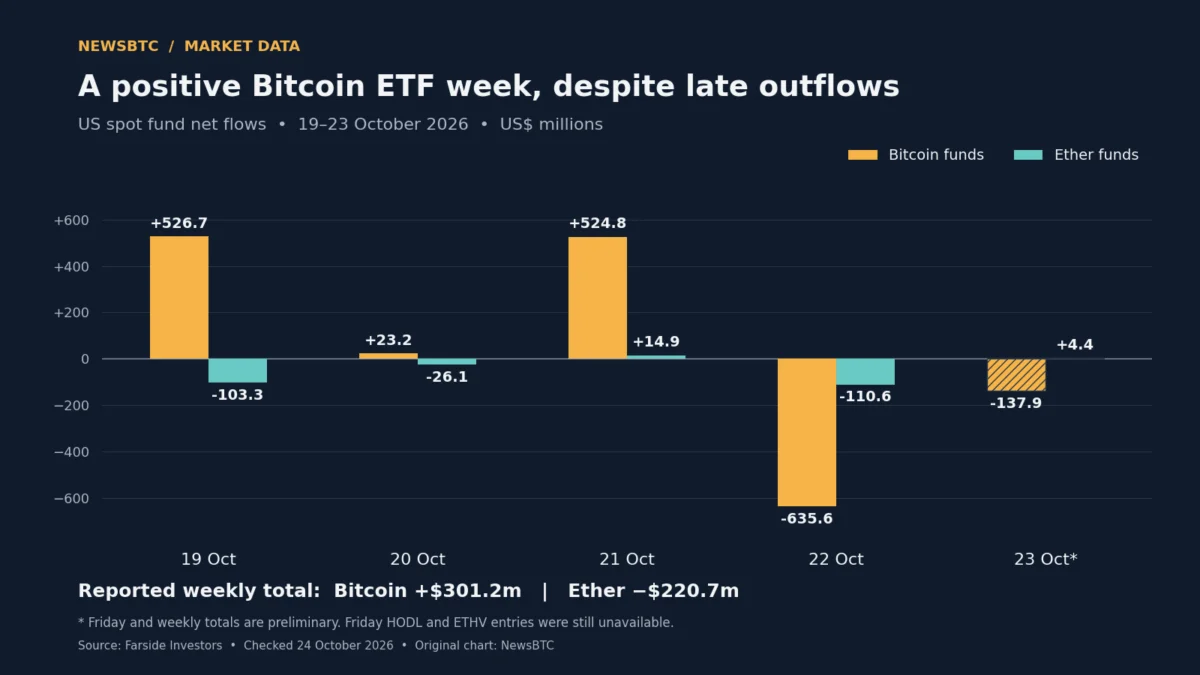
The institutional cryptocurrency landscape experienced a dramatic tug-of-war in the penultimate week of October, with United States spot exchange-traded funds (ETFs) painting a fractured picture of digital asset demand. According to preliminary figures compiled by Farside Investors, US spot Bitcoin funds managed to retain a positive foothold, securing a $301.2 million net weekly inflow despite suffering severe headwinds during the final two trading sessions.
Conversely, the story for spot Ethereum (Ether) investment vehicles was decidedly more pessimistic. Ether-backed funds endured a bruising week defined by heavy institutional redemptions, closing the period down $220.7 million despite a modest, late-session green print on Friday.
These divergent trajectories underscore the complex, shifting nature of institutional sentiment. While early-week buying sprees propelled both asset classes higher, severe late-week corrections erased billions in prospective gains, demonstrating that institutional demand is far from a predictable, one-directional march. Furthermore, analysts note that these figures remain provisional. As of late Friday, October 24, several data entries—including VanEck’s fund metrics—remained unconfirmed, suggesting the final accounting could shift once reporting is fully reconciled.
Chronology of the Week: A Story of Highs, Lows, and Late-Week Reversals
To understand the macro-narrative of the week’s trading, one must examine the day-by-day progression of capital movements across both asset classes. The market environment transitioned rapidly from unbridled optimism to sharp risk-off behavior.
The Bitcoin Rollercoaster
The week began with a wave of aggressive accumulation across US spot Bitcoin ETFs. Monday through Wednesday served as a masterclass in institutional buying, pulling in an astonishing $1.0747 billion in net inflows. Investors appeared emboldened by favorable macroeconomic indicators and a buoyant spot price market, injecting capital into products managed by industry titans like BlackRock, Fidelity, and others.
However, the momentum stalled dramatically toward the end of the week.
- Thursday, October 23: The sentiment shifted abruptly as a wave of profit-taking or risk mitigation swept through Wall Street. The single-day tally recorded a staggering $635.6 million in net outflows, wiping out a significant portion of the early-week gains.
- Friday, October 24: The downward pressure persisted. Farside Investors’ tracking tables registered an additional $137.9 million in net outflows for the final session.
Combined, the Thursday and Friday sessions bled $773.5 million out of the ecosystem. Yet, because the early-week figures were exceptionally robust, Bitcoin funds narrowly avoided a negative weekly balance, closing the five-day window with a net positive inflow of $301.2 million.
Ethereum’s Relentless Redemptions
Ethereum funds experienced an even more volatile and ultimately damaging week. While Bitcoin funds enjoyed a multi-day grace period of heavy buying, Ethereum struggled to capture sustained momentum.
The critical turning point occurred mid-to-late week. On Thursday, Ethereum ETFs absorbed a punishing $110.6 million withdrawal. While Friday’s session brought a slight reprieve—registering a minor inflow of $4.4 million—it was far too little to rescue the weekly tally. When aggregating all five sessions, Ethereum products finished the week deep in the red with a net outflow of $220.7 million, leaving the asset underwater heading into the weekend.
Supporting Data and Granular Breakdown
A deeper dive into the specific fund mechanics reveals where the capital was concentrated and which issuers bore the brunt of the late-week liquidations.
Bitcoin Fund Ledger: IBIT and FBTC Lead the Volatility
The Friday Bitcoin bleed was not distributed evenly across the asset class; rather, it was heavily concentrated in the market-leading products managed by traditional financial powerhouses.
- BlackRock’s iShares Bitcoin Trust (IBIT): As the heavyweight champion of spot Bitcoin ETFs, IBIT recorded $110.3 million in outflows on Friday alone, serving as the primary driver of the day’s negative balance.
- Fidelity Wise Origin Bitcoin Fund (FBTC): Fidelity’s flagship product also saw notable capital flight, shedding $31.8 million on Friday.
- Morgan Stanley’s MSBT: Bucking the broader macro trend, Morgan Stanley’s product managed a modest $4.2 million inflow on Friday, providing a tiny counterweight to the institutional sell-off.
The Missing Data Caveat
Market participants examining these metrics must approach them with a degree of methodological caution. When checked on October 24, Farside’s tables still contained missing entries—specifically denoted by a "dash" for VanEck’s Friday entry in both the Bitcoin and Ether schedules.
In financial data processing, a dash does not automatically convert into a confirmed zero. It indicates missing or pending data from the underlying custodian or issuer reporting systems. Consequently, the published figures should be treated as incomplete snapshots. Subsequent updates and delayed reporting reconciliations could materially alter the final weekly totals.
Official Responses and Regulatory Mechanics: Decoding ETF Flows
Interpreting institutional fund flows requires an understanding of how these financial vehicles actually operate under the regulatory framework established by the U.S. Securities and Exchange Commission (SEC).
Secondary Market Trading vs. Fund Creation/Redemption
A common misconception among retail market participants is that every dollar traded on an exchange equates to a net creation or redemption of fund shares. The SEC’s general investor guidelines regarding ETF mechanics emphasize a crucial distinction:
- Secondary Market Transactions: Investors buy and sell existing ETF shares among themselves on public exchanges (e.g., NASDAQ, NYSE) throughout the trading day. These peer-to-peer transactions do not inherently alter the total assets under management (AUM) of the fund or require the underlying custodian to buy or sell spot Bitcoin/Ethereum.
- Primary Market Creations/Redemptions: Authorized Participants (APs) interact directly with the fund issuer to create or redeem large blocks of shares (creation units), which does involve buying or selling the underlying digital assets in the open market.
Therefore, high turnover and massive volume days do not always align cleanly with net inflow or outflow figures. Observers must separate trading liquidity from institutional accumulation.
The Limits of Blockchain Transfers
Similarly, analysts frequently misinterpret massive on-chain wallet movements—such as transfers involving institutional custodians like Coinbase Prime or BitGo—as direct proof of retail or institutional subscriptions.
A transfer involving a custodian is rarely a complete account of investor capital flows. Custodians manage internal ledger rebalancing, hot-to-cold wallet migrations, and institutional OTC (over-the-counter) settlements that have little to do with daily ETF retail sentiment. Fund-flow data, share counts, and on-chain custody movements must always be read within their specific structural contexts.
Market Implications and Outlook
What do these mixed figures signal for the immediate future of the digital asset market?
Is Institutional Demand Steady?
The late-week reversal provides empirical evidence against the narrative that institutional demand is a uniform, steady, one-directional buyer. Traditional financial institutions, hedge funds, and corporate allocators utilize these ETFs for tactical positioning, hedging, and macro-driven strategies. When macroeconomic conditions tighten or short-term volatility spikes, these institutional players prove just as willing to trim risk and lock in profits as retail traders.
Key Questions for the Next Trading Week
As the market prepares for the upcoming trading cycle, analysts and portfolio managers are focusing on several critical questions:
- Can Fresh Subscriptions Materialize? The primary question for the next week is whether fresh capital subscriptions can rebuild the demand that was lost during the late-week exodus. The fact that Bitcoin managed to close the week with a positive net balance of $301.2 million leaves the door open for a bullish continuation, provided macroeconomic catalysts remain supportive.
- Ethereum’s Recovery Path: For Ethereum, the mandate is more urgent. Ether funds must reverse weeks of sluggish performance and claw back lost ground to convince institutional allocators of its long-term utility as a yield-bearing, smart-contract settlement layer.
- The Macro Overlay: Beyond crypto-specific flows, broader macroeconomic data—including upcoming inflation prints, central bank interest rate decisions, and traditional equity market performance—will likely dictate whether institutional investors feel emboldened to re-enter the digital asset space with aggressive allocations or retreat to safer, traditional asset classes.
Ultimately, while spot crypto ETFs have successfully bridged the gap between traditional finance and blockchain assets, the plumbing of these markets remains sensitive to short-term sentiment shifts. Investors and analysts monitoring these vehicles must look past the flashy opening bells of Monday mornings and pay close attention to the hard-fought closing tallies at the end of the week.
