

On June 9, 2026, a significant dialogue unfolded between the crypto-asset industry and the U.S. Treasury. The Hyperliquid Policy Center (HPC) and the prominent venture capital firm Paradigm submitted a formal joint comment letter to the Office of Foreign Assets Control (OFAC) and the Financial Crimes Enforcement Network (FinCEN). The document serves as a critical critique of the proposed stablecoin compliance rules tethered to the GENIUS Act, highlighting the tension between traditional financial surveillance and the inherent architecture of decentralized ledger technology.
While the industry stakeholders expressed broad support for the regulatory intent, they issued a stark warning: without precise calibration, the current proposal threatens to stifle innovation, drive decentralized finance (DeFi) activity into offshore jurisdictions, and impose unworkable obligations on permissionless blockchain networks.
The Core Conflict: Regulation vs. Decentralized Reality
The crux of the matter lies in the application of legacy financial compliance standards to a novel, automated asset class. The GENIUS Act, which aims to provide a comprehensive legal framework for stablecoins, mandates strict oversight to prevent money laundering and the financing of illicit activities. However, the comment letter submitted by HPC and Paradigm argues that the draft rules fail to distinguish between the primary market—where issuers have direct control—and the secondary market, which functions on decentralized, peer-to-peer protocols.
"We broadly support the proposed rule, and in particular FinCEN’s decision to tailor most issuer obligations to the primary market," the groups stated. "But we write to recommend that certain secondary market obligations be clarified or narrowed to avoid unintended consequences for permissionless blockchain infrastructure and the DeFi ecosystem."
The primary fear expressed by the firms is that the current language is too broad, potentially forcing stablecoin issuers to assume responsibility for every secondary transaction occurring on a public blockchain—a technical and legal impossibility in many permissionless environments.
Chronology of the Regulatory Push
To understand the weight of this intervention, one must look at the timeline of the "GENIUS era" of regulation.
- Early 2026: Legislators introduced the GENIUS Act, seeking to codify stablecoin oversight as a matter of national security and financial stability.
- Spring 2026: Federal agencies, including FinCEN and OFAC, initiated the rulemaking process, drafting compliance standards that would govern everything from issuance to redemption.
- May 2026: The New York State Department of Financial Services (NYDFS) signaled its intention to act as a "blueprint regulator," aligning state-level oversight with the impending federal GENIUS Act framework.
- June 9, 2026: The joint letter from HPC and Paradigm was submitted, marking the most significant industry-led pushback against the technical feasibility of the draft rules.
This chronology reflects a rapid transition toward a formalized regulatory environment, yet the friction points remain centered on how "centralized compliance" can exist in a "decentralized ecosystem."
Six Pillars of Reform: Paradigm and HPC’s Recommendations
The joint letter identifies six specific areas where the current proposal requires refinement to ensure it remains functional for the digital asset industry.
1. Clarification of Secondary-Market Obligations
The groups argue that issuers cannot be held liable for the actions of anonymous participants on secondary markets. They are seeking a clear "safe harbor" that limits issuer responsibility to transactions where they possess the technical ability to monitor or freeze assets.
2. Precise Blocking and Freezing Protocols
Current drafts lack clarity on the triggers for freezing assets. The authors urge regulators to define the exact circumstances under which an issuer is required to reject a transaction, ensuring these requirements align with existing AML (Anti-Money Laundering) standards rather than creating an impossible burden of real-time policing.
3. Enhanced Safe Harbor for SAR Filings
Suspicious Activity Reports (SARs) are the backbone of financial intelligence. The coalition argues that without robust legal protections, firms will be forced into "defensive filing," clogging the system with low-quality data. They propose an enhancement of safe harbor provisions to encourage accurate, high-quality reporting.
4. Adherence to Government Directives
There is a need for a clear hierarchy of compliance. The letter asks for guidance on how firms should reconcile federal sanctions directives with the constraints of smart contracts, which operate autonomously and are often immutable once deployed.
5. Customer Due Diligence (CDD) Overhaul
The groups suggest that the standard CDD requirements, designed for banks with centralized account holders, do not translate to wallet-based interactions. They propose a more flexible framework that acknowledges the pseudonymity of blockchain addresses while still meeting national security objectives.
6. Defining Effective Sanctions Compliance
Perhaps the most technical request is the call for a definition of an "effective" sanctions program. In the digital asset space, what constitutes "due diligence" varies. The industry is asking for a regulatory standard that rewards proactive, automated compliance measures rather than penalizing firms for the inherent nature of permissionless networks.
The CLARITY Act and the Yield Debate
A major point of contention within the GENIUS Act is the prohibition on stablecoin issuers paying out yield to holders. This provision was intended to curb systemic risk but has been viewed by the industry as an overreach that limits the utility of stable assets.
In response, the proposed CLARITY Act has emerged as a potential legislative remedy. The CLARITY Act aims to preserve the ability of third-party crypto companies—such as exchanges and DeFi protocols—to offer activity-based rewards. By decoupling the issuer of the stablecoin from the distributor of the yield, this act seeks to maintain a vibrant, competitive market without sacrificing the stability mandates of the GENIUS Act.
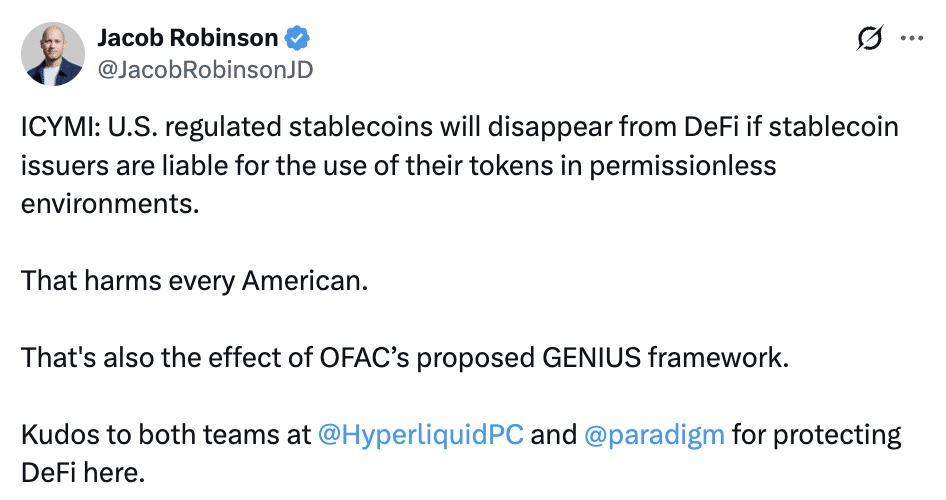
Industry voices, such as Jacob Robinson of Law of Code, have praised the nuanced approach of the CLARITY Act. Robinson’s perspective, widely shared among industry participants, suggests that the market needs a "surgical" regulatory approach rather than a "sledgehammer" that bans financial innovation. Brad Bourque, Policy Counsel at HPC, echoed this sentiment, emphasizing that the goal of these interventions is to keep the U.S. at the forefront of financial technology while maintaining the highest standards of regulatory integrity.
Implications: The Risk of Regulatory Flight
The underlying concern driving these recommendations is the threat of "regulatory flight." If the U.S. implements rules that effectively ban or severely handicap permissionless blockchain infrastructure, the likely outcome is not compliance, but the migration of developers, capital, and innovation to more permissive jurisdictions.
The NYDFS’s recent move to position itself as a blueprint regulator for the GENIUS era adds another layer of complexity. By attempting to unify state and federal requirements, New York is effectively setting the standard for how the rest of the country—and potentially the world—views stablecoin compliance. If New York and federal regulators adopt the feedback provided by Paradigm and the HPC, it could establish a "gold standard" for stablecoin regulation that is both safe and scalable.
However, if these recommendations are ignored, the industry fears a "chilling effect." Excessive KYC requirements on secondary markets, for example, could essentially render public blockchains unusable for mainstream stablecoin commerce, forcing developers to abandon open protocols in favor of permissioned, "walled garden" systems. This would arguably undermine the very promise of the technology—transparency, interoperability, and global accessibility.
Conclusion: Toward a Realistic Compliance Framework
The intervention by Paradigm and the Hyperliquid Policy Center is a pivotal moment for the U.S. stablecoin market. It underscores a fundamental truth about modern financial regulation: it must evolve alongside the technology it governs.
The recommendations provided by these firms are not a call for deregulation; rather, they are a call for functional regulation. By refining the obligations for secondary market participants, clarifying sanctions requirements, and ensuring that yield-bearing activities can continue through compliant intermediaries like those envisioned in the CLARITY Act, regulators have the opportunity to foster an environment where stability and innovation coexist.
As the Treasury evaluates these comments, the eyes of the global financial community remain fixed on Washington. The outcome of this regulatory process will dictate the competitive landscape for digital assets for the next decade. Whether the U.S. chooses a path of rigid, legacy-focused oversight or a more agile, technology-aligned framework will determine if the nation remains the primary home for the next generation of financial infrastructure or if it cedes that position to global competitors.
The path forward, as articulated by the HPC and Paradigm, requires a delicate balance—ensuring that the "GENIUS era" of stablecoins is defined not by the constraints it imposes, but by the security and efficiency it provides to the global economy.
