

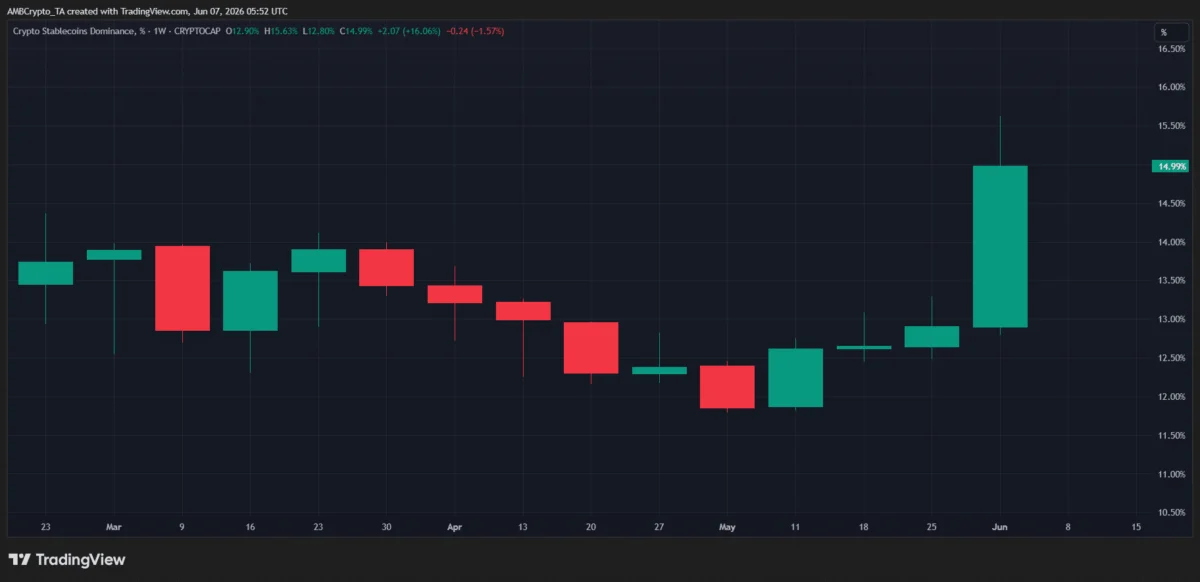
The landscape of the cryptocurrency market is undergoing a structural transformation that has caught even the most seasoned market analysts off guard. In a development that signals a profound shift in investor sentiment, the digital asset ecosystem is witnessing a historic "risk-off" exodus. Rather than rotating capital from volatile altcoins into more defensive positions, participants are increasingly opting to exit the ecosystem entirely, favoring the liquidity and safety of stablecoins over the speculative allure of blockchain innovation.
This phenomenon, now colloquially dubbed "Stablecoin Season" by market participants on platforms like X (formerly Twitter), represents a fundamental change in the behavior of institutional and retail capital alike.
Main Facts: The Liquidity Exodus
At the core of this bearish trend is a stark correlation: the simultaneous decline in stablecoin market capitalization and the rapid evaporation of value in risk assets. Typically, in a healthy market cycle, when investors flee high-risk altcoins, they park their funds in stablecoins—a "flight to safety" that keeps capital within the crypto ecosystem.
However, the current cycle is different. The data indicates that capital is not merely rotating; it is leaving the ecosystem. Over the last 21 days, the market has seen a contraction of more than $7 billion in stablecoin supply, while an staggering $400 billion has been pulled from the broader crypto market. This indicates a systemic reduction in leverage and a retreat from the digital asset space, reflecting a pervasive lack of conviction in the immediate price action of major protocols.
Chronology: A Historic Flippening
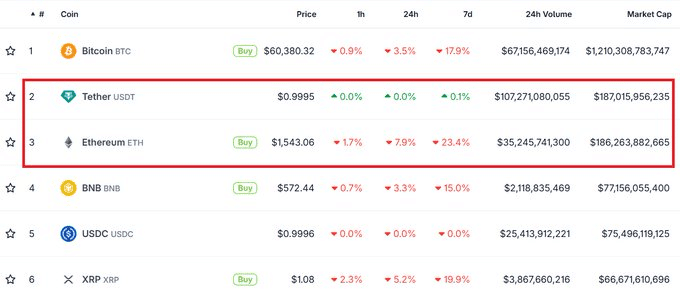
The most poignant indicator of this shift occurred in early June 2026, when Tether (USDT) achieved a milestone that had not been seen in nearly eight years: it officially flipped Ethereum (ETH) in total market capitalization.
- The Lead-up: Throughout late May, Ethereum faced sustained selling pressure as decentralized finance (DeFi) activity began to wane.
- The Critical Pivot: By early June, Ethereum’s market cap dipped to approximately $185 billion, while Tether held firm at roughly $187 billion.
- The Psychological Impact: This event, occurring for the first time since 2018, served as a "canary in the coal mine" for the broader market. It highlighted that the market’s center of gravity had moved away from the "World Computer" and toward the "Digital Dollar."
- The Aftermath: Following the flippening, the market saw an acceleration in the decline of Total Value Locked (TVL) across the Ethereum network, which has since plummeted to a concerning $36 billion.
Supporting Data: Decoding the Divergence
To understand why this cycle is so distinct, one must look at the technical indicators of capital flow. Usually, when Bitcoin hits a resistance level, capital rotates into altcoins as traders seek higher risk-reward ratios. This cycle, however, that rotation is entirely absent.

The Stagnation of Bitcoin Dominance
Bitcoin dominance (BTC.D) has stalled at the 60% level, a point that historically precedes a massive capital inflow into the Ethereum and altcoin sectors. Instead of a breakout, the ETH/BTC pair has been trapped in a steady, relentless downtrend for nearly eight weeks. This absence of "alt-season" vigor confirms that speculative appetite has been replaced by risk aversion.
The Utility Premium
While the broader market shrinks, the continued usage of stablecoins as a settlement layer and store of value persists. Stablecoins are currently the only assets in the space offering immediate, tangible utility:
- Settlement: Rapid cross-border value transfer.
- Trading Pairs: Acting as the primary quote currency for exchanges.
- Capital Preservation: Providing a hedge against the volatility of the underlying crypto-assets.
The data suggests that in 2026, liquidity is no longer a tool for speculation, but a defensive shield. Investors are prioritizing the "functional purpose" of their holdings over the potential for 10x gains in decentralized applications.
Official Perspectives and Market Sentiment
Market analysts have noted that the current environment is heavily influenced by macroeconomic uncertainty. "The market is becoming utility-driven," says one senior analyst at a prominent crypto research firm. "When the macro climate becomes unpredictable, the ‘crypto-native’ mindset of high-risk appetite vanishes, replaced by a need for liquidity. Tether’s ascent over Ethereum isn’t just a chart anomaly; it’s a reflection of a risk-averse, liquidity-starved investor base."
Furthermore, the "Stablecoin Season" narrative has gained traction because it accurately describes the current strategy of the "Smart Money." Rather than timing the bottom of volatile altcoins, large-scale participants are holding stablecoins to capture high yield in lending protocols while waiting for the dust to settle on global economic conditions.
Implications: What Comes Next?
The implications of this shift are twofold.
1. The Decline of DeFi Conviction
The drop in Ethereum’s TVL to $36 billion is the most alarming signal for the DeFi ecosystem. It implies that users are not just selling their tokens; they are withdrawing their liquidity from the very protocols that form the backbone of the decentralized economy. Without this liquidity, the innovation cycle of DeFi is effectively paralyzed, leading to a "zombie" phase where development continues, but usage remains stagnant.
2. A Shift in Market Psychology
If 2026 is indeed the year of "Stablecoin Season," the traditional cycle of "Bull -> Alt-Season -> Correction" may be fundamentally broken. Investors are proving that they are no longer willing to rotate into speculative assets at the first sign of a Bitcoin stall. This represents a more "mature" but less "exciting" market.
Long-term Outlook
While the current trend is bearish, history teaches us that markets are cyclical. The concentration of capital in stablecoins means that, theoretically, there is a massive "dry powder" reserve sitting on the sidelines. Should macroeconomic conditions improve or should there be a catalyst for renewed growth, this capital is primed to re-enter the market.
However, until such a catalyst appears, the market is destined to remain in a state of high-liquidity, low-risk volatility. The "flippening" of Ethereum by Tether is not merely a piece of trivia; it is a clear warning that the market has chosen preservation over participation.
Conclusion
The data is incontrovertible: the 2026 market is defined by a flight to quality and utility. As investors continue to exit the volatile ecosystem in favor of stablecoins, the narrative of "Stablecoin Season" will likely persist until the macroeconomic landscape shifts or a new, undeniable value proposition emerges to tempt capital back into the risk-on sector. For now, the digital asset space remains in a period of consolidation, where liquidity is king, and speculation has taken a back seat to survival.
As we look toward the remainder of the year, the primary metric for traders will not be the performance of a specific altcoin, but the total market cap of the stablecoin sector. When that number finally begins to rotate back into risk assets, the real recovery will begin. Until then, the industry is in a defensive crouch, waiting for a signal that the era of stablecoin dominance has finally reached its end.
