

For any Layer 1 blockchain, stablecoin liquidity acts as the lifeblood of the ecosystem—a foundational metric that indicates how easily capital can flow into decentralized finance (DeFi) applications, non-fungible token (NFT) marketplaces, and high-frequency trading platforms. Recently, Solana has demonstrated an aggressive expansion in this area, with USDC minting activity reaching levels that suggest the network is becoming a primary destination for on-chain capital. Yet, despite this surge in liquidity, the price of SOL remains mired in a multi-month slump, creating a stark divergence that has analysts questioning the nature of the network’s current growth.
The Core Facts: A Surge in Stablecoin Liquidity
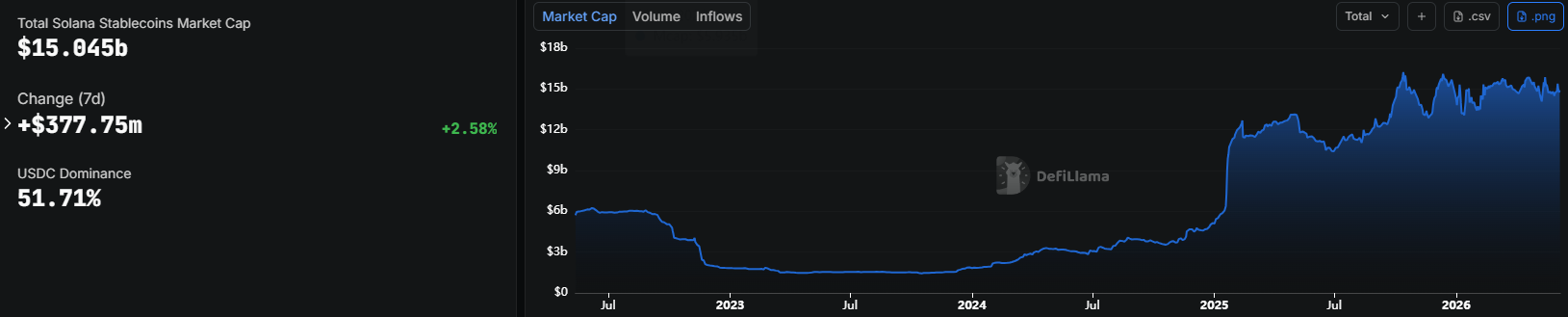
The data emanating from the Solana ecosystem is, on the surface, undeniably bullish. Solana’s stablecoin market capitalization is rapidly approaching its all-time high of $16 billion, a milestone that reflects robust demand for its on-chain infrastructure. Over the past week alone, more than $370 million in new liquidity has flooded into the network.
Central to this movement is USDC, the stablecoin issued by Circle, which now accounts for over 51% of the total stablecoin liquidity on Solana. This concentration highlights the network’s increasing reliance on regulated, fiat-backed assets to facilitate its rapid-fire trading environment. While Ethereum remains the dominant force in the broader stablecoin landscape, holding approximately 64% of the total USDC supply, the growth trajectory tells a different story. Solana, currently holding roughly 10.3% of the total supply, is capturing the lion’s share of new issuance, signaling a shift in where market participants are choosing to deploy their capital.
Chronology of the Recent Liquidity Shift
To understand the current state of the Solana ecosystem, one must look at the recent timeline of capital flows.
- Early May 2026: Solana recorded its strongest month in history for perpetual decentralized exchange (DEX) volume, hitting a staggering $64.5 billion. This period marked the beginning of a sustained spike in on-chain activity, driven largely by retail interest in memecoins and speculative assets.
- Late May to Early June 2026: Circle accelerated its minting activity on the Solana network. In a single week, roughly $500 million in new USDC was minted specifically for the Solana ecosystem, representing a 6% increase in supply.
- The Contrast: During this identical window, USDC supply on the Ethereum mainnet experienced a contraction of approximately 1.48%. This shift suggests that capital is not merely being created in a vacuum but is being actively bridged or allocated away from legacy networks toward the high-throughput environment of Solana.
Supporting Data: Liquidity vs. Speculation
The paradox of Solana’s current market position lies in the distinction between "utility-driven liquidity" and "speculative velocity." While the raw numbers suggest adoption, the behavior of that liquidity tells a more nuanced story.
The Memecoin Engine
Critics and analysts alike have pointed to platforms like Pump.fun as the primary engines of Solana’s recent revenue generation. These platforms have turned the network into a hotbed for high-frequency, low-cap token trading. When liquidity enters an ecosystem primarily to chase volatile memecoins, that capital is often "transient"—it arrives, trades rapidly, and leaves just as quickly, or sits idle in wallets waiting for the next trend.

Perpetual DEX Volumes
The record-breaking $64.5 billion in perp DEX volume recorded in May is a double-edged sword. While it generates significant fee revenue for the network, it also indicates that users are utilizing Solana primarily as a casino for leveraged bets rather than as a foundation for long-term DeFi protocols, such as under-collateralized lending or institutional-grade synthetic asset issuance. Elevated perp volumes typically correlate with short-term speculative engagement, which lacks the "stickiness" of long-term capital lock-ups.
Technical Indicators and Price Performance
Despite the massive influx of USDC, the SOL/ETH ratio—a key barometer of Solana’s strength relative to the broader crypto market—has declined by nearly 3% this week. SOL itself has retreated to multi-month lows. Technical analysts have noted that the Relative Strength Index (RSI) for SOL has dipped into "deeply oversold" territory, yet the price has failed to stage a meaningful recovery. This lack of upward momentum, even in the face of record liquidity, suggests that the market is currently viewing Solana’s "growth" as a symptom of a localized trading craze rather than a structural expansion of the network’s fundamental value.
Perspectives and Official Interpretations
While the market data is clear, the interpretation of this data remains divided among stakeholders.
The Pro-Growth Perspective: Proponents of the Solana ecosystem argue that the surge in USDC is a prerequisite for long-term institutional adoption. By establishing deep liquidity pools, Solana is building the "plumbing" necessary for larger, more traditional financial entities to enter the space. From this viewpoint, the current focus on memecoins is merely a "bootstrapping" phase that stress-tests the network’s capacity and creates a high-velocity environment that will eventually attract more sophisticated capital.
The Skeptical Perspective: Conversely, institutional observers often view the reliance on speculative memecoin activity as a structural weakness. If a network’s liquidity is tethered to the volatile cycles of retail gambling, the "stability" of that liquidity is questionable. Should the memecoin frenzy subside, a significant portion of that $500 million in newly minted USDC could potentially exit the ecosystem as quickly as it arrived, leading to a liquidity crunch that could further pressure the price of SOL.
Implications for the Future
The current state of the Solana ecosystem presents several critical implications for investors and developers:
1. The "Sticky Liquidity" Challenge
Solana’s next major hurdle is converting its high-velocity speculative capital into "sticky" liquidity. For the network to decouple its price action from its current speculative reputation, it must foster an ecosystem where USDC is used for more than just gambling on tokens. Increased adoption of real-world assets (RWAs), decentralized identity solutions, and enterprise-grade payment rails will be essential in demonstrating that the network provides value beyond the current meme-trading mania.
2. The Relationship Between Fees and Value
The record-breaking perp DEX volumes have undoubtedly enriched the network’s fee-generation capabilities. However, if the price of SOL continues to slide despite these earnings, the market may be signaling that it does not value "transaction throughput" as highly as it values "decentralized security" or "ecosystem diversity." Solana must prove that its high-performance architecture can sustain value even when the trading volume of volatile tokens inevitably contracts.
3. Market Sentiment and Price Decoupling
The current divergence between on-chain metrics and price action is a classic warning sign. When a network’s fundamental "inputs" (liquidity) rise while the "output" (token price) falls, it indicates that the market is discounting the future utility of those inputs. Investors should be wary of the assumption that liquidity always equals price appreciation. In the current market cycle, liquidity is a tool, not a guarantee; its effectiveness depends entirely on the purpose for which it is being used.
Conclusion: A Network at a Crossroads
Solana currently sits at a fascinating intersection. It has successfully positioned itself as the fastest, most accessible highway for crypto-native capital, evidenced by its massive USDC inflows and record-breaking DEX activity. However, it is also wrestling with the perception that its growth is built on the sands of speculation rather than the bedrock of long-term economic utility.
As the network continues to scale and mature, the true test will be its ability to transition from a speculative playground into a durable financial ecosystem. If the current wave of USDC minting remains tied to high-risk trading, the network may continue to see periods of volatility and price stagnation. Conversely, if Solana can successfully leverage this liquidity to anchor more meaningful, long-term financial infrastructure, the current "oversold" status of its native token could eventually be seen as a significant entry point. For now, the market remains cautious, waiting to see whether the "Solana Summer" will be defined by the frenzy of the moment or the emergence of a truly resilient decentralized economy.
