


In the high-stakes world of smart contract platforms, liquidity is the lifeblood of on-chain activity. Unlike speculative social media sentiment or vague project roadmaps, the movement of capital—specifically stablecoins like USDC and USDT—serves as an empirical "source of truth." When billions in capital shift into a network, it is rarely the result of haphazard treasury management. Rather, it is a calculated deployment of resources into liquidity pools, perpetual futures markets, and complex DeFi strategies.
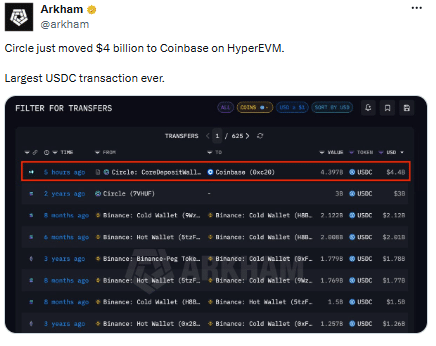
A recent, massive transaction has sent shockwaves through the crypto ecosystem: Arkham Intelligence has tracked Circle, the issuer of USDC, transferring over $4 billion to a Coinbase-linked address operating within HyperEVM—the Ethereum-compatible smart contract environment hosted on Hyperliquid. This movement is not merely a record-breaking transaction; it is a signal of a structural pivot in how capital is being positioned within the next generation of decentralized finance (DeFi).
The Anatomy of the Transaction: A Strategic Deployment
To understand the weight of this $4 billion transfer, one must first understand the symbiotic relationship between the entities involved. Circle serves as the primary architect and issuer of USDC, while Coinbase operates as the central hub for institutional distribution and liquidity management. When these two industry titans facilitate a multi-billion dollar shift into a specific network, it indicates a high degree of confidence in that network’s infrastructure.
Currently, Hyperliquid’s [HYPE] ecosystem is dominated by USDC, which accounts for over 95% of its total stablecoin supply. Recent data indicates a 20% surge in USDC supply over the last month alone, bringing the total value deployed on HyperEVM to an impressive $6 billion. In stark contrast, USDT remains a minor player on the chain, with a presence of only $192 million. This lopsided distribution underscores a clear preference among institutional and high-net-worth liquidity providers for the USDC standard within the Hyperliquid environment.
The $4 billion transfer to a Coinbase-linked address is not an isolated event. It is the logical conclusion of a broader strategy to bolster liquidity in anticipation of heightened trading activity, suggesting that "smart money" is preparing for a significant expansion in on-chain volume.
Chronology of Growth: From HIP-3 to Market Dominance
The current liquidity surge did not happen in a vacuum. It is the culmination of a rigorous growth trajectory that began in late 2025.

- October 2025: The launch of Hyperliquid’s HIP-3 ecosystem provided the technical foundation for the current scalability. The platform introduced high-performance perpetual futures, designed to compete with centralized exchanges.
- Late 2025 – Q1 2026: Throughout the first quarter of 2026, Hyperliquid saw a steady climb in Open Interest (OI). The platform’s ability to handle massive throughput while maintaining low latency began attracting sophisticated market makers.
- May 2026: Market momentum shifted as macroeconomic conditions improved. The surprise announcement of a SpaceX IPO reignited interest in high-beta assets, creating a "risk-on" environment that benefited decentralized perpetual platforms.
- June 2026: The current month has been defined by record-breaking inflows. Total stablecoin supply hit a historical peak of $7.04 billion in early June, representing a 20% growth spurt. It was during this period of peak liquidity that the $4 billion transfer was flagged by blockchain monitoring tools.
This timeline demonstrates that the current liquidity injection is not a speculative "pump" but rather a structural expansion designed to support a growing, active marketplace.
Data-Driven Insights: The Correlation Between Liquidity and OI
The strength of the Hyperliquid ecosystem is evidenced by the direct correlation between stablecoin inflows and trading depth. As shown in recent reports, the platform’s cumulative trading volume has eclipsed $200 billion—a staggering figure for a relatively young protocol.
Key Metrics Analysis
- Open Interest (OI) Expansion: Perpetual futures Open Interest has climbed above $8 billion. This is a crucial metric, as it indicates the total amount of outstanding contracts that have not yet been settled. High OI generally suggests that traders are holding positions for longer durations, indicating sustained confidence in the underlying assets.
- Stablecoin Velocity: The 20% jump in USDC supply is significant because it is moving in lockstep with trading volume. Often, a rise in trading volume without a rise in stablecoin supply suggests that traders are simply increasing their leverage. However, at Hyperliquid, the presence of "fresh" capital confirms that the ecosystem is growing through new, external deposits rather than purely internal credit expansion.
- The HyperEVM Edge: The efficiency of the HyperEVM environment allows for near-instant execution of these large-scale transfers. This technological advantage is likely what prompted Circle and Coinbase to prioritize this network over legacy alternatives that suffer from higher latency and greater congestion.
Industry and Institutional Implications
The decision by institutional heavyweights to park $4 billion within the Hyperliquid orbit carries profound implications for the wider crypto market.
1. The Institutional Stamp of Approval
By allocating such a substantial sum, these entities are effectively validating Hyperliquid as a "Tier 1" destination for institutional-grade DeFi. For smaller protocols, this creates a "liquidity moat," making it harder for competitors to displace Hyperliquid as the preferred venue for high-volume trading.
2. Catalyst for Price Discovery
The influx of capital is a prerequisite for price discovery. When liquidity is thin, volatility is high and often artificial. With $6 billion in USDC now backing the platform, the HYPE token and other ecosystem assets are better positioned to reflect true market demand. Analysts are already noting that these flows are acting as a primary catalyst for the current price action, as the market digests the influx of capital.
3. The "SpaceX Effect" and Macro Correlations
The mention of the SpaceX IPO is not incidental. In 2026, the lines between traditional equity markets and crypto-native assets are blurring. Speculative assets—both digital and traditional—are moving in tandem as liquidity floods the global financial system. Hyperliquid has successfully positioned itself as a primary beneficiary of this trend, capturing the spillover capital from investors looking to diversify away from traditional brokerage environments.
Official Responses and Market Sentiment
While Circle and Coinbase have not issued a detailed public statement regarding the specific operational intent of the $4 billion transfer, the silence is, in itself, a statement. In the world of high-frequency finance, massive capital movements are usually handled via institutional OTC (Over-the-Counter) desks.
Market observers and on-chain analysts at Arkham Intelligence have noted that such transfers are typically pre-arranged to ensure that liquidity is available before a major event or product rollout. The prevailing sentiment among analysts is that this is a "pre-positioning" move. Whether this is in preparation for a new suite of financial products, a massive expansion in perpetual pairings, or a broader partnership, the market is currently viewing the move as a bullish indicator for the long-term viability of the Hyperliquid ecosystem.
Conclusion: The Future of Hyperliquid
The $4 billion USDC transfer serves as a diagnostic tool for the health of the Hyperliquid ecosystem. It reveals that the platform is moving beyond its experimental roots and entering a phase of institutional maturity. With record-breaking stablecoin supplies, a soaring Open Interest, and an infrastructure capable of handling hundreds of billions in volume, Hyperliquid has secured its position as a central pillar of the decentralized finance landscape.
As we look toward the remainder of 2026, the question is no longer whether Hyperliquid can handle high-volume activity, but rather how it will deploy this newly arrived capital to capture further market share. For investors and developers alike, the message is clear: the liquidity has arrived, the infrastructure is holding, and the platform is entering its most critical phase of growth. The "strategic" movement of capital observed this month is merely the beginning of a broader trend that will likely redefine the boundaries of what is possible in the world of on-chain trading.
