

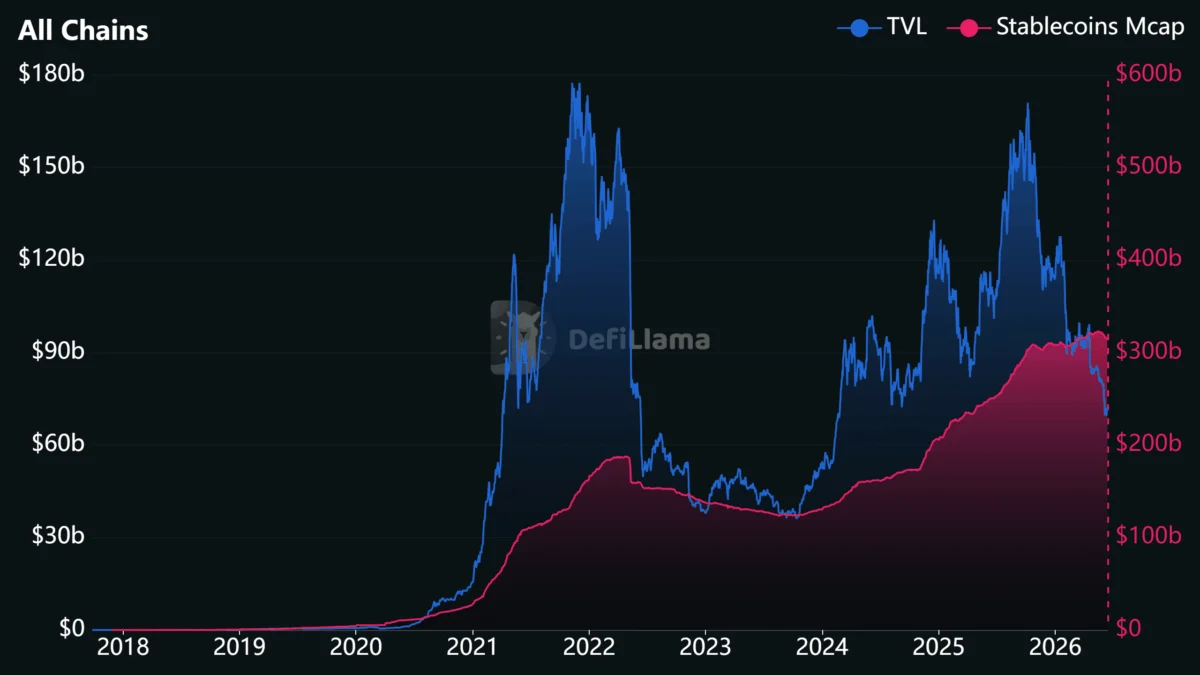
The decentralized finance (DeFi) sector, once the high-octane engine of the cryptocurrency market, is currently undergoing a significant cooling period. Total Value Locked (TVL)—the primary metric used to measure the health and capital depth of the ecosystem—has plummeted from its late-2025 peak of nearly $178 billion to approximately $72.5 billion. This dramatic contraction represents more than just a market correction; it signals a fundamental shift in how institutional and retail participants are evaluating risk in an increasingly volatile digital asset landscape.
As the industry grapples with this downturn, the trend is not isolated to a single niche. The weakness is systemic, spanning lending platforms, liquid staking protocols, and cross-chain bridges. This widespread decline suggests that the issue is not a failure of specific protocols, but rather a broader, ecosystem-wide migration away from aggressive capital deployment.
The Chronology of Contraction: From Peak to Present
To understand the current state of DeFi, one must look back to the exuberant highs of late 2025. During that period, low interest rates, high-yield farming incentives, and a surge in speculative activity pushed TVL to record-breaking levels. However, as the macroeconomic environment shifted and the initial frenzy surrounding various "innovative" protocols began to fade, the cracks started to appear.
Q1 2026: The Initial Retreat
The decline began in early 2026 as the "easy money" era of DeFi came to an abrupt halt. As the broader crypto market faced headwinds, investors began pulling liquidity from high-risk pools, preferring to keep their assets in more stable, albeit lower-yielding, positions.
Q2 2026: The Security Crisis
The second quarter of 2026 proved to be a watershed moment for the industry’s reputation. A wave of security exploits hit the ecosystem, with nearly 70 protocols suffering from hacks and smart contract vulnerabilities. In total, approximately $746 million was siphoned from the ecosystem. While these incidents were largely fragmented—avoiding the systemic collapse seen in the "mega-hacks" of previous years—the sheer frequency of these events shattered investor confidence. The constant fear of a protocol exploit began to outweigh the potential benefits of yield farming.
Mid-2026: The Current Stagnation
As of mid-June 2026, the ecosystem remains in a state of flux. While the exodus of capital has slowed, there is little evidence of a return to the growth trajectories of the previous year. Instead, the market has entered a "wait-and-see" phase, defined by caution and a preference for capital preservation over exponential growth.
Supporting Data: The Liquidity Paradox
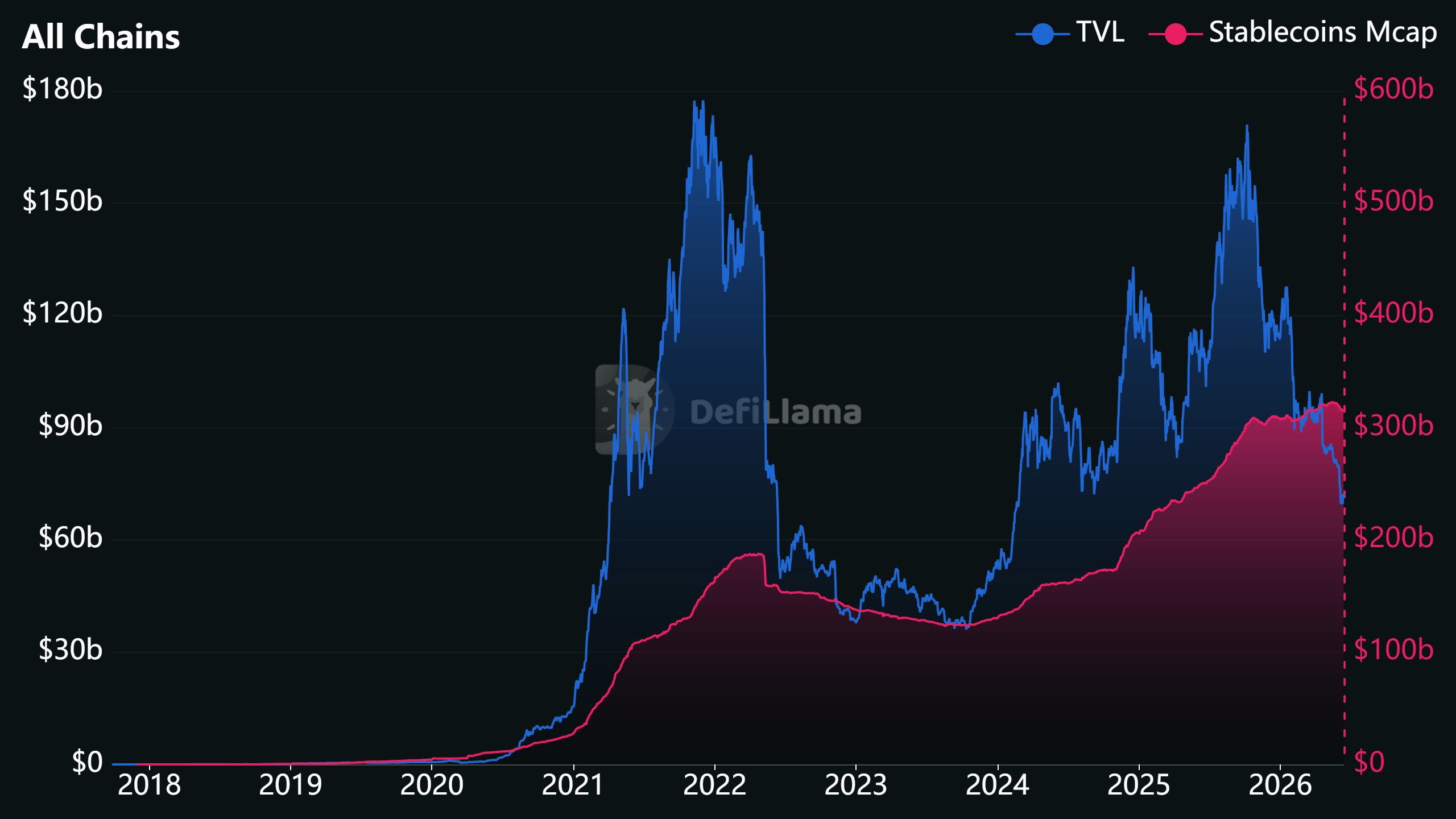
One of the most compelling aspects of this downturn is the resilience of stablecoin supply. Despite the $100+ billion evaporation of TVL, the aggregate supply of stablecoins—the lifeblood of DeFi—remains robust at approximately $315 billion.
A Mismatch in Expectations
This discrepancy between stablecoin supply and TVL suggests that the capital is not necessarily leaving the crypto ecosystem; rather, it is sitting on the sidelines. Investors are holding onto liquidity, waiting for clearer signals or improved risk-adjusted returns before re-entering the DeFi fray.
The current yield landscape further illuminates this trend. Stablecoin lending rates on major platforms have compressed to a range of 3.5% to 9%. For many investors, this yield is no longer sufficient to justify the risks inherent in DeFi, such as:
- Smart Contract Risk: The persistent threat of code vulnerabilities.
- Liquidity Risk: The danger of being unable to exit positions during market volatility.
- Liquidation Risk: The potential for cascading failures during price drops.
When the reward for taking these risks is marginal, rational investors choose to keep their capital in cold storage or on centralized exchanges, effectively removing it from the DeFi ecosystem.
Network Conviction: The Ethereum and Solana Divergence
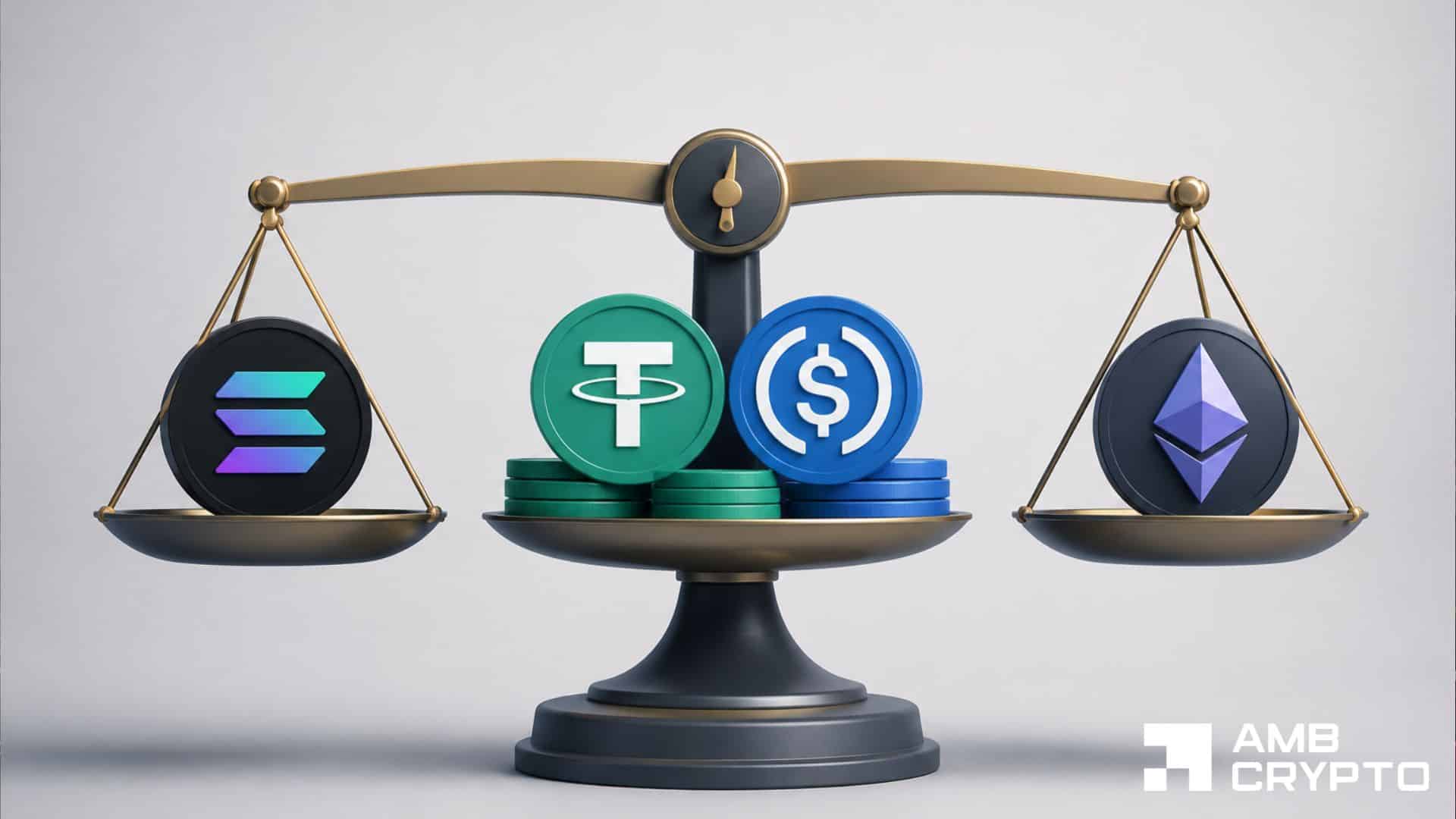
While the DeFi protocol layer is struggling, there is a fascinating divergence occurring at the network layer. Both Ethereum (ETH) and Solana (SOL) continue to see strong engagement, proving that while investors are fleeing protocols, they are not abandoning the networks themselves.
Ethereum’s Staking Resilience
Ethereum continues to boast a remarkably high staking participation rate, with roughly one-third of its total supply locked in proof-of-stake contracts. This indicates that long-term holders are prioritizing the fundamental security and yield of the base layer over the complex, and often precarious, yield-generating schemes found in dApps.
The Solana Phenomenon
Similarly, Solana’s staking participation holds steady near 68%. This suggests that despite the broader cooling of DeFi, the community surrounding Solana remains deeply committed to the ecosystem’s growth. Investors are signaling that they trust the underlying architecture of these chains, preferring to stake native tokens rather than lend them out into protocols that may be vulnerable to hacks.
Official Perspectives and Market Implications
Industry analysts and protocol developers have been quick to address the shift in sentiment. Most observers agree that this period represents a "maturation phase" for the industry.
"The industry is currently transitioning from a growth-at-all-costs mindset to one focused on sustainability," noted a lead researcher at a prominent crypto-analytics firm. "The decline in TVL is not a sign of the death of DeFi, but rather a necessary cleaning of the house. Capital is moving away from unsustainable incentives and toward protocols that offer genuine utility and robust security audits."
Implications for the Future
- Increased Scrutiny: Developers will face higher hurdles for launch. Future protocols will likely require multiple independent audits and a proven track record of security before attracting significant institutional liquidity.
- Product Evolution: The industry is expected to shift toward real-world asset (RWA) tokenization and more sophisticated risk-mitigation tools to entice investors back.
- The End of "Yield Farming" Dominance: The era of astronomical, unsustainable APYs appears to be coming to an end. Investors are becoming more sophisticated, prioritizing protocols with clear revenue models and sustainable tokenomics.
Final Summary: Is DeFi Collapsing or Evolving?
The current state of DeFi is often mischaracterized as a collapse. However, the data suggests a different narrative: one of consolidation and risk recalibration.
The drop from $178 billion to $72.5 billion in TVL is a sobering reminder of the volatility inherent in decentralized finance. Yet, the continued existence of $315 billion in stablecoin liquidity confirms that the ecosystem remains well-funded. The capital is present; the appetite for risk is not.
As investors continue to pivot toward capital preservation, the DeFi ecosystem is being forced to evolve. The future of decentralized finance will likely be built on a foundation of improved security standards, more sustainable yield models, and a renewed focus on network-level staking. For now, the "DeFi Winter" continues, but it is a winter that is likely purging the inefficiencies of the past and laying the groundwork for a more resilient, albeit more conservative, financial architecture.
While the days of reckless liquidity mining may be over, the core promise of DeFi—the ability to interact with financial services without intermediaries—remains a powerful motivator for the industry’s long-term participants. The question remains: how long will the sidelines hold their capital before the next cycle of innovation proves too tempting to ignore?
