

In a bold market forecast that has sent shockwaves through the cryptocurrency sector, global banking giant Standard Chartered has initiated formal coverage of the decentralized finance (DeFi) leader, Uniswap. In a client note issued on June 15, 2026, Geoff Kendrick, the bank’s Global Head of Digital Assets Research, unveiled a bullish thesis for the platform’s native token, UNI, projecting a staggering 40x appreciation by the end of 2030, potentially pushing the asset to a $100 valuation.
This ambitious target rests on a foundation of shifting macroeconomic trends and the rapid institutional adoption of blockchain technology. As traditional finance (TradFi) increasingly converges with decentralized infrastructure, Standard Chartered posits that Uniswap is uniquely positioned to capture the lion’s share of the burgeoning tokenized assets market.
The Core Thesis: Tokenization as a Catalyst
At the heart of Standard Chartered’s prediction is the concept of asset tokenization—the process of converting rights to real-world assets into digital tokens on a blockchain. Kendrick estimates that the value of tokenized assets active within the DeFi ecosystem is set for a monumental 37x expansion over the next four years.
"Uniswap is uniquely positioned to scale to meet this opportunity," the report stated, highlighting the protocol’s infrastructure as a cornerstone of the next financial wave. Standard Chartered projects that by 2030, a massive $2.7 trillion will be locked within various DeFi protocols. By acting as an all-purpose infrastructure layer, Uniswap is expected to function as the liquidity backbone for these trillions in assets, drawing on its established brand, deep liquidity pools, and robust security architecture.
Chronology of the Market Response
The release of the report triggered an immediate and palpable reaction in the digital asset markets.
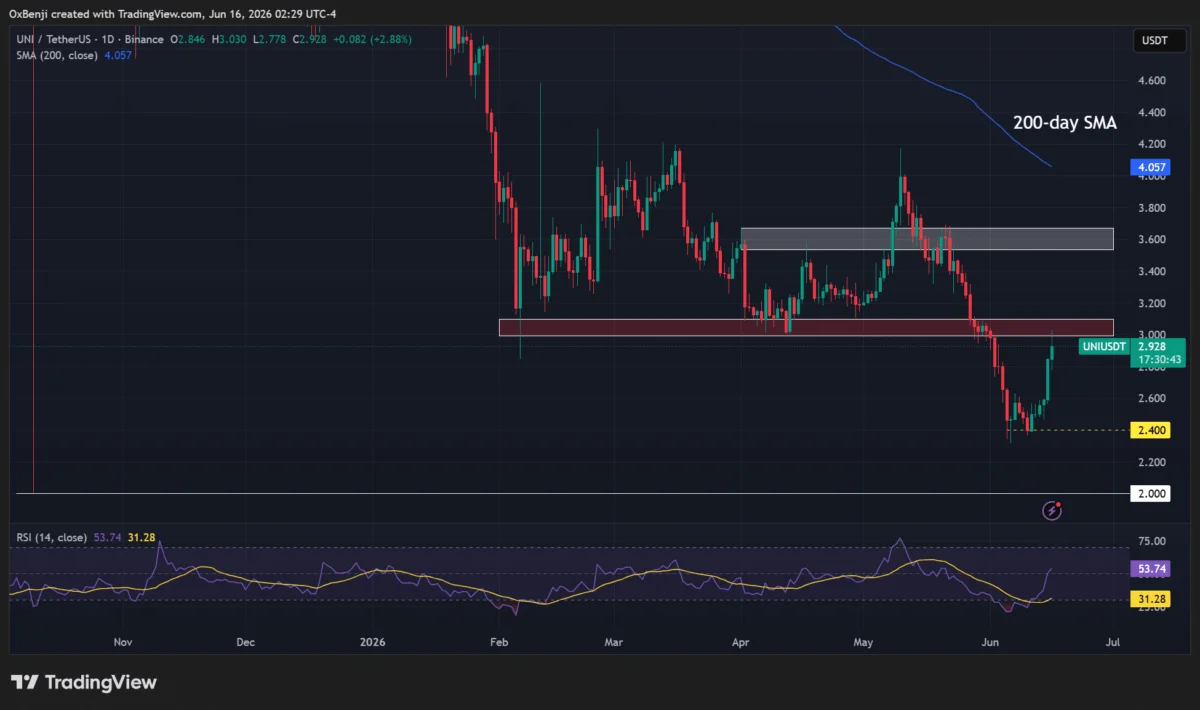
- Pre-Report Stagnation: Entering the second week of June 2026, UNI had been struggling, mirroring the broader market’s tepid performance and recording consistent losses throughout the month.
- The June 15 Announcement: Following the publication of Standard Chartered’s coverage, sentiment shifted instantaneously. Traders and institutional investors scrambled to adjust their positions, driving an 18% surge in the token’s price.
- Breaking the Resistance: The rally saw UNI climb to the $3.00 psychological threshold, effectively erasing all losses sustained earlier in the month and signaling a potential trend reversal.
- Post-Update Consolidation: As of the latest market data, the $3 level has become the primary battleground. Market participants are now watching closely to see if bulls can establish this price point as a solid support level, which would pave the way for further growth toward $3.60 and $4.00.
Supporting Data: Fees, Burns, and Market Multiples
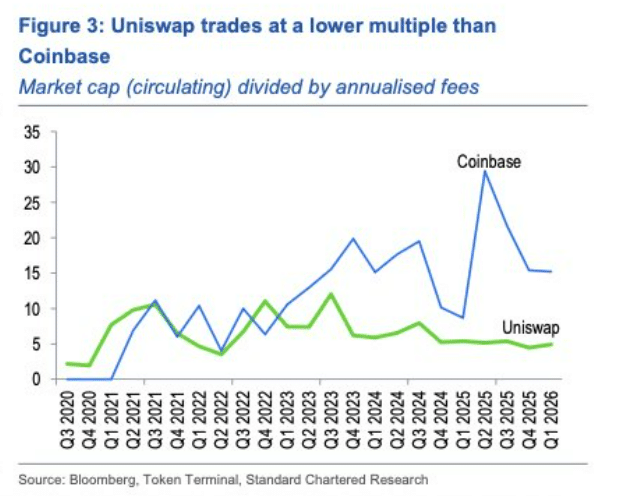
The bullish outlook is supported by a sophisticated analysis of Uniswap’s internal economics. Standard Chartered’s report draws a direct comparison between Uniswap and publicly traded entities like Coinbase. By evaluating the "market cap to annualized fees" ratio, the bank argues that Uniswap is currently undervalued compared to its centralized counterparts, suggesting that as the protocol matures and integrates further with institutional players, this valuation gap will narrow.
The Impact of the Fee Switch
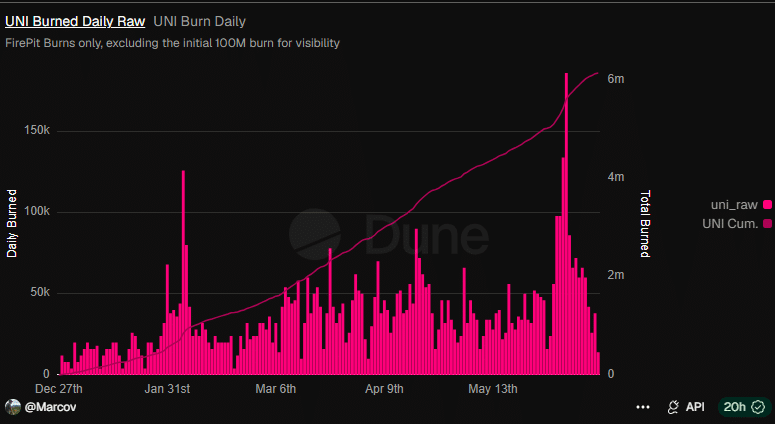
A critical component of the UNI value proposition is the implementation of the protocol’s "fee switch," which went live last year. This mechanism, which directs a portion of the $858 million in annual fees generated by the platform toward UNI buybacks and burns, has fundamentally altered the token’s scarcity model.
Data from the blockchain indicates that since the inception of the burn mechanism, the protocol has effectively removed over 100 million UNI from circulation. In 2026 alone, the protocol has maintained an average burn rate of roughly 1 million UNI per month, excluding the initial, larger-scale burn. This deflationary pressure is expected to be a primary driver of long-term value, as the supply of UNI becomes increasingly constrained while utility demand climbs.
Official Responses and Industry Divergence
The reaction to the report has been far from monolithic. Uniswap’s leadership has been quick to acknowledge the significance of the analysis. Hayden Adams, the founder and CEO of Uniswap, publicly described the Standard Chartered document as a "great piece," signaling institutional alignment with the bank’s vision for the protocol’s future.
However, the wider financial and crypto-analytical community has expressed skepticism. Omar Kanji, an investor at the venture capital firm Dragonfly, took to social media to push back against the methodology used in the report. Kanji described the analysis as "chart crime," specifically criticizing the bank’s decision to include Liquidity Provider (LP) fees in the annualized revenue calculations. According to critics, comparing these figures to the revenue metrics of a centralized exchange like Coinbase is "slop analysis" that misrepresents the true economic reality of the protocol.
This discord highlights a broader tension in the industry: the clash between traditional valuation methods—which favor established revenue streams and P/E ratios—and the nuanced, often complex economic structures of decentralized governance and liquidity provision.
Institutional Integration: The TradFi Bridge
The feasibility of the $100 price target rests heavily on Uniswap’s ability to maintain its relevance in the face of TradFi encroachment. The narrative of "TradFi vs. DeFi" is being rapidly replaced by one of collaboration.
In early 2026, the industry witnessed a landmark shift when financial titans BlackRock and Fidelity integrated with the Uniswap protocol. These firms began leveraging Uniswap’s infrastructure to scale their respective tokenized money market funds. This integration serves as the strongest empirical evidence for Standard Chartered’s thesis. If such partnerships continue to multiply, the protocol will likely transition from a retail-centric platform into a critical piece of the global financial plumbing.
Kendrick noted that if these partnerships continue to accelerate, UNI is highly likely to outperform Bitcoin and Ethereum, as the protocol directly captures the value generated by institutional capital flows rather than acting merely as a store of value or a base-layer asset.
Implications for Investors and the Market
For investors, the Standard Chartered report serves as both a roadmap and a cautionary tale. While the 40x growth projection provides a compelling long-term narrative, the immediate market reality remains volatile.
- Short-Term Technicals: The $3.00 level is currently the definitive roadblock. A failure to hold this level could embolden short-sellers, potentially dragging the token back to the $2.60 or $2.40 range.
- Strategic Shift: The transition of the Uniswap protocol toward a more institutional-facing entity changes the risk profile of the investment. Investors are no longer just betting on decentralized trading volume; they are betting on the protocol’s success in navigating regulatory hurdles and institutional integration.
- The "Fee" Debate: The ongoing controversy regarding how to value DeFi protocols suggests that investors should exercise caution when relying solely on traditional banking valuation metrics. The "fee switch" mechanism is a powerful tool, but its long-term impact on governance and token price remains a subject of intense academic and professional debate.
Final Summary
Standard Chartered’s prediction marks a definitive moment for Uniswap, positioning it not merely as a decentralized exchange, but as the foundational layer of the future tokenized economy. While the $100 target by 2030 is highly speculative and subject to significant criticism from within the crypto-native community, the underlying logic—driven by institutional adoption and the deflationary mechanics of the protocol—presents a case that cannot be ignored.
As the lines between traditional and decentralized finance continue to blur, Uniswap’s ability to remain the dominant hub for tokenized assets will be the ultimate determinant of whether this 40x projection becomes a reality or remains a bold, yet unreachable, ambition. For now, the market remains focused on the immediate, watching the $3.00 support level to see if the institution-backed bull case holds, or if the skepticism of seasoned crypto analysts proves more prophetic.
