

In a sobering development for the Ethereum Layer 2 ecosystem, Taiko—a ZK-Rollup scaling solution—has fallen victim to a sophisticated exploit that resulted in the theft of approximately $1.7 million in digital assets. The breach, which targeted the protocol’s core infrastructure rather than user-facing applications, has sent shockwaves through the decentralized finance (DeFi) community, raising urgent questions about the robustness of chain-state verification mechanisms in emerging scaling solutions.
The attack, which bypassed critical validation checks, highlights the inherent risks associated with early-stage blockchain infrastructure. While Taiko’s development team has moved swiftly to contain the damage, the incident serves as a stark reminder that even protocols built on advanced cryptographic foundations are not immune to architectural vulnerabilities.
Chronology of the Breach: A Systematic Extraction
The exploit did not occur in a vacuum; it was a calculated maneuver against the structural integrity of the Taiko Bridge Proxy and the ERC20 Vault.
Phase 1: The Breach
The sequence of events began when the attacker successfully exploited a failure in the chain-state verification mechanism. By circumventing the protocol’s validation logic, the malicious actor gained unauthorized access to the vaults holding liquidity. Once the "gates" were effectively left open by the verification failure, the attacker initiated a series of unauthorized withdrawals, systematically draining approximately $1.7 million from the bridge contracts.
Phase 2: Consolidation and Monetization
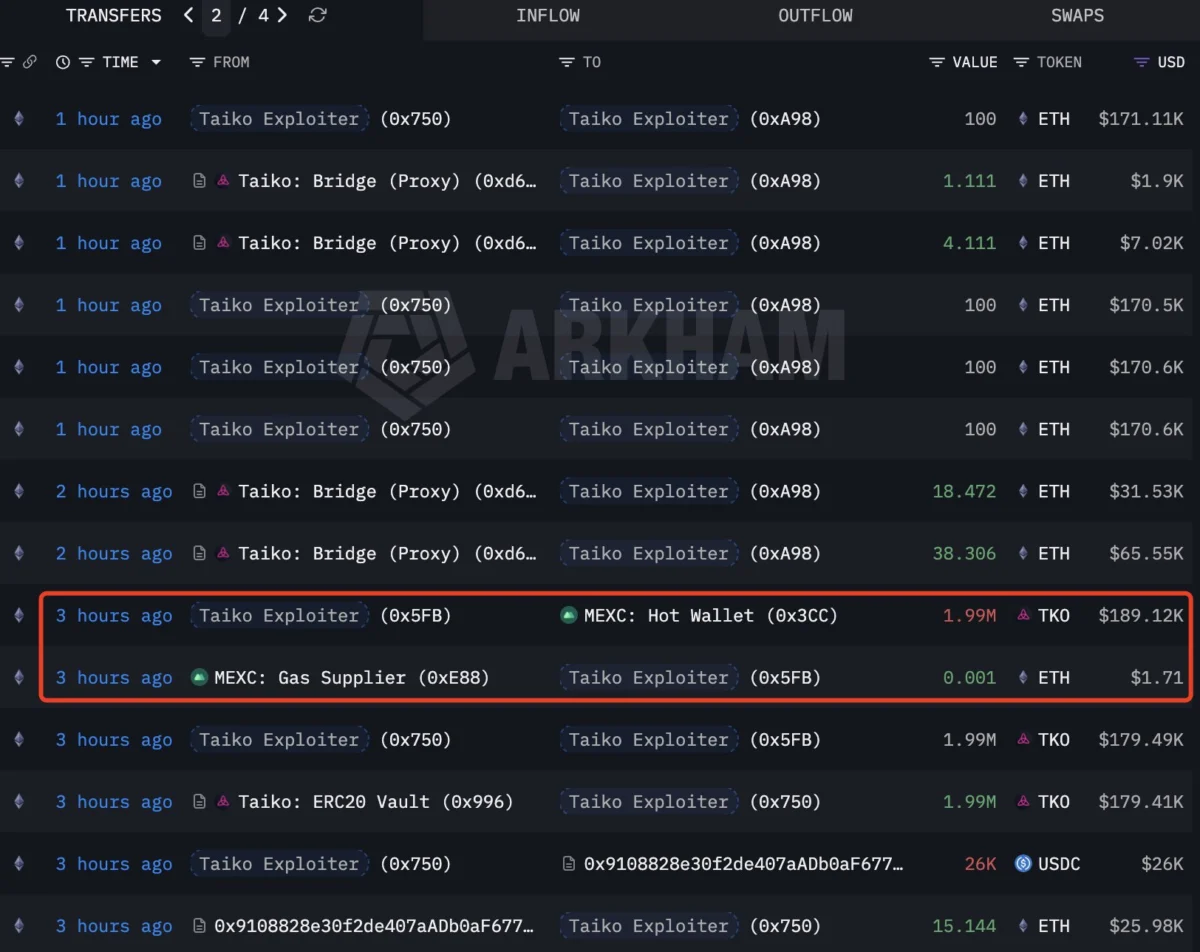
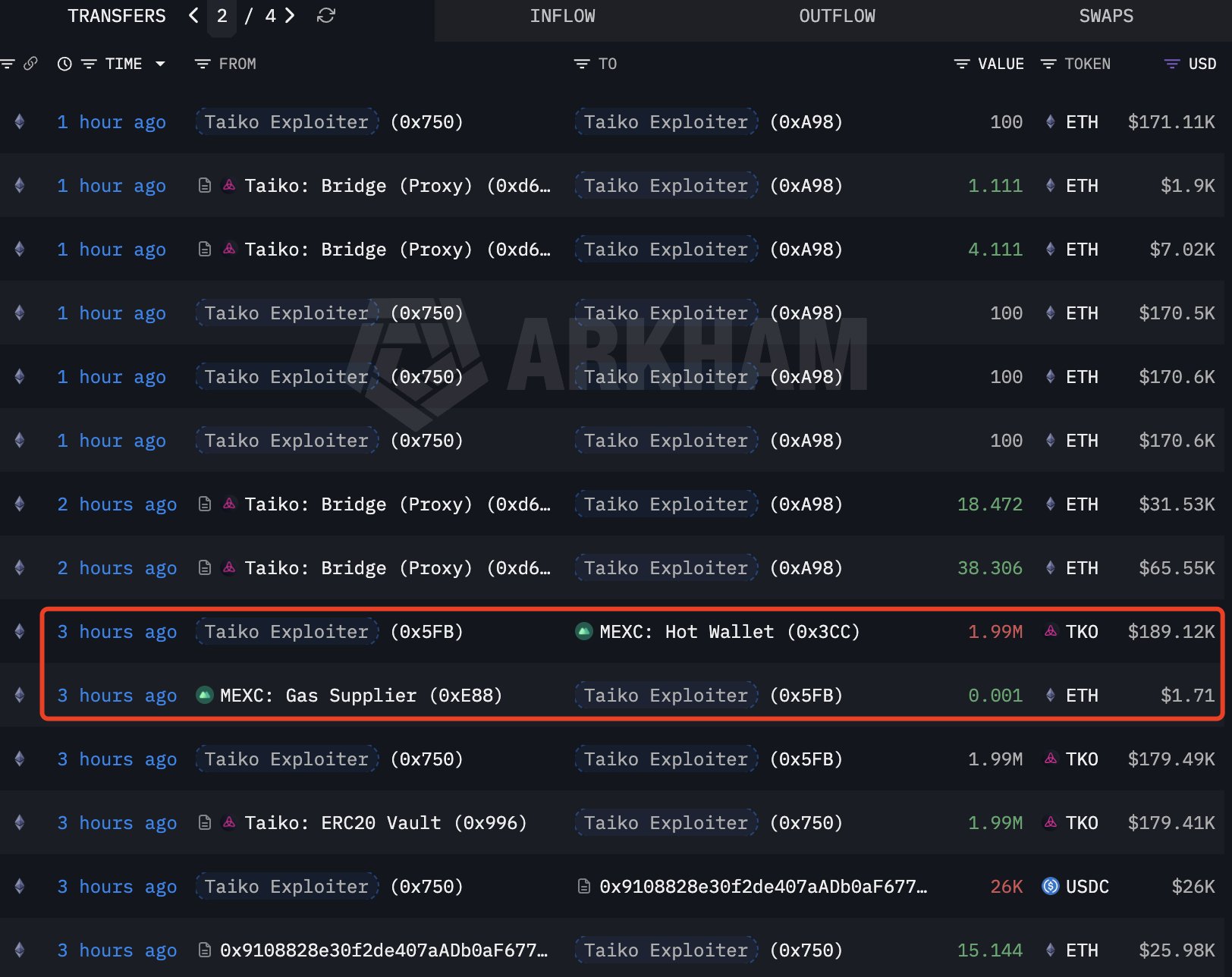
Immediately following the extraction, the attacker initiated a "consolidation phase." The stolen assets were moved rapidly through a series of intermediary wallets, a common obfuscation tactic used by bad actors to complicate on-chain forensic analysis.
The transition to the "monetization phase" was almost instantaneous. Recognizing the need for immediate liquidity, the exploiter moved 1.99 million TKO tokens—valued at approximately $189,000—directly to a hot wallet on the MEXC exchange. This move signaled a clear intent to offload stolen assets for stablecoins or fiat-equivalent liquidity.

Phase 3: Current Status of Funds
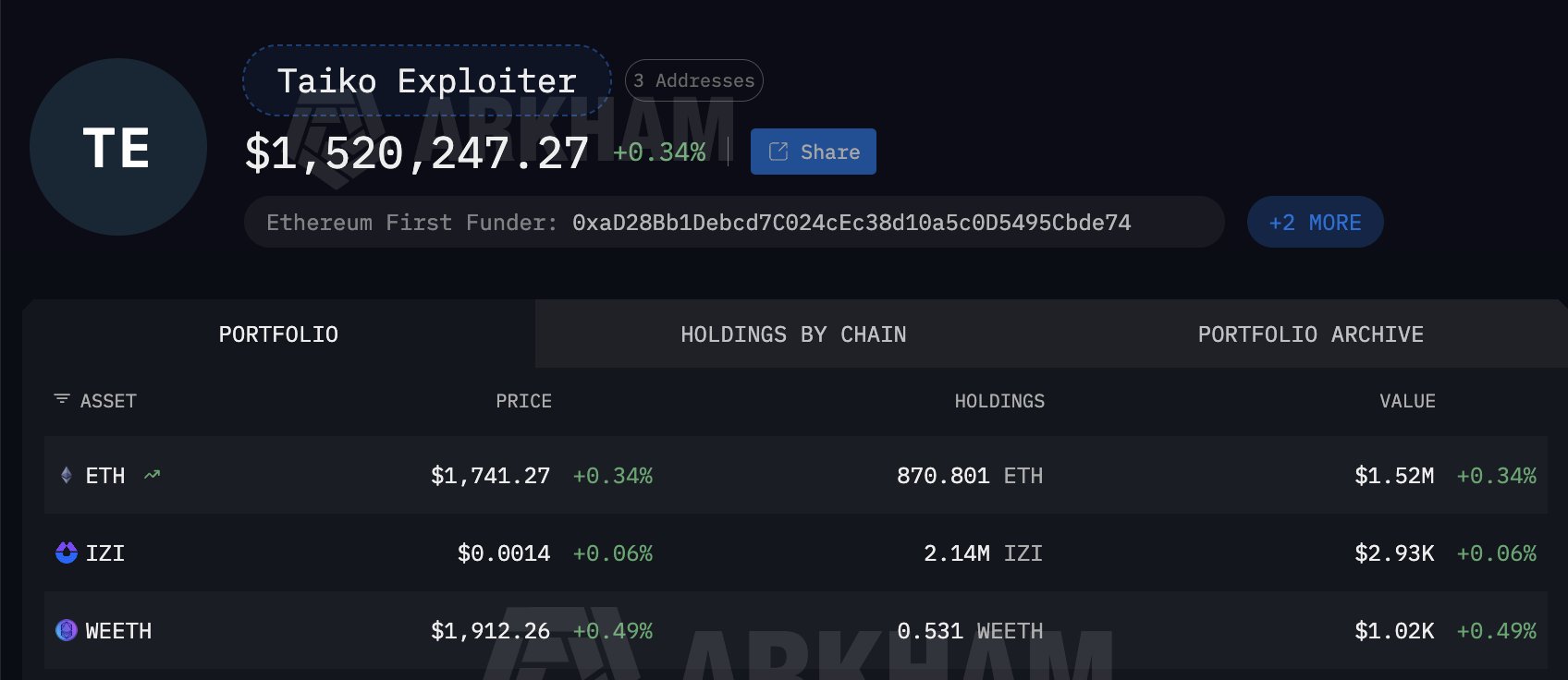
According to real-time analytics provided by Arkham Intelligence, the attacker currently maintains custody of 870.8 ETH, representing a valuation of roughly $1.52 million. This significant concentration of stolen funds is currently being monitored closely by both security researchers and on-chain investigators. The fact that the bulk of the haul remains in a centralized address suggests that the perpetrator may be waiting for the heat to die down before attempting further movement or "mixing" the funds through privacy-preserving protocols.
Supporting Data and Market Impact
The financial ramifications of the attack were immediate, impacting both the protocol’s native token and its broader market sentiment.
Token Price Volatility
The market reaction to the exploit was swift. At the time of the breach, the TKO token saw its value tumble by approximately 10%. Trading at $0.1279 prior to the incident, the price retracted to $0.07499 as panic selling ensued. While some recovery attempts have been noted, the price action remains bearish, reflecting a temporary loss of investor confidence in the wake of the security incident.
Ecosystem Health Metrics
Despite the exploit, the underlying ecosystem metrics present a complex picture. Interestingly, DeFi Total Value Locked (TVL) on Taiko actually saw a modest uptick, rising to approximately $3.84 million—a 3.64% increase. Conversely, the Bridged TVL remained relatively stable at $12.85 million.
Transaction volume, however, tells a different story. Weekly transaction counts dipped to 324,630, marking a 3.37% decrease over the previous week. This decline suggests a "wait and see" approach from the user base, as participants pause activity to assess whether the network’s security patches are sufficient to prevent a recurrence.
Official Response: Taiko’s Containment Strategy
Taiko’s response team demonstrated a high degree of technical agility, prioritizing the preservation of network integrity over short-term operational continuity.
Immediate Mitigation Measures
Upon identifying the breach, the Taiko team confirmed that the integrity of the chain-state verification process had been compromised. To prevent further hemorrhaging of funds, the team made the difficult decision to pause block production. By halting all block proposers, the network effectively entered a state of "suspended animation," preventing the attacker from utilizing the bridge infrastructure to execute further unauthorized withdrawals.
Outreach and Cooperation
Beyond technical patches, Taiko proactively engaged with the centralized exchange (CEX) ecosystem. By identifying the attacker’s public wallet addresses, the team issued urgent communications to major exchanges, requesting that they freeze any incoming TKO deposits associated with the exploiter’s addresses. This cross-industry collaboration is a standard, yet critical, component of modern DeFi incident response, designed to limit the attacker’s ability to convert stolen tokens into spendable assets.
Broader Implications: Questioning Security Assumptions
The Taiko exploit is significant not only for the amount stolen but for the nature of the target.
Infrastructure vs. User Error
Most security incidents in the Web3 space involve social engineering, phishing, or vulnerabilities within user-facing smart contracts (such as liquidity pools or yield farms). However, this exploit targeted a key component of the underlying blockchain infrastructure—the chain-state verification.
When the infrastructure layer itself is compromised, the "security assumptions" of the entire network are called into question. If the mechanisms that verify the state of the blockchain can be bypassed, it strikes at the core promise of trustlessness. This has prompted a wider discussion among developers regarding the necessity for more rigorous, multi-layered audits of bridging protocols and state verification logic.
The "Layer 2" Dilemma
As Ethereum scales, the industry is increasingly relying on a modular architecture where L2s act as the primary execution environment. The Taiko incident underscores that the complexity of ZK-Rollups and bridge proxies introduces a massive "attack surface." Developers must now balance the drive for high-speed, low-cost transactions with the requirement for robust, perhaps redundant, security layers.
Conclusion and Future Outlook
The Taiko exploit serves as a sobering "stress test" for the project. While the loss of $1.7 million is significant, the fact that the team was able to halt block production and coordinate with exchanges indicates a maturing incident response capability.
For the broader crypto community, this event will likely lead to a renewed focus on "defense-in-depth" strategies. Projects will be under increased pressure to implement automated circuit breakers, more granular access controls, and decentralized monitoring systems that can detect anomalies in chain-state verification before they result in catastrophic losses.
As the dust settles, the focus shifts to how Taiko will restore its reputation. Transparency will be paramount—the release of a detailed post-mortem report, explaining exactly how the verification mechanism failed and what steps are being taken to prevent a recurrence, will be essential for regaining the trust of liquidity providers and developers. In an industry where security is the bedrock of adoption, Taiko’s next steps will be closely watched by the entire Layer 2 ecosystem.
