

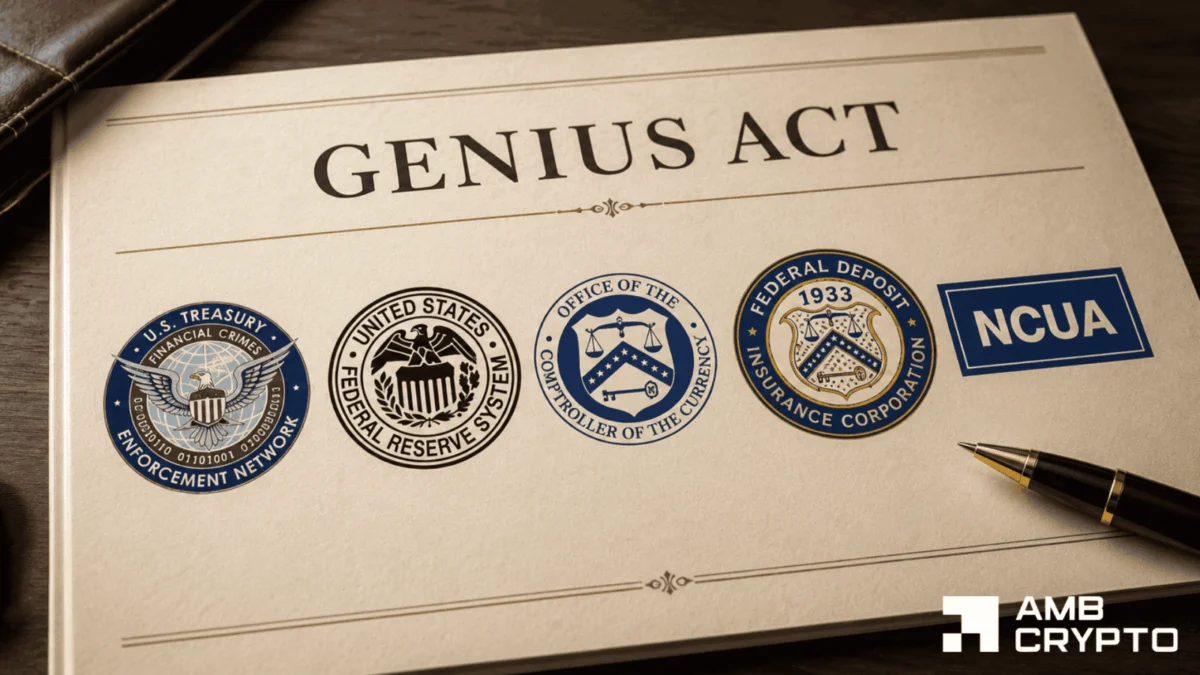
In a significant move to bridge the gap between traditional banking oversight and the burgeoning digital asset economy, a coalition of U.S. financial regulators has unveiled a sweeping proposal that would subject stablecoin issuers to rigorous "Know Your Customer" (KYC) requirements. Under the framework provided by the GENIUS Act, these issuers would be compelled to implement Customer Identification Programs (CIPs) mirroring those currently mandatory for traditional commercial banks.
The joint proposal, released by the Financial Crimes Enforcement Network (FinCEN), the Federal Reserve, the Office of the Comptroller of the Currency (OCC), the Federal Deposit Insurance Corporation (FDIC), and the National Credit Union Administration (NCUA), represents the latest effort to institutionalize the stablecoin sector. By classifying "Permitted Payment Stablecoin Issuers" (PPSIs) as financial institutions under the Bank Secrecy Act (BSA), regulators are seeking to solidify anti-money laundering (AML) and counter-terrorist financing (CTF) protocols within the crypto ecosystem.
Crucially, however, the proposal includes a strategic carve-out: it stops short of extending these burdensome identification requirements to peer-to-peer (P2P) wallet transfers and secondary-market trading, signaling a nuanced regulatory approach that balances safety with technological innovation.
The Regulatory Framework: Harmonizing Crypto and Banking Standards
The proposed rule is a foundational component of the broader GENIUS Act, which aims to provide a comprehensive regulatory roadmap for the digital currency market. For years, the stablecoin sector—which serves as the primary "on-ramp" for crypto markets—has operated in a legislative gray area. This new proposal aims to strip away that ambiguity.
Defining the "Permitted Payment Stablecoin Issuer"
Under the new guidelines, a PPSI is defined as an entity authorized to issue payment-grade stablecoins under federal or state-qualified frameworks. By integrating these entities into the BSA framework, regulators are effectively treating stablecoins not merely as digital assets, but as functional equivalents to traditional demand deposits or money market instruments.
The mandate requires that issuers maintain a formal CIP, a process that goes beyond simple account creation. It involves the systematic collection and verification of:
- Legal Identity: Full names, addresses, and dates of birth for individuals; formation details for entities.
- Verification Data: Tax identification numbers, government-issued IDs, and other documentation required to confirm the authenticity of the client.
- Risk Profiling: The requirement to maintain a "reasonable belief" that the issuer knows the true identity of the person or entity establishing an account.
Chronology of the Shift: From Wild West to Regulatory Oversight
To understand the weight of this proposal, one must look at the timeline of the stablecoin’s evolution within the U.S. financial system.
- The Rise of Stablecoins (2017–2020): Stablecoins grew rapidly as a tool for traders to hedge against the volatility of Bitcoin and Ethereum. During this period, the industry largely self-regulated, with minimal oversight from federal banking agencies.
- The "GENIUS Act" Genesis (2023): As stablecoins became systemic, Congress began drafting the GENIUS Act to address concerns regarding reserve transparency, redemption rights, and consumer protection.
- Regulatory Joint Action (Early 2024): Recognizing the complexity of the market, the Fed, OCC, FDIC, NCUA, and FinCEN formed a working group to determine how to integrate these digital assets into existing banking laws without stifling the underlying blockchain technology.
- The Current Proposal (Present Day): The release of the CIP requirement marks the first major policy output from this interagency collaboration, setting a 60-day window for public comment before moving toward a final rule.
Secondary Markets: The "Boundary of Reason"
One of the most contentious aspects of crypto regulation has historically been the treatment of anonymous wallet-to-wallet transactions. Many industry advocates feared that regulators would demand KYC for every individual who touches a stablecoin on a decentralized exchange (DEX) or through a self-custody wallet.
The current proposal explicitly rejects this "blanket" approach. By distinguishing between direct relationships (issuer to user) and secondary-market activity (user to user), the agencies have acknowledged the practical limitations of blockchain technology.
Why Secondary Markets Were Spared
Regulators cited several key reasons for excluding secondary-market transfers from the CIP mandate:
- Implementation Hurdles: The pseudonymous nature of public blockchains makes it technically infeasible for an issuer to identify the owner of a wallet address if that individual acquired the token via a secondary exchange or P2P transfer.
- Operational Integrity: Imposing KYC on every blockchain transfer would essentially break the functionality of stablecoins, turning them into highly restricted, gated products rather than liquid instruments for global trade.
- Market Preservation: The regulators noted that their goal is to apply "traditional financial safeguards to stablecoin issuance while preserving stablecoins’ ability to circulate across public blockchain networks."
Implications for the Financial Ecosystem
Impact on Issuers
For companies like Circle or Paxos, this proposal entails a significant operational shift. While many have already implemented robust KYC for direct customers, the formalization of these rules under the BSA means that any lapse in compliance could now lead to federal sanctions, loss of banking charters, or civil penalties. Issuers will need to invest heavily in automated identity verification infrastructure to remain competitive while maintaining strict compliance.
Impact on Crypto Exchanges
Interestingly, the proposal places the onus of identity verification primarily on the issuer rather than the exchange. However, centralized exchanges (CEXs) that act as intermediaries between users and issuers will likely be expected to share data to ensure the chain of custody remains compliant.
Impact on Investors
For the retail user, the landscape remains largely unchanged for those who trade on regulated platforms. For those who prioritize self-custody and P2P transfers, the proposal offers a reprieve, as it avoids the most draconian forms of surveillance that many activists feared would effectively "de-anonymize" the blockchain.
Supporting Data and Official Perspectives
The agencies involved have emphasized that this is a risk-based approach. The data suggests that while the volume of stablecoin transactions has grown exponentially, the most significant risk of illicit activity—such as money laundering or terror financing—occurs at the point of fiat-to-stablecoin entry and exit.
Official Stance:
In joint statements, representatives from the OCC and the Federal Reserve emphasized that the proposal is not an attack on decentralized finance (DeFi). Instead, they framed it as a necessary measure to ensure that stablecoins function as a "safe and reliable" component of the U.S. payment system.
"We are building a bridge," noted one agency official during the press briefing. "We are ensuring that the digital dollar—or its private-sector equivalent—is as reliable as the cash in your wallet, without trying to dismantle the decentralized pipes that make these assets so efficient."
Future Outlook: The Path to Finalization
As the proposal moves into the public comment period, the industry is expected to push back on specific technical definitions. Questions remain regarding how "direct relationship" will be defined in the context of "stablecoin-as-a-service" providers or white-label issuers who use third-party infrastructure.
Moreover, the regulatory burden of these CIPs could create a barrier to entry for smaller, innovative firms, potentially consolidating the stablecoin market around a handful of large, well-capitalized entities that can afford the legal and technical overhead of bank-style compliance.
Conclusion
The GENIUS Act’s latest proposal represents a pivotal moment in the maturity of the digital asset market. By opting for a targeted regulatory approach—focusing on the "source" of the stablecoin rather than every node in the network—the U.S. government has signaled a willingness to integrate crypto into the mainstream financial system.
Whether this balance of oversight and liberty will suffice to prevent illicit actors from abusing stablecoins remains to be seen. However, for the first time, stablecoin issuers have a clear, albeit rigorous, set of instructions on how to exist within the U.S. regulatory perimeter. The transition from the "Wild West" to a regulated financial utility is well underway, and the market is now forced to reconcile the speed of blockchain with the steady, cautious pace of federal oversight.
