

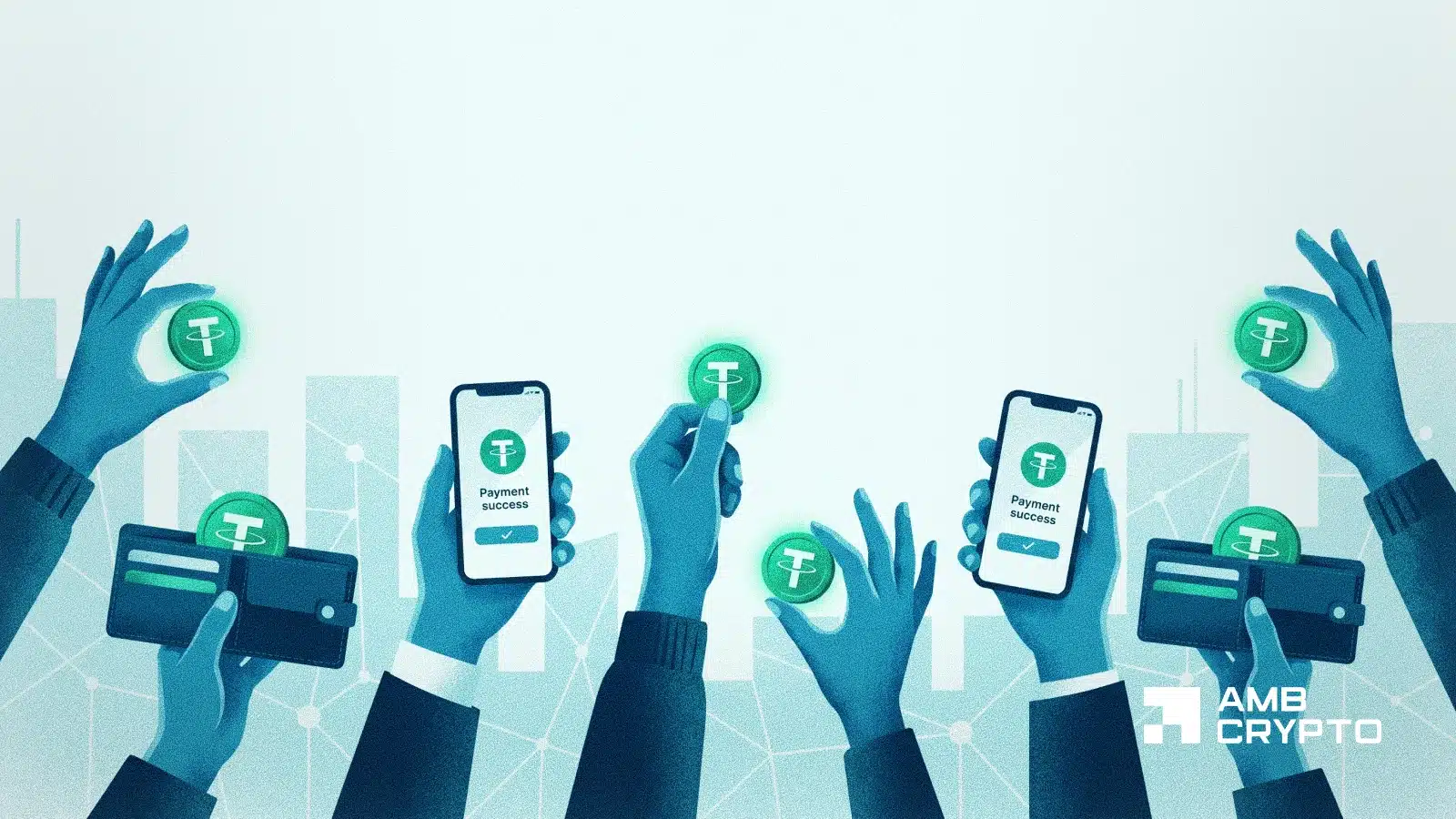
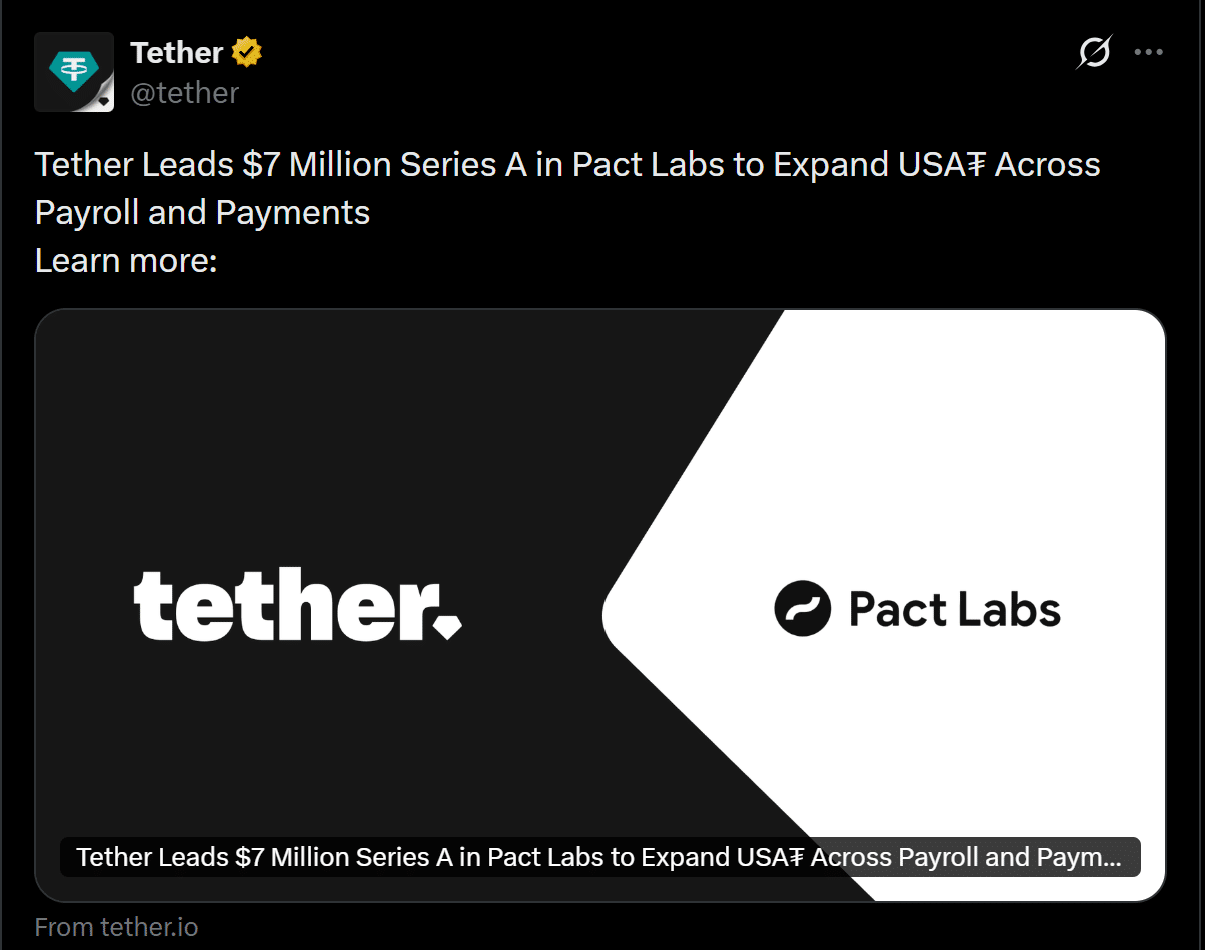
In a definitive move that signals a structural evolution for the stablecoin industry, Tether—the issuer of the world’s largest stablecoin, USDT—is aggressively shifting its focus from crypto-native trading markets toward the bedrock of traditional financial infrastructure. By leading a $7 million Series A funding round for Pact Labs, Tether is signaling its intent to capture a significant share of the massive U.S. payroll, earned wage access (EWA), and real-time payment sectors.
This strategic pivot marks a departure from the speculative trading volume that has historically defined the stablecoin ecosystem. Instead, Tether is betting on the necessity of high-frequency, recurring payment flows, aiming to integrate its technology directly into the plumbing of the global economy.
Main Facts: The Infrastructure Play
The core of Tether’s recent initiative is the development of "USA," a project designed to modernize the archaic U.S. payroll system. Currently, the U.S. processes more than $11 trillion in payroll annually, yet the system remains hampered by legacy settlement processes that often result in multi-day delays for employees attempting to access earned wages.
By leveraging blockchain-based settlement, Tether aims to provide a near-instantaneous alternative to the Automated Clearing House (ACH) network. The investment in Pact Labs is not merely a venture capital move; it is a tactical acquisition of expertise and infrastructure meant to facilitate the integration of stablecoins into the daily financial lives of millions of workers.
The fundamental shift here is one of utility. While stablecoins have functioned as the "liquidity layer" for decentralized finance (DeFi) and centralized exchanges for years, Tether is now positioning them as the "settlement layer" for the real economy.
A Chronology of Integration
The path to this moment has been paved by years of gradual, yet persistent, institutional interest in blockchain settlement.
- 2020–2022: The Speculative Era. Stablecoins primarily served as a mechanism for traders to exit volatile crypto positions without moving funds back into traditional banking rails, which were often slow and expensive.
- 2023: The Search for Yield and Utility. As crypto markets faced volatility, issuers began seeking ways to anchor stablecoins to real-world assets (RWAs). This period saw the first serious discussions regarding payroll and cross-border remittances.
- Early 2024: The Rise of "Stable" Layer 1. The development of Stable, a USDT-native Layer 1, introduced a purpose-built environment for institutional transactions. This infrastructure was designed to handle higher throughput with lower latency than general-purpose chains.
- Mid-2025: The Compliance Mandate. Tether realized that to enter the enterprise space, it needed to solve the "compliance hurdle." Partnerships with firms like Chainalysis began to materialize, ensuring that every transaction could be monitored for regulatory adherence.
- July 2026: The Strategic Funding. The lead investment in Pact Labs marks the current phase, where Tether moves from providing the token to providing the delivery mechanism for payroll and wage access.
Supporting Data: Why Payroll?
The demand for a more efficient payroll system is backed by staggering financial data. The $11 trillion annual payroll figure is only the tip of the iceberg when considering the global market for earned wage access.
- The Friction of Legacy Systems: Traditional banking settlement takes an average of 1–3 business days. For the average worker living paycheck to paycheck, this delay creates a constant need for predatory short-term lending or "payday loans."
- The "Wages Story": Tether CEO Paolo Ardoino has repeatedly highlighted that internal transaction data shows a massive, underserved demand for dollar-denominated settlement among the global workforce. This is no longer about crypto traders; it is about payroll managers and employees.
- Institutional Throughput: The Stable Layer 1 infrastructure is designed to handle thousands of transactions per second, a necessity for payroll processing, which is characterized by mass-payout events occurring on specific dates.
Official Responses and Perspectives
The vision for this transition is anchored in the belief that blockchain technology is the only viable path forward for a modernized, globalized economy. Addressing the shift, Tether CEO Paolo Ardoino stated:
"This confirms what our transaction data has shown for years: the demand for dollar-denominated settlement is a wages story. We are not just building a token; we are building a more efficient financial rail that gives people faster access to the money they have already earned."
Industry analysts view this as a "pragmatic pivot." By moving into payroll, Tether is attempting to embed itself into the most stable and recurring part of the financial system. If a company uses Tether’s rails to pay its employees, that stablecoin becomes a permanent feature of that company’s financial operation, creating a "stickiness" that is nearly impossible to achieve in the volatile trading markets.
Compliance: The Bedrock of Institutional Trust
One of the most significant challenges in moving from crypto-markets to institutional finance is the regulatory landscape. Institutions cannot risk exposure to illicit funds or money laundering risks associated with pseudonymous wallets.
The partnership with Chainalysis provides the critical bridge between blockchain’s transparency and institutional compliance. By integrating real-time transaction screening, entity monitoring, and fund flow analysis, Tether is addressing the concerns of enterprise-level CFOs.
The Role of Stable (Layer 1)
The support for Stable by Chainalysis is a milestone. It means that the Stable network is not just a fast, cheap blockchain—it is a compliant environment. As Chainalysis adds support for more ERC-20 and ERC-721 tokens on this network, the ecosystem gains the ability to manage complex assets, including payroll smart contracts and employee benefits, all while maintaining a continuous audit trail.
For the first time, institutions can point to a blockchain network and demonstrate to regulators that they have full visibility into the movement of funds, satisfying Anti-Money Laundering (AML) and Know Your Customer (KYC) requirements.
Implications: The Future of Mainstream Finance
The implications of this shift are profound, both for the crypto industry and the broader global financial system.
1. From "Crypto" to "Finance"
If Tether succeeds, the term "stablecoin" may eventually become a misnomer, replaced by the term "digital dollar" or "programmable currency." The goal is to make the technology invisible. An employee receiving their paycheck via a blockchain rail should experience the same ease as a bank transfer, but with the added benefits of speed and availability.
2. Competitive Re-positioning
The competitive advantage in the stablecoin market is no longer just about who has the highest market cap; it is about who has the most reliable infrastructure. Networks that attract recurring payment activity—payroll, B2B settlements, and supply chain finance—will become the new pillars of the financial system.
3. The Resilience Test
The true test for Tether and the Stable ecosystem will be resilience. Can they handle the sheer volume of a global payroll cycle? Can they manage the regulatory scrutiny that comes with being a central part of the U.S. economy?
The industry is watching closely. If the integration of USA into the payroll ecosystem succeeds, it will prove that blockchain technology has graduated from a speculative experiment to a foundational piece of the global financial architecture.
Conclusion
Tether’s strategic move into payroll and real-time payments represents a pivotal moment for digital assets. By focusing on the $11 trillion payroll market, the company is attempting to secure a role as the backbone of the next generation of financial services.
With the combined power of high-speed settlement via the Stable Layer 1 and the rigorous compliance oversight provided by Chainalysis, the transition from crypto-trading to everyday financial infrastructure is no longer theoretical. It is underway. The success of this initiative will be measured not in trading volume, but in the number of enterprise wallets, the stability of transaction flows, and the widespread adoption of blockchain-based settlement by businesses worldwide. As we look toward the future, it is clear that the next great financial revolution will not be found in a trading app, but in the digital systems that power our daily wages.
